Low-Carbon Energy Tracking
LAU tracks energy consumption and solar photovoltaic production at its Beirut and Byblos campuses through operational records supplied by Facilities Management. The Office for Sustainability uses these data to support institutional sustainability monitoring, greenhouse-gas calculations and reporting.
Separate records of renewable generation and campus consumption provide a basis for monitoring low-carbon energy performance.
Institutional Framework for Energy Monitoring
Facilities Management’s published sustainability framework identifies resource measurement as a foundation for energy management. Under its “Measure It to Manage It” initiative, FM describes a university-wide metering plan designed to establish benchmarks and Key Performance Indicators for continuous resource monitoring and management.
The framework identifies monitoring pilots at the Gilbert and Rose-Marie Chagoury Health Sciences Center and Tohme-Rizk Building in Byblos, and the Adnan Kassar School of Business and Wadad Sabbagh Khoury Student Center in Beirut.
The earlier Facilities Management Sustainability Plan also documents assessments of meter availability and types, together with building-level collection of energy and water consumption data where available. These records establish the historical foundation of LAU’s resource-monitoring approach.
Facilities Management: Energy Saving and Water Conservation
Facilities Management Sustainability Plan
Campus Energy and Solar-Production Records
Facilities Management supplies separate energy-consumption and solar photovoltaic production records for the Beirut and Byblos campuses. The campus-level dataset distinguishes renewable generation from reported energy consumption, enabling the Office for Sustainability to incorporate these records into institutional sustainability monitoring.
This reporting provides evidence of low-carbon energy tracking across both campuses and supports assessment of renewable-energy performance alongside overall consumption.
Renewable-Energy Sources
FM’s public documentation identifies solar electricity and hot-water generation at the Byblos Library and Riyad Nassar Central Administration project, together with a solar water-heating installation at Beirut’s Wadad Sabbagh Khoury Student Center.
These installations form part of LAU’s renewable-energy infrastructure. The available campus dataset separately records solar PV production; solar thermal output should be distinguished from quantified photovoltaic generation.
Facilities Management: Energy Saving and Water Conservation
Greenhouse-Gas Accounting and Ministry of Environment Reporting
The Office for Sustainability calculates LAU’s greenhouse-gas emissions and prepares its reporting to the Lebanese Ministry of Environment, using fuel-consumption, electricity-consumption and other relevant activity data supplied by Facilities Management.
The calculations follow the GHG Protocol Corporate Standard and cover direct emissions from university operations and indirect emissions from purchased electricity.
This emissions-accounting process complements low-carbon energy tracking. It connects operational consumption records with institutional climate reporting, while renewable-energy production remains separately identified in the campus energy dataset.
Carbon Footprint Reporting Certification Ceremony
January 21, 2026
LAU’s greenhouse-gas reporting was recognized at a certification ceremony held with the Lebanese Ministry of Environment.
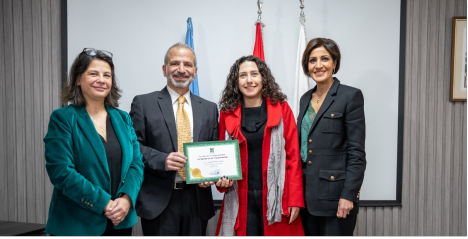
The ceremony documented LAU’s participation in formal greenhouse-gas reporting and the recognition of its 2024 emissions submission by the Ministry of Environment.
LAU Commended for Emissions Reporting
January 8, 2025
LAU received a Greenhouse Gas Emissions Reporting Certificate from the Lebanese Ministry of Environment for emissions data prepared by Facilities Management.
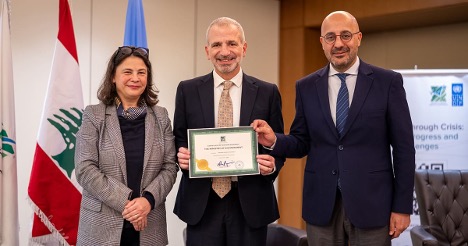
The recognition was presented during the Planning through Crisis: Climate Progress and Challenges seminar organized by the Ministry of Environment and the United Nations Development Programme. Chief Sustainability Officer Dr. Nadim Farajalla accepted the certificate on behalf of LAU. The recognition documents the university’s formal greenhouse-gas reporting and reinforces the institutional process through which Facilities Management and the Office for Sustainability monitor, compile and communicate emissions information.