Schemes to Support Low-Income Students
LAU has robust schemes to support students from low or lower-middle-income countries, ensuring they have access to high-quality education and essential resources to succeed. Programs such as the USAID Higher Education Scholarship Program that has a special scholarship for foreign refugees or displaced individuals in Lebanon and the Tomorrow’s Leaders Undergraduate (TLU) and Graduate (TLG) Programs which also support capable and highly motivated young scholars from underserved backgrounds in the Middle and North African (MENA) region by providing a fully funded undergraduate and graduate level academic matriculation, civic education, and leadership development. These scholarships are funded by entities like the U.S. Department of State and USAID, provide full coverage of tuition, enrollment, and related institutional fees, effectively offering free education to eligible students.
Additionally, these programs include monthly stipends to cover food and other necessities, housing allowances or full dormitory coverage, and book allowances. For those commuting, transportation allowances are also provided. In cases where students face personal or academic challenges, they benefit from psychosocial support, academic advising, and mentoring services. These comprehensive schemes are designed to ensure that students from disadvantaged backgrounds can focus on their academic and professional development without financial barriers.
Moreover, our university offers financial aid to students who need additional support to complete their studies. This aid is aimed at addressing the financial challenges faced by students from diverse socio-economic backgrounds. Through need-based scholarships, grants, and work-study opportunities, the financial aid office ensures that students can cover their educational and living expenses, allowing them to thrive academically and participate fully in university life. This ensures that every student has the opportunity to pursue their education, regardless of their financial background.
Alumni Solidarity and Support Dinner in London Gives Hope to LAU and Lebanon
The LAU community in London honored Basim and Karen Lorenz Ziadeh and Rima Maktabi, and supported students and patients.
By Raissa Batakji December 19, 2024
Time and again, LAU alumni have risen to the challenges facing Lebanon and their alma matter. The dynamic, professionally diverse members of the university’s London Alumni Chapter are no exception.
On November 26, they hosted a Solidarity and Support Dinner at One Great George Street in London to benefit the LAU Emergency Relief Fund and honor Basim and Karen Lorenz Ziadeh (BA ’72) and Rima Maktabi (BA ’00; MA ’03), distinguished alumnae and longtime LAU supporters.
Attendees included the Ambassador of Lebanon to the UK and Northern Ireland Rami Mortada, LAU Chairman of the Board of Trustees Philip Stoltzfus, LAU President Chaouki T. Abdallah, LAU Vice President for Institutional Advancement for Lebanon and the Middle East Gabriel Abiad, LAU Assistant Vice President for Alumni Relations Abdallah Al Khal, as well as alumni and friends of the university. The dinner raised funds to support LAU through the main sponsor of the event, Credit Financier Invest (CFI), as well as a donation from Mrs. Latifa Saidi Kosta (BA ’73), the sale of tickets and a raffle draw.
Welcoming the audience, Co-Presidents of the London Alumni Chapter— Director of Alliances for Growth Markets at Salesforce Karim Boulos (BS ’06) and Professor of Oncology at Kingston University Shereen Nabhani (PharmD ’01) —shed light on the challenges that face Lebanon and the region, underlining the significance of this event in supporting students and patients in Lebanon. They also pointed out that LAU, “which has been providing outstanding education for 100 years,” remains steadfast in its commitment to Lebanon.
Ambassador Mortada described the evening as “an act of defiance and a glimpse of hope, optimism and solidarity in the face of one of the most brutal attacks against Lebanon.” He noted that the university has long been a center of excellence which, along with similar institutions, will “chart the way for the country, capitalizing on its graduates’ magnificent skills and talents.” The ambassador further wished Dr. Abdallah well on his appointment as the new LAU president, and expressed his confidence that under his guidance, the university will maintain its rich legacy.
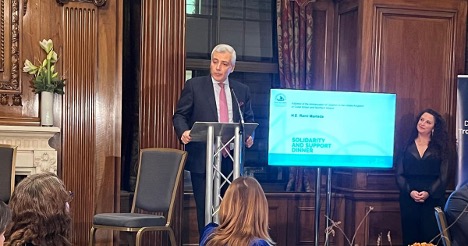
Drawing a connection to the evening’s honorees, the Ziadehs and Maktabi, Stoltzfus remarked how “the true merit of an individual is the weight of the impact they have on their community, the way they contribute to our common good and the lifelong applications of their beliefs and values.”
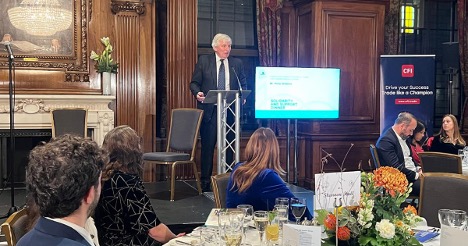 Speaking of the impact that institutions can have, he pointed out that what LAU faculty, healthcare providers, staff and students have done in this centennial year of LAU—which coincided with the toughest of circumstances in Lebanon—is nothing short of miraculous.
“LAU is a trusted institution because it acts in the right way for our community and for Lebanon, armed with the mission and values of our founders, which are renewed with every generation,” said Stoltzfus. “The belief in the infinite possibilities of a future we cannot imagine is what animates this mission.”
Reflecting on the power of education in transforming trajectories, Dr. Abdallah gave the example of his mother’s determination to educate him and his seven siblings, and how this led him to connect with a university that was founded on the promise to educate women at a time when that was illegal in many parts of the world.
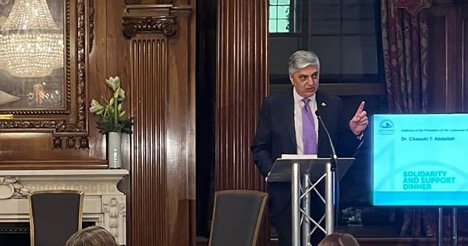 Connecting this with LAU at present, the president affirmed that the continuity of learning is paramount during a crisis, as it “not only provides hope but also real positivity for the future of Lebanon.”
Dr. Abdallah further underlined that universities strive for excellence through teaching, producing research and contributing to economic development. To that end, he presented some recent figures. Around 60 percent of tuition is covered for LAU students thanks to the robust financial aid offering, which further grew beyond the initial grants due to the crisis, and two LAU mobile clinics have catered to the health needs of more than 1,200 children, women and elderly among the displaced communities across Lebanon.
Pledging to stay true to LAU’s noble mission, Dr. Abdallah said: “Being here with you tonight gives me hope that we will emerge a better, stronger institution and that we will deliver on the promise that we have made to our students.”
Honoree and Al Arabia UK Bureau Chief, Maktabi shared her own connection to the university, thanking her mother for pushing her to pursue both a BA and a master’s degree at LAU, despite having a full-time job at the time. She stressed the value of education, noting how “countries can be rebuilt from the rubble, but making up for years of lost education is close to impossible.”
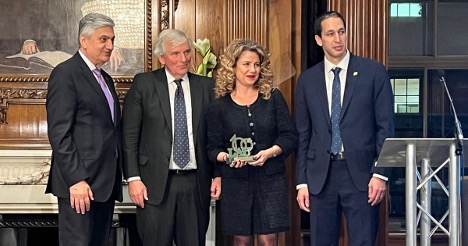 Maktabi also appealed to attendees to support LAU and Lebanon, as “it is our mandate to keep education institutions in Lebanon on their feet during these trying times.”
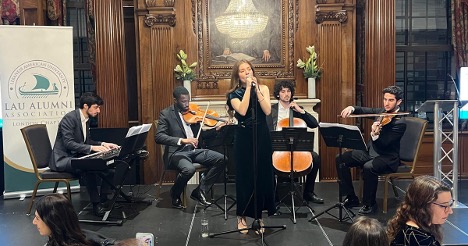
Musical Theatre Artist and alumna Dona Atallah (BA ’22) was joined by pianist Sami Saade and violinist Leyth Almani for a performance at the event that was supported by the Peace and Prosperity Trust.
An Act of Kindness Initiates a Full-Fledged Relief Operation
Five USAID scholars unite and launch a humanitarian aid project, translating their civic engagement skills and passion into real-world impact.
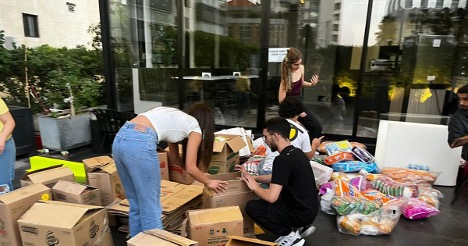
Back in September, as the war disrupted classes and confined students to their homes and dormitories, Elise Moussa, Mayssa Merie, Farah Ktaish, Farah Nassar and Tala Hareb—all USAID-Higher Education Scholarship Program (USP) scholars—chose to channel their feelings of helplessness into action.
Despite the escalation in their hometowns in the south, this group of like-minded altruistic LAU students came together to help alleviate the hardships of hundreds of displaced individuals in Beirut. Pooling their limited resources, they began distributing water bottles and cakes to families sheltering in the Manara area of Beirut.
Encouraged by the gratitude they received, they formalized their efforts and founded Youth for Lebanon, a humble initiative aimed at providing essential food, water and hygiene products to those in need.
“We organized ourselves into functional teams: tech, media, design, finance, outreach, management and logistics,” explained Moussa, a third-year marketing student at the Adnan Kassar School of Business and one of the five co-founders of the initiative responsible for its media communications.
To ensure transparency, the group created public spreadsheets to track every cent donated, detailing the types and quantities of items purchased and their recipients. “We maintain a well-organized system of collaboration, meeting three to four times a week—both online and in-person—to divide tasks, set priorities and monitor progress,” explained Nassar, a third-year marketing student responsible for the project’s logistics.
In just three months, the group exemplified the power of collective effort by raising over $2,000, enabling the distribution of more than 120 meal boxes, feeding approximately 1,200 individuals, and delivering over 100 hygiene kits.
“The drive to make a difference—even in the smallest way—became our guiding force,” said Merie, a third-year psychology student, who connects with families in need, understanding their specific requirements while coordinating with her team members to ensure they receive the necessary items.
Additionally, the group drew on their diverse educational backgrounds and the experience gained through the Community Service & Engagement (CSE) program at LAU, which equips students, including USAID scholarship recipients, with the tools, opportunities and guidance needed to excel academically and become active, compassionate and socially responsible leaders within their communities and beyond.
“Since our first year at LAU, the CSE program has encouraged us to engage in social responsibility and volunteering,” Kteish, a third-year banking and finance student who took care of the project’s finances, shared. She added that “having volunteered for over two years, co-founding Youth for Lebanon became much easier as I was already used to this type of work.” She also noted that the program had supported their efforts by featuring their initiative in its magazine, helping to raise awareness and broaden their outreach.
When it came to balancing the project’s growing demands and their academic responsibilities, the group decided to have joint study sessions, a shared space that allowed them to emotionally process the ongoing crisis while staying focused on their studies.
“We used to have study nights, half of which were spent studying and the other half discussing Youth for Lebanon,” said Hareb, a third-year computer science student who was responsible for setting up the project’s website. In addition to her tasks, she also shared duties with other members, including packing and delivering donation boxes.
Now, as the situation has shifted with people returning to their homes, the team has quickly embarked on a new mission: clearing up the spaces that had served as shelters.
The Community Service & Engagement (CSE) at LAU aims to provide LAU students and student recipients of USAID scholarship grants with the tools, opportunities, and guidance needed to not only excel academically but also become active, compassionate, and socially responsible leaders within their communities and the world at large.
CSE serves as the driving force behind fostering a culture of community engagement throughout the LAU community. We provide innovative and immersive programming that encourages LAU students to explore the diverse landscapes of their nation while contributing to meaningful causes. This experiential learning is not just an addendum; it’s a vital facet of the LAU academic journey.
How will CSE transform my experience?
- Aptitude Development: Participating in CSE programs allows you to hone your core competencies through practical experiences, workshops, and interactions with mentors, empowering you to become a more effective and influential changemaker.
- Community Impact: CSE offers chances to engage in community service and public service initiatives, enabling you to make a positive impact on society and develop a sense of social responsibility that goes beyond the classroom.
- Personal Growth: Beyond academic excellence, CSE promotes personal growth by encouraging self-discovery, resilience, and adaptability, preparing you to face challenges and seize opportunities with confidence.
Capacity Building
Soft Skills Series (SSS)
In collaboration with the Offices of the Dean of Students, CSE introduced the Soft Skills Series (SSS) workshops to all LAU students in 2017. These workshops serve as a platform for students to enhance their soft skills through engaging and informative sessions aimed at refining their abilities. Led by professional trainers and entrepreneurs, the workshops offer interactive forums for skill development. As of December 2022, the SSS program has conducted 50 workshops, benefiting 1,378 LAU students. Topics covered include Conscientious Leadership, Unlocking Innovation: Creative Thinking, How to Define Your Purpose in Life, Smart Phones, Smart Pictures, The Art of Happiness, and others.
LEE-Leadership Empowerment Education
Cultivates vital soft and digital skills essential for personal and professional growth among youth. This immersive, hands-on, and short-term learning initiative is tailored to equip students with targeted life skills aligned with their career aspirations and academic pursuits. As of December 2022, the LEE program, conducted by LAU students for high school students and facilitated by experts for LAU students, has conducted 89 workshops benefiting 1,849 high school and LAU students.
Volunteerism, Networking, and Civic Engagement
Corporate Visit Series (CVS)
The CVS program offers LAU students a unique opportunity to immerse themselves in diverse work environments, foster civic responsibility, and engage with leading companies, firms, and factories across industries such as Food and Beverage (ex: Pepsi Co), Aviation (ex: Middle East Airlines (MEA), Educational (ex: Unilever), Culture (ex: Sursock Museum), and others. Providing a direct insight into future job cultures, it also facilitates volunteering and community service experiences. Despite facing interruptions in 2020 due to the pandemic and subsequent economic challenges, the CSE unit revitalized the program in 2023, organizing 102 impactful visits to companies spanning various sectors.
Volunteer Teachers Program
The Community Service & Engagement Unit at LAU is cooperating with NGO MMKN, under the Volunteer Teacher Program for the 12th year. The program engages an estimate of 150 LAU students in enhancing the educational journey of 1,600 grade 8 and grade 9 public school students. Their objective is to provide essential academic support in scientific subjects, delivered in both English and French, to ensure these students succeed in their classes.
The USAID Higher Education Scholarship Program
The CSE unit oversees all USAID Higher Education Scholarship programs, ensuring their effective management and implementation. Within this realm, the LAU HES team excels in administering both HES Phase I & Phase II awards, collectively valued at $58M, along with overseeing the financial aid component amounting to $13M under HES Phase I.
These awards are geared towards fostering academic excellence, promoting civic engagement, and facilitating employment opportunities for academically gifted yet underprivileged scholars from both public and private educational institutions in Lebanon. This is achieved through the HES USP (University Scholarship Program) for Lebanese nationality and is extended to refugees legally residing in Lebanon via the HES RSS (Refugee Scholarship Support) program. Moreover, provisions are made to accommodate scholars with disabilities, ensuring they receive the necessary support throughout their academic journey at LAU, thus fostering inclusivity and equal opportunities for all beneficiaries of the program.
Community Service Projects (CSP)
The CSP projects are an opportunity for scholars to give back to their communities and exemplify the spirit of voluntarism and participation. The primary goal is to allow scholars to use their gained leadership and soft skills in actual practice through formulating a brief technical concept paper, in line with USAID’s guidance, to be actually implemented in the field. Scholars are encouraged to start thinking about prospective projects in their hometowns or cities shortly after they join LAU and acclimate to the academic atmosphere. The CSP hones the scholars’ skills in teambuilding, networking, communication with peers and with vetted local community-based organizations, budgeting, and actual execution, let alone conflict resolution to mitigate challenges, respecting diversity, and thinking about gender and culturally sensitive projects. It is worth mentioning that 353 Community Service Projects, so far, have been successfully completed as part of the scholarship programs.
TL Undergraduate Program (TLU)
TLU Program Overview and Benefits
This program provides four-year university scholarships and internship opportunities at LAU to high school students who have the potential to become leaders. It aims to transform participants into well-rounded individuals, endowed with the knowledge and skills to be successful in the marketplace and to take on the challenges facing their home countries.
In addition to their studies, recipients are expected to engage in community service activities and internships. Limited English-language training is provided for some participants. Undergraduate students who maintain a 3.0 GPA may have an opportunity for a study abroad semester in the United States.
Student Life
In addition to pursuing rigorous academic studies on campus and a semester-long study abroad program in the United States, the LAU MEPI-TL students organize and participate in a number of supplemental activities designed to develop them into well-rounded professionals and leaders.
- Seminars/Roundtable discussions/Workshops: Academics, representatives of local and international NGOs, government officials, and business leaders lead students in a variety of programs.
- Site visits: Visits to businesses and public organizations, in addition to non-governmental and community associations give students a broad perspective on leadership and management as well as insight into the career paths available to them.
- Mentoring: The LAU MEPI-TL staff provides both academic and psychological support to students as they transition to life in Lebanon and the university. Selected faculty members also serve as mentors, trainers and supervisors to students throughout the duration of the program. In addition, new participants are paired with senior TL students who serve as mentors, helping newcomers quickly integrate into both the LAU community and the TL program.
Study Abroad in the United States
TL students have the opportunity to apply for a study abroad program and spend a semester in a US-affiliated partner university during their Junior year at LAU. Students are selected based on LAU’s study abroad rules and procedures. During their time in the States, students are expected to continue to pursue coursework toward their major requirements.
This experience is designed to broaden each student’s global perspective through cross-cultural and academic exchanges.
Supplemental Activities
In addition to their coursework, students are expected to participate in a number of supplemental activities aimed at developing their interpersonal, leadership and professional skills:
- Seminars/Roundtable discussions
- Summer internships
- Community service
- Networking activities
- Leadership skill-building
- Mentoring experiences
- TL Capstone Project
Student Governance
All LAU MEPI-TL students are encouraged to take a leadership role at LAU, so that they may affect their rights and lives at LAU. To this end, the students elect their representatives every October. The representatives liaise on the students’ behalf with the LAU MEPI-TL administrative team, and with the LAU student body and councils.
Leadership Engagements
In addition to their academic studies and supplemental activities, LAU MEPI-TL students benefit from leadership skills development programs and internships, which prepare them for leadership roles in the region’s public or private sector upon graduation.
Leadership skills sessions
Regularly conducted workshops and retreats help students build their leadership capabilities throughout the program. These sessions help students develop the soft skills key to being both a contributing team member and effective team leader.
Summer internships/Community service
The internships and community service programs have an international and reform focus. Students participate in summer internships following their freshman and sophomore years, as well as a six-month civic service project at the conclusion of the program. At the end of their internship/volunteer experiences, students prepare a public presentation.
Program Benefits
The LAU-MEPI Tomorrow’s Leaders Program provides exceptional opportunities and services for students, including:
- Full coverage of enrollment, tuition and related institutional fees.
- Medical insurance coverage
- A monthly living allowance
- An allowance for books
- A laptop
- Full housing coverage at LAU’s dormitories.(Double Room Occupancy)
- Leadership training including: team building, goal setting, time management, work ethics, public relations, networking, and other related skills.
- Exposure to and engagement in community development projects throughout Lebanon in order to learn about different forms of intervention and ways of interacting and interfacing with community-related issues and causes.
- Academic advising and mentoring services.
TL Graduate Program (TLG)

TLG Program Overview and Benefits
LAU was the first university in the MENA region to implement the Tomorrow’s Leaders Graduate (TLG) Program in 2018. The program is a fully funded scholarship by the United States Department of State, MEPI.
The Program spans over a period of two years with the purpose of equipping graduate students with the professional experience needed to advance their academic knowledge and engage in research that furthers the professionalization of emerging leaders.
Benefits
If you are accepted, the program will cover the following:
- Full coverage of all applicable charges for enrollment, tuition, and fees.
- University Medical insurance coverage.
- A monthly living allowance.
- One laptop for the duration of the program.
- A yearly book allowance.
- Student housing.
- Two roundtrip tickets to the student’s home country.
- Exposure to, and engagement in, different community development projects and/or internships in the host country, and/or their home countries. Through such projects and internships, TLG students learn about different forms of public and civic- engagement actions, to apply such learning back in their respective countries.
- Academic advising, mentoring services, and learning services.
- Professional training on leadership;
- Opportunity to participate in the new Tomorrow’s Leaders College-to-work Pipeline as a part of the consortium between LAU and the Georgia Institute of Technology.
Refugee/Displaced Scholarship Support

Requirements to Join RSS 2 Cohort 1
To be eligible to apply under RSS, parents must not be receiving an educational university subsidy of US $5,000 or more and students should:
- Be a refugee/displaced student residing in Lebanon and holding a valid and legal Lebanese residency permit issued by the Lebanese authorities.
- Not be an asylum seeker.
- Be enrolled in a public or private high school in Lebanon for at least the last three years of your secondary education.
- Have a cumulative average of 13.5/20 (Grades 10 and 11) if you are applying from a public school.
- Have a cumulative average of 13.5/20 (Grades 10 and 11) if you are applying from a private school.
- Obtain a minimum of 13.5/20 on the official Lebanese Baccalaureate exam.
- Demonstrate past and present performance of service and community activities.
- Not be registered at any university and not have completed studies at any university.
- Register at LAU or AUB as a full-time student at all times.
- Not have siblings who have benefited or are benefiting from any USP or US funded undergraduate scholarship.
Financial Aid Guidelines
If you are interested in being considered as a candidate for the RSS 2 Cohort 1 support program, you need to demonstrate financial need. Make sure to submit hard copies of all the financial aid required documents starting January 16 and prior to April 6, 2023.
The list of financial aid required documents
Sample of the financial aid required documents
IMPORTANT: Students should have at all times a valid residency permit in order to maintain the scholarship
Benefits of RSS 2
If you are accepted, RSS 2 will cover the following:
- Full tuition fees for the duration of your program (as per LAU’s academic regulations), including one preparatory year if needed
- Medical insurance
- Book allowance
- Student housing or transportation allowance
Please note that all those who shall be entitled to dorms are explicitly bound to clear rules and regulations. Dorms are segregated (dorms for girls - dorms for boys).
- A monthly stipend for nine to eleven months per year depending on the major
- Laptop
- Counseling services and psychological support as needed
- Support services shall be offered to women coming to live on campus, if and when needed
Need-Based Financial Aid
At LAU, we believe that all eligible students deserve an excellent education, regardless of financial limitations. LAU allocated a generous budget, possibly the highest in the region, for financial aid and scholarships for the upcoming academic year. LAU is committed to helping you fund your education regardless of your nationality, race, gender, religion or ethnicity.
We encourage you to apply for financial aid as early as possible.
Financial Aid is a package composed of the following elements:
LAU provides the following grants:
LAU Grants:
Awarded to students showing an element of need in accordance with specific need categories.
Hardship Grants: Awarded to students with extreme need.
Triplets Grant: This is an additional percentage that may be given to triplets demonstrating financial need and enrolled simultaneously at LAU.
Program Grants: Awarded to students majoring in programs requiring special promotional support in line with university enrollment goals.
Special Grants: These grants are awarded to selected students according to special agreements approved and signed by the LAU President and external donors or organizations. Applications, if required, are to be filled in the initial stage only.
Donors’ Grants
These grants are created through the generous donations of LAU benefactors.
Tomooh/PepsiCo Scholarship
Scholarship Amount: To be determined by donor
Eligibility: Students demonstrating financial need. Open for all majors
Selection process: recipients will be selected by donor
Duration of grant: renewed upon the discretion of the donor
Application: Apply for the Tomooh/PepsiCo Scholarship
Educational Loans
LAU is the only educational institution in Lebanon to offer educational loans as an additional financial support for its students.
The educational loan helps plan the financing of up to 10% of tuition fees. It carries zero interest while the student is registered at LAU, and a minimal interest rate (usually half the market rate) after he/she graduates, with a grace period of 9 years.
The loan does not replace financial aid; it is in addition to the financial aid package that students receive.
US Federal Aid
US Federal Aid: are fixed-rate student loans from the US Department of Education for undergraduate and graduate students attending university at least half-time. Subsidized, Unsubsidized, and PLUS loans can be granted to students from the United States of America who choose to study at LAU. View the details of the US Federal Aid.