SDG 12: Responsible Consumption and Production
LAU’s Commitment to Advancing SDG 12: Responsible Consumption and Production
Against the backdrop of Lebanon’s escalating economic challenges, food insecurity, and environmental degradation, SDG 12 has emerged as a critical priority for institutions nationwide. LAU recognizes the urgency of addressing these interconnected issues and has taken proactive steps to champion sustainable practices in consumption and production.
Fostering Sustainable Practices
LAU has implemented a series of impactful initiatives aimed at promoting sustainable living and reducing ecological harm. From waste management and recycling programs to awareness campaigns tackling waste management, the university is addressing critical global challenges. Additionally, LAU has focused on combating pharmaceutical waste and encouraging sustainable purchasing practices, ensuring that consumption aligns with ecological preservation and responsible resource use.
Creating a Culture of Responsibility
Through these efforts, LAU is fostering a culture of environmental stewardship among its students, faculty, and staff. By embedding sustainability into its policies and community activities, the university prepares its members to be conscientious global citizens. This includes emphasizing the importance of reducing waste, optimizing resources, and prioritizing sustainable choices in daily life.
LAU’s commitment to SDG 12 exemplifies its role in addressing urgent environmental and societal issues, contributing to a more sustainable and equitable future while equipping its community to safeguard the planet for generations to come.
Ethical sourcing of food and supplies:
LAU Procurement Procedure:
LAU maintains a formal policy on ethical sourcing through its university-wide Procurement Procedure PP-001 (2024).
The policy requires that all procurement decisions prioritize sustainability, social responsibility, and ethical business practices when selecting suppliers, including for food and other supplies. It mandates transparency, fairness, and accountability, ensuring that vendors demonstrate compliance with ethical standards. This integrates sustainability considerations into all purchasing and supplier-management processes, reflecting LAU’s institutional commitment to responsible consumption and production.
Hazardous Waste
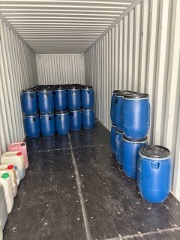
A Hazardous Waste Management Plan Committee (HWMC) has been established to work on a comprehensive hazardous waste management plan covering both LAU and LAU Medical Center-Rizk Hospital. The plan will tackle the minimization of hazardous waste generation, segregation and storage in appropriate areas, the packaging and labeling of containers, transportation from the generating area to the storage area, and transportation from LAU and LAU Medical Center-Rizk Hospital to a certified high incineration treatment facility. The following was completed on July 2024 by the hazardous waste international specialist Polyeco:
- The hazardous waste at LAUMCRH was fully segregated as per international standards and placed in UN approved drums of 60 L capacity, awaiting export. A total of 17 drums were packed at LAUMCRH.
- The hazardous waste at LAU- Beirut Campus was fully segregated as well and placed in UN approved drums of 60 L capacity, awaiting export. A total of 120 drums were packed at LAU-Beirut Campus.
- The packed drums of LAU- Beirut Campus were placed in a newly provided container (40 ft) placed in the same area, therefore Beirut Interim Storage was emptied and the risk of fire incidents was considerably reduced after completing the segregation/ packing phase.
Seminar on Pharmaceutical Waste Spreads Life-Saving Practices
Students were brought up to speed on the importance of pharmaceutical waste treatment and encouraged to take part in international mobility training.
As part of the Erasmus+-funded Sustainable Wastewater Treatment for Hospitals (SWaTH) project, the LAU School of Pharmacy hosted a seminar on pharmaceutical waste with the participation of its faculty and industry professionals.
LAU is among 11 organizations that are part of SWaTH, which is aimed at evaluating hospital wastewater treatment in Lebanon and sharing best practices in hospital wastewater treatment in France, Sweden, Finland and Spain with academics, researchers and students from five Lebanese universities.
Back in 2021, faculty and graduate students from the school joined a group of other Lebanese academics on a mobility training at the University of Granada Faculty of Science in Spain.
At the seminar, SWaTH Project Coordinator and Assistant Professor at the University of Balamand Makram Bachawati urged pharmacy students to apply to the mobility training opportunities available to them through the program.
The program offers an invaluable capacity-building opportunity for faculty and students alike. The seminar falls under the “knowledge-transfer aspect of the program so that more of our students are aware of this unique partnership and the doors it opens,” explained Associate Professor and Associate Dean for Academic Affairs Roy Kanbar.
The students’ participation in the project is essential as they stand to learn about innovative wastewater management practices, thereby enhancing their academic or career prospects. “Seeing how some of the facilities in Europe treat wastewater first-hand is an unmatched experience that would not otherwise be accessible for them in Lebanon,” said Associate Professor Jad Abdallah.
LAU is leading the pharmaceutical aspect of the SWaTH project, namely designing and running a national survey that assesses wastewater management across 136 hospitals in Lebanon while the other Lebanese universities tackle the engineering side, added Dr. Abdallah. An overview of the baseline assessment results was presented by Drs. Kanbar and Bachawati.
The seminar explored correct procedures for disposing of pharmaceutical waste – including expired or unused medication – to mitigate its threat to public health and the environment.
A presentation by Joelle Kawerk, deputy quality control manager of Benta Pharma Industries, a local pharmaceutical manufacturer, discussed the various types of pharmaceutical waste and their impact on human and ecological health. LAU alumnus Antonio El Hajj, who is also a research and development pharmacist at Benta, elaborated on the thermal, physical, chemical, and biological approaches to pharmaceutical waste treatment.
Drawing on examples from LAU’s medical centers, Clinical Instructor of Pharmacy Carl Aoun spoke about the proper handling of cytotoxic medications at hospitals.
School of Engineering Professor Mahmoud Wazne shared an alternative perspective on industrial wastewater management based on his extensive experience and research on treating industrial wastewater. In collaboration with the Litani River Authority, Dr. Wazne developed an innovative eco-friendly technology to treat wastewater. Anaerobic digestion – a process through which bacteria break down organic matter in the absence of oxygen – he said can be effective in managing pharmaceutical waste.
Thanks to the faculty and experts, pharmacy students in attendance gained a comprehensive view of pharmaceutical waste treatment, its negative impact, and its management in hospitals.
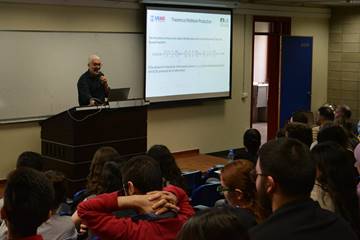 |
Dr. Wazne shared an alternative perspective on industrial wastewater management based on his extensive experience and research on treating industrial wastewater. |
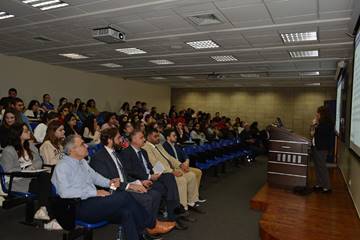 |
The seminar explored correct procedures for disposing of pharmaceutical waste – including expired or unused medication – to mitigate its threat to public health and the environment. |
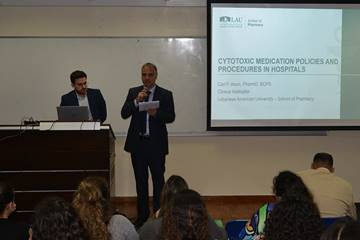 |
Drawing on examples from LAU’s medical centers, Dr. Carl Aoun (L) spoke about the proper handling of cytotoxic medications at hospitals, while Dr. Kanbar (R) presented the baseline assessment results. |
Recycling and Waste Management
While many institutions in developing countries are mandated by law to participate in recycling programs, LAU is taking the lead to initiate a program promoting the “reduce, reuse, and recycle” mentality, not because it is easy or less expensive than the alternatives, but because it is the right thing to do.
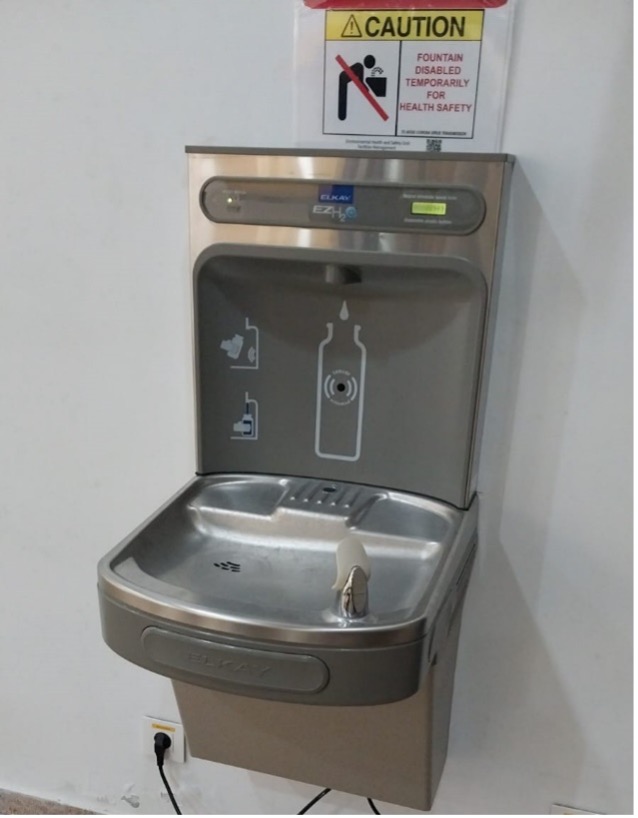
A FM recycling committee was formed involving the constituency of LAU’s two campuses and came up with a complete study that was reported to the University Recycling and Waste Management Committee (RWMC). The study identified paper, cardboard, glass, cans and plastics as the main recyclable materials, noting that other recyclables may be added later on. For optimization purposes, it was decided to divide these recyclables into two streams: paper and cardboard on one side and glass, cans and plastics on the other. This project was implemented as of 2015. Moreover, we have fitted some of our buildings with drinking water bottle filling stations to reduce the consumption of PET bottles.
The FM team researched potential recycling partners and presented the results to the RWMC, which opted for partnering with a nonprofit charity organization so as to maximize the positive impact of this initiative. The committee favoured “Association l’Écoute”, whose mission is to rehabilitate humans (mainly the deaf and blind and people with reduced mobility) through recycling materials. The profits from the recyclables is used to finance their needs for hearing kits and other medical services as well as providing them with full time employment opportunities. For further information, visit Association l’Écoute.