Financial Assistance to the Local Community
LAU provides financial assistance to the local community, actively supporting the start-up of financially and socially sustainable businesses through a variety of programs and resources.
The SPARK Program, a university-based startup accelerator, plays a central role by offering financial support of up to $10,000 to students, alumni, faculty, researchers, and staff. This program also provides mentorship, training workshops, and access to clients and investors to help participants validate, develop, and scale their business ideas into impactful ventures.
Through Spark Cycle 3, the university has incubated startups tackling critical social and financial challenges, such as DonaLeb and Takatkom. DonaLeb, founded by Yasmine Darwich, transformed into a dynamic enterprise platform that leverages behavioral economics to incentivize health and positive habits. The platform has successfully converted over 8 million steps into global contributions, expanding its reach to support various causes while partnering with corporations and organizations. Takatkom, led by Vladimir Abdelnour, addresses Lebanon’s electricity crisis by proposing sustainable energy solutions. The project, developed through the Tomorrow’s Leaders Program (TLP), received recognition at the TLP VIP+ Industry-Academia workshop, winning the attendees’ choice award, and continues to be incubated under the SPARK Program.
The university also provides free incubation services for startups and facilitates their access to potential funding sources. Notably, winners of incubation programs receive financial assistance, further empowering them to establish and sustain their ventures.
By integrating financial support, mentorship, and innovative incubation programs, the university enables entrepreneurs to overcome challenges, create sustainable businesses, and contribute meaningfully to the local and global community.
LAU Startups Gain a Head Start
The LAU Innovation Center transforms twelve entrepreneurial ideas into market-ready businesses through hands-on mentorship and seed capital.
In line with the university’s dedication to innovation and giving back to the community, the Fouad Makhzoumi Innovation Center (FMIC), the entrepreneurial arm of LAU, continued for the fourth year to support Lebanese startups in their journey to build sustainable, profitable and impactful businesses.
As part of the centennial edition of its SPARK program, FMIC hosted iDay, the final pitching event for this year’s cohort of entrepreneurs, at the Beirut campus on August 12, 2024, where 16 startups presented their businesses to the LAU investment committee, competing for a $10,000 prize to help them turn their products and services into thriving enterprises.
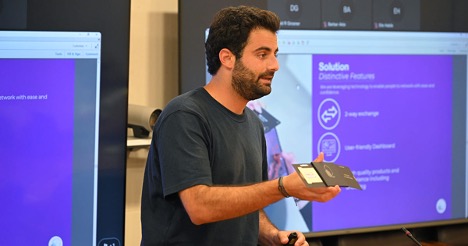 iDay marked the end of a five-month incubation program that began with a record of 107 startup applications. After multiple screenings, 31 teams advanced to a rigorous program featuring 14 expert training modules, including legal, marketing, finance and purpose-driven sales. From there, 20 startups reached Demo Day, and 16 finalists were selected to pitch to the investment committee.
 “It is obvious that the selection process was driven by passion, intense competition and meticulous scrutiny,” said LAU President Michel E. Mawad, who headed the committee alongside institutional and industry veterans.
Committee members included Vice President for Business Development and Global Affairs Elie Badr, Chief Investment Officer of LAU David Grosner, Associate Provost for International Education and Programs Barbar Akle, Director of the Industrial Hub and Assistant Professor of Practice Ali Ammouri, Vice President of Finance Charles Abou Rjeily, Chief Operating Officer at Berytech Ramy Boujawdeh and Anghami Co-Founder Elie Habib.
“The SPARK program not only empowers entrepreneurs by addressing gaps in their expertise and opening networking opportunities with business leaders and LAU partners,” said FMIC Director Annie Seferian, “but it also helps them launch businesses that ultimately contribute to their communities.”
Among the pitching teams were students, alumni, staff and faculty who received tailored mentorship on how to gear their startups toward success. Using a new startup-targeted assessment tool, the jury evaluated the diverse projects, scaling them on innovation, sustainability and business model, among other key elements essential for startup success.
Exceptionally this year, on the occasion of the university’s 100th anniversary, 11 teams were declared winners instead of the customary five, each receiving $10,000. This investment mandates quarterly presentations of their growth and profitability, after which external auditors re-evaluate them for a potentially larger investment.
Winners of the Centennial Cohort Incubation are:
- Coducators SARL: A gamified learning method of skills, such as robotics and coding, to prepare the youth for the new tech-heavy job market.
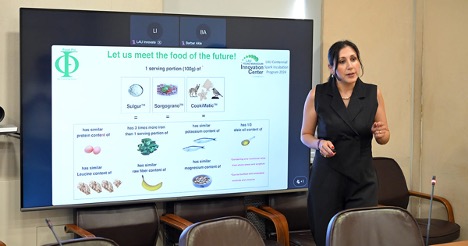
- Food Phi: A range of food products that combines the benefits of sorghum and wheat, offering superior nutrition while using fewer resources.
- Honeylicious Treats: A natural honey powder serving as a healthier sugar alternative.
- Jibly World: An e-commerce platform that provides exclusive Lebanese products to global consumers.
- Muscle Engineer: Nutritious protein snacks that curb cravings and enhance metabolic and energetic performance.
- Netify: A networking application that uses Near Field Communication (NFC) technology and digital business cards to build a dynamic community and turn interactions into meaningful results.
- Parapharma: A digital platform that aggregates premium, expert-approved parapharmaceuticals, cosmetics and fitness essentials, providing personalized recommendations and health content.
- Rukun: A digital platform that connects clients with vetted freelance interior designers, offering customized and affordable design solutions tailored to individual tastes and lifestyles.
- Sourcing & Beyond: A tech integrated supply chain marketplace to allow collaboration between companies and reliable suppliers.
- Stir: Versatile drink capsules for coffee and cocktails that can be added to any base, without a machine.
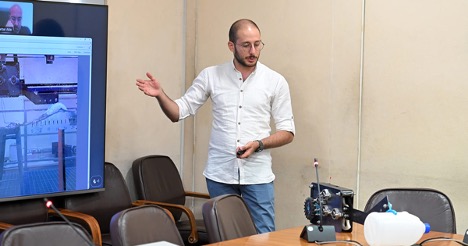
- WaveTech: A compact and versatile machine that produces usable energy from sea and ocean waves.
Celebrating Excellence in Innovation & Entrepreneurship at LAU
Apr 29, 2024
LAU continues to foster a culture of innovation and entrepreneurship within its academic community. On April 29, 2024, the second round of the Innovation and Entrepreneurship Competition took place at the Adnan Kassar School of Business (AKSOB). The event featured students from both Beirut and Byblos campuses and involved the School of Pharmacy as well as the School of Business. This exemplified the spirit of innovation and provided participants with invaluable experience in conceptualizing business solutions.
Participants presented their interdisciplinary projects to a distinguished panel of judges, including seasoned board members, industry professionals, and LAU faculty and staff. Dr. Michel Majdalani, who designed the course with an emphasis on experiential learning, praised the students’ journey: “This semester has been one of exploration, creativity, and unwavering dedication. Our students have demonstrated exceptional vision and resilience, transforming concepts into impactful ventures.”
The judging panel comprised prominent figures such as Mr. Michel Bayoud, founder and CEO emeritus of Boecker World Holding; Ms. Catherine Moukheiber, CEO of MedDay Pharmaceuticals and Mr. Bassam Tabshouri, founder and chair of the Healthcare Technology Management and Advancement Society. From LAU, the panel included Dr. Mohammad Mroueh, professor and chair of the Department of Pharmaceutical Sciences; Ms. Annie Seferian, director of the Fouad Makhzoumi Innovation Center; Dr. Grace Dagher, associate chair of the Marketing and Management Departments; and Dr. Michel Majdalani.
Projects were evaluated based on their originality, innovation, feasibility, market potential, business model, social impact, and presentation delivery. The students addressed various sectors, including pharmaceuticals, and competed for cash prizes after receiving tailored coaching sessions.
The competition’s sponsor, Mr. Michel Bayoud, was acknowledged for his pivotal role in encouraging an environment where creativity and entrepreneurship thrive. He, along with Ms. Moukheiber, Ms. Seferian and Mr. Tabshouri volunteered their time and efforts to provide mentoring sessions to students throughout the semester.
The competition winners were as follows:
- First Prize ($2,000 and 10 days of coaching): Vanessa Tarraf and Siham Bazzi for “SIVALume: Skincare Serum,” a nano-based serum derived from yeast.
- Second Prize ($1,500 and one week of coaching): Tala Machmouchi, Ghazal El Beb, Nasser Al Allaq, and Rami Youness for “ParaHerba,” a mobile application enhancing integrative wellness in Lebanon.
- Third Prize ($1,000 and five days of coaching), a tie between:
“Connect,” an application simplifying the purchase and exchange of concert tickets, by Raymond Bedran and Mohammad Hajj Ali; and
“Oli Pharm,” an online pharmacy service, by Afifeh Massoud, Celine Abboud, and Antoine Khalifeh.
Ms. Seferian, reflecting on the commitment to nurture the next generation of innovators, invited all group winners to the LAU Innovation Center and offered all participants the opportunity for incubation in the next cohort, along with a chance to win a $10,000 prize through the center.
Dr. Majdalani acknowledged the management department’s leadership role in facilitating the event. “We are grateful for the partnerships we forge with our stakeholders. This joint collaborative effort prepared our students to address real-life challenges through innovation and entrepreneurship. The event highlighted LAU’s dedication to excellence, passion for innovation, and commitment to shaping the future through transformative learning, ” he said.
Meet Afkar: A Mental Health Platform Making a Real Difference!
Founded by TLU student Mohamad Osama Kurdi and Mariam Jamous, Afkar is a nonprofit that’s all about making mental health support more accessible and breaking the stigma, especially in the MENA region. Afkar brings people together through free online guidance sessions and welcoming community workshops, creating safe spaces for anyone who needs mental health support, no matter where they are.
Their mission is to break down barriers to mental health care. Afkar offers free one-on-one support sessions and shares honest, science-backed content on mental health through posts and reels. They’re working to make it normal to talk about mental health and to seek help without any fear of judgment.
Mohamad and Mariam were able to gather 20+ volunteers from all over the world — Syria, China, Nigeria, Morocco, India, and beyond — each bringing unique skills and passion to the platform. They research, design, write, and share resources to make sure mental health information is clear, accessible, and supportive.
Afkar’s posts and guidance sessions have already reached thousands, tackling real-life topics like bullying, family issues, and ways to take care of mental health.
What’s next for Afkar? Well, they plan to register as a nonprofit, welcome even more volunteers, and launch a dedicated mental health app to make support even easier to find.
Success Stories
Vladimir Abdelnour Proposes a Solution to the Energy Crisis in a Sustainable Approach
Being a Tomorrow’s Leaders Gender Scholars (TLS) student, Vladimir Abdelnour experienced a wide array of benefits that the program could offer him. From this enriching experience, he learned that TL programs are one-of-a-kind scholarships that invest in youth’s capabilities. To that effect, when the TLP project was introduced to TL students at LAU, Abdelnour showed immediate interest in joining the project. With Lebanon’s deepening electricity crisis and fuel shortage, Abdelnour could not find a better opportunity that allows him to address the problem than getting involved in the renewable energy project proposed by TLP. Abdelnour galvanized his knowledge in electrical engineering at the service of the project while tapping into new learning in different disciplines such as research, market analysis, online trading, and management solutions. While the project which resulted in a startup « Takatcom » did not reach a turn-key stage yet, Vladimir and the team members presented confidently the startup concept during the TLP VIP+ Industry-Academia workshop while describing in detail where the project will lead. The project got the attention of the Inas Academic Awards Foundation (IAAF) and proposed to the team to apply for the IAAF Awards competition and get the chance to fund the project partially. Additionally, the project won the attendees’ choice award at the VIP+ workshop and that is currently participating in the LAU Spark program for startup incubation. « I attribute this achievement to the TLP project that believes in youth’s caliber and pushes our limits and makes us realize that we can do things we did not think we could by breaking the « it is impossible » mindset, says Abdelnour.
Alumna Martine Zaarour Shares Love in a Jar
A remarkable journey of preserving culture, empowering women, and sharing the love for local heritage, one jar at a time.
|
Zaarour believes that the ongoing financial and economic crises shed much-needed light on the importance of local production. |
Zaarour identifies as an architect first, even though her “heart and career are both set on entrepreneurship and gender advocacy.” |
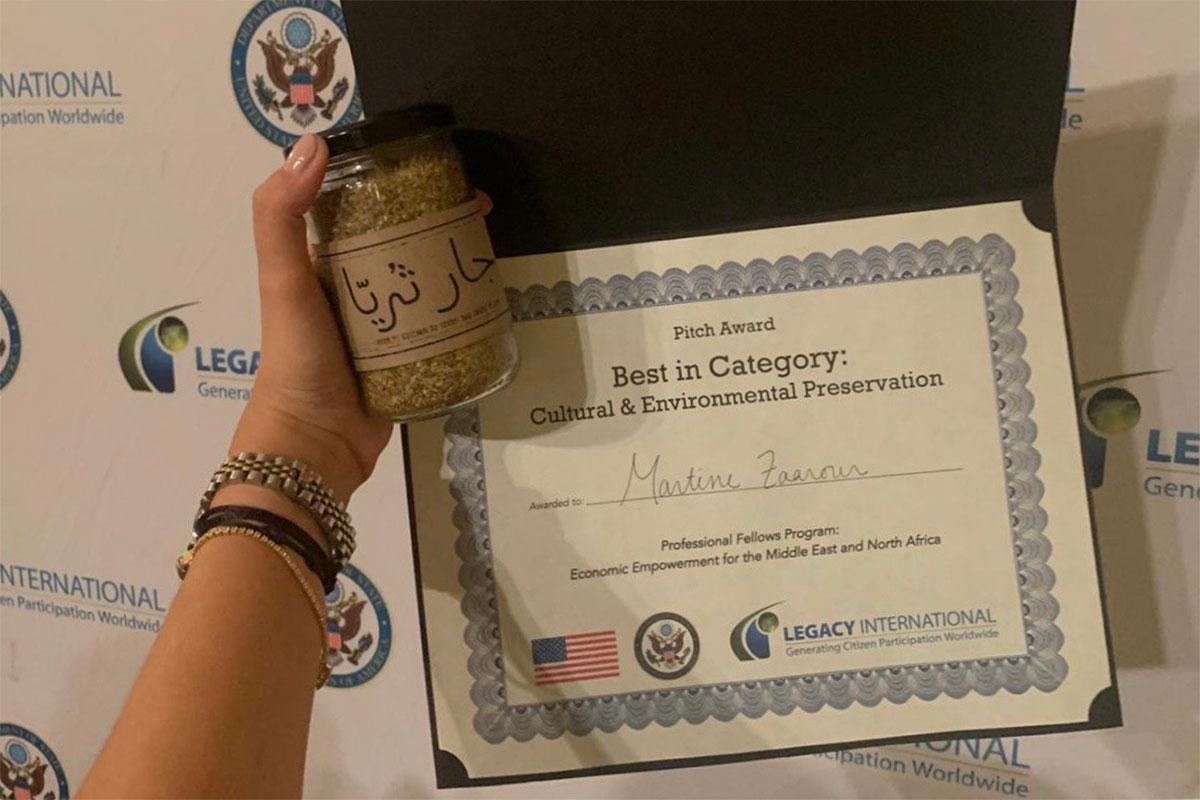
Jar Thuraya was recently selected as best in the Cultural & Environmental Preservation category at the Professional Fellows Program final pitch. |
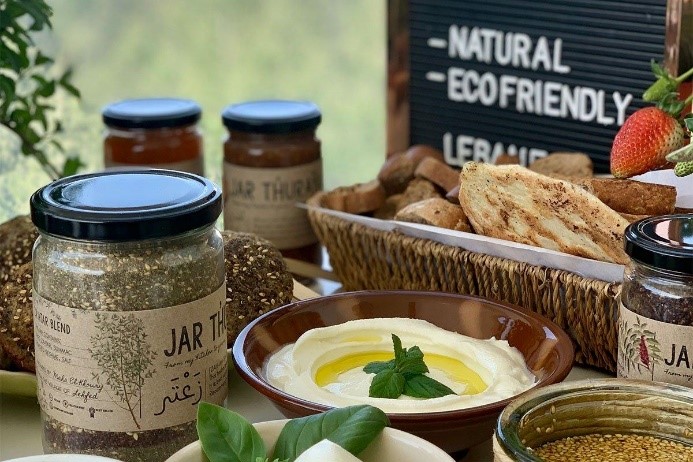

Lebanese women are famed for being resourceful. Perhaps the very origins of preparing mouneh – the practice of food preservation – started with a group of such women, who sought to provide their families year-round with a balanced diet that included seasonal staples.
In recent years, however, younger women have admitted they lacked the skills essential to making mouneh – such as sun-drying, pickling, slow-cooking, or oil-packing traditional food, according to Martine Zaarour (BArch ’14).
“When I realized that my grandma is the only source of my larger family’s mouneh, it was a wake-up call,” said Zaarour, adding that “not even the mothers knew how to prepare it.”
In co-founding Jar Thuraya, she saw an opportunity to keep this practice alive, while throwing a lifeline to resourceful rural women, and preserving an essential part of the Lebanese cuisine.
At first glance, the endeavor seemed a departure from Zaarour’s degree in architecture, but she was quick to connect the dots. Shortly after graduating and working briefly at an architecture firm in Madrid, she returned to Lebanon and engaged in socially conscious projects that were in line with the United Nations’ Sustainable Development Goals.
With a focus on women’s economic empowerment, Zaarour developed a seed idea for a platform that helps women sell homemade food, as part of a youth leadership program run by the United Nations Development Programme (UNDP). This earned her invites to pitch her idea at the Regional Forum on Gender Equality in Tunisia, and at the UN Economic and Social Council in New York.
The international exposure and support landed her a six-week fellowship with the Professional Fellows Program (PFP) in Washington DC, funded by the US Department of State. While there, she was mentored and trained to complete the business development model for Jar Thuraya, which was selected as best in the Cultural & Environmental Preservation category at the PFP final pitch.
Zaarour returned to “a very different Lebanon” in December 2019, just as she had planned to launch her enterprise. Political, economic, and financial distress enveloped the country, as people took to the streets in protest and the local currency began its steep decline.
She was determined to kick off and found hope in her brand that promised to “empower women working from their homes, helping them generate income and become financially independent.”
Zaarour and her colleagues took part in several programs and incubators that resulted in different forms of monetary and in-kind support, while the COVID-19 pandemic forced a dramatic rise in e-commerce. “In a way, the ongoing crises had shed much-needed light on the importance of local production,” she said.
“Every jar is stamped with the name of the woman who prepared it and where she comes from,” said Zaarour, noting that the glass jars are 100 percent eco-friendly. As for engaging and appealing to the new generation, products by younger women make up Jar Thuraya’s line of fusions that are “inspired by the endless possibilities of Lebanese cuisine,” she added.
As Zaarour juggles several professional development courses in user-experience design and project management, she is grateful for the well-rounded education she gained at LAU’s School of Architecture and Design. She recalls final-year overnights at the studios, as well as exposure to international speakers and several extracurricular activities that introduced her to social issues.
“I believe that I wouldn’t be here if it weren’t for architecture and my background in design,” she concluded. “Even though my heart and career are both set on entrepreneurship and gender advocacy, I will always consider myself an architect first.”
Mohammad Kabakibi Launches an Online Tutor Learning Initiative with a Focus on Gender Equality
With the Pandemic and the unforeseen economic, political and social crises with its lingering impact on education, TLS student Mohammad Kabakibi took stock of the aftermath of all calamities combined that affected drastically students’ learning abilities and their well-being and decided to act upon it. Driven by his inner passion for helping others, Kabakibi created a network of talented undergraduate and graduate students and launched Chain of Education ™, an online platform which main aim is to help students to catch up on pandemic/economic crises- related unfinished learning.
Chain of Education ™ provides online free tutoring to students on STEM courses moderated by tutors with the supervision of university professors who hail from different remarkable institutions: LAU, American University of Beirut, Princetown University, University College London, Syracuse University, Bradford University, University of Manchester, and Université de Technologie de Troyes. Chain of Education ™ attracted more than 100 outstanding undergraduates/graduates and Ph.D. holders from around 8 countries to join and support. It hosted many services including tutoring sessions, online soft skills training with a dedicated space for students’ blog writing.
Kabakibi and the team are currently working on expanding the platform services to be more personalized, sustainable, and accessible. The LAU- MEPI TLS program helped Kabakibi to have a sort of bird’s eye view on the importance of education with a focus on gender parity. « The TLS program has re-shaped scholars including me about the significance of the sustainable developmental goals (SDGs) with special emphasis on gender equity and education. This has inspired many TLS colleagues to join and contribute in this initiative to reach an inclusive, sustainable, accessible, and gender-equitable education » he said.