Financial Aid for Low-Income Students
LAU Financial Aid and Scholarships
At LAU, we are committed to providing equitable access to higher education by setting targets to admit students from the lowest household income groups in the country, including those in the bottom 20%. This approach reflects our belief that all eligible students, regardless of financial limitations, nationality, race, gender, religion, or ethnicity, deserve an excellent education.
To further this mission, we offer scholarships and financial aid packages that can cover up to 100% of tuition costs.
We encourage all students to apply early for financial aid and scholarships to maximize their access to available support.
In a Nutshell
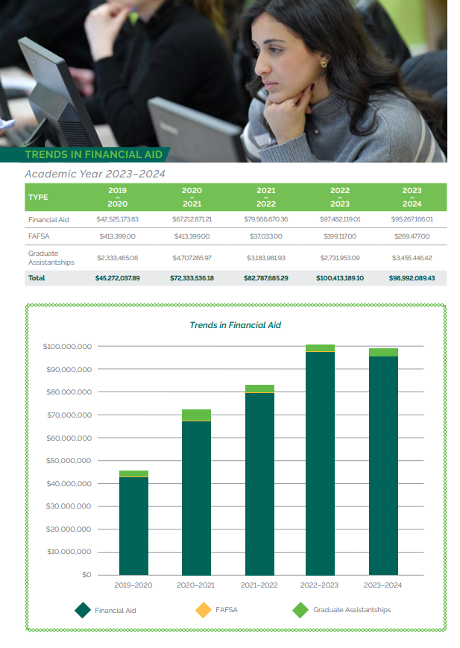
$98 Million+ allocated for SCHOLARSHIPS and FINANCIAL AID packages for AY 23-24
90%+ of students benefit from one or more forms of FINANCIAL AID / SCHOLARSHIP
2,500+ students are on SCHOLARSHIPS
1,700+ students receive SAT/Entrance and Honor SCHOLARSHIPS covering between 10 & 50% OF TUITION
700+ students benefit from MEPI and USP SCHOLARSHIPS
400+ students receive BACC SCHOLARSHIPS covering between 25 & 50% OF TUITION
175+ students benefit from ATHLETIC Scholarships
135 students benefit from Merit Scholarships covering 100% OF TUITION
Alumni Solidarity and Support Dinner in London Gives Hope to LAU and Lebanon
The LAU community in London honored Basim and Karen Lorenz Ziadeh and Rima Maktabi, and supported students and patients.
By Raissa BatakjiDecember 19, 2024
Time and again, LAU alumni have risen to the challenges facing Lebanon and their alma matter. The dynamic, professionally diverse members of the university’s London Alumni Chapter are no exception.
On November 26, they hosted a Solidarity and Support Dinner at One Great George Street in London to benefit the LAU Emergency Relief Fund and honor Basim and Karen Lorenz Ziadeh (BA ’72) and Rima Maktabi (BA ’00; MA ’03), distinguished alumnae and longtime LAU supporters.
Attendees included the Ambassador of Lebanon to the UK and Northern Ireland Rami Mortada, LAU Chairman of the Board of Trustees Philip Stoltzfus, LAU President Chaouki T. Abdallah, LAU Vice President for Institutional Advancement for Lebanon and the Middle East Gabriel Abiad, LAU Assistant Vice President for Alumni Relations Abdallah Al Khal, as well as alumni and friends of the university. The dinner raised funds to support LAU through the main sponsor of the event, Credit Financier Invest (CFI), as well as a donation from Mrs. Latifa Saidi Kosta (BA ’73), the sale of tickets and a raffle draw.
Welcoming the audience, Co-Presidents of the London Alumni Chapter— Director of Alliances for Growth Markets at Salesforce Karim Boulos (BS ’06) and Professor of Oncology at Kingston University Shereen Nabhani (PharmD ’01) —shed light on the challenges that face Lebanon and the region, underlining the significance of this event in supporting students and patients in Lebanon. They also pointed out that LAU, “which has been providing outstanding education for 100 years,” remains steadfast in its commitment to Lebanon.
Ambassador Mortada described the evening as “an act of defiance and a glimpse of hope, optimism and solidarity in the face of one of the most brutal attacks against Lebanon.” He noted that the university has long been a center of excellence which, along with similar institutions, will “chart the way for the country, capitalizing on its graduates’ magnificent skills and talents.” The ambassador further wished Dr. Abdallah well on his appointment as the new LAU president, and expressed his confidence that under his guidance, the university will maintain its rich legacy.
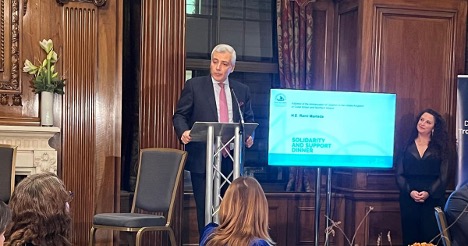 Drawing a connection to the evening’s honorees, the Ziadehs and Maktabi, Stoltzfus remarked how “the true merit of an individual is the weight of the impact they have on their community, the way they contribute to our common good and the lifelong applications of their beliefs and values.”
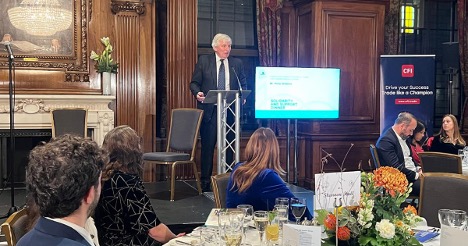 Speaking of the impact that institutions can have, he pointed out that what LAU faculty, healthcare providers, staff and students have done in this centennial year of LAU—which coincided with the toughest of circumstances in Lebanon—is nothing short of miraculous.
“LAU is a trusted institution because it acts in the right way for our community and for Lebanon, armed with the mission and values of our founders, which are renewed with every generation,” said Stoltzfus. “The belief in the infinite possibilities of a future we cannot imagine is what animates this mission.”
Reflecting on the power of education in transforming trajectories, Dr. Abdallah gave the example of his mother’s determination to educate him and his seven siblings, and how this led him to connect with a university that was founded on the promise to educate women at a time when that was illegal in many parts of the world.
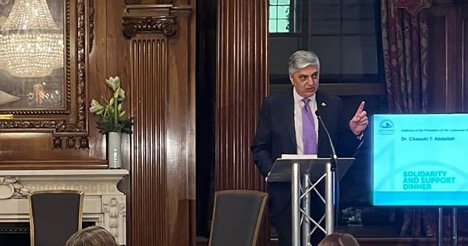 Connecting this with LAU at present, the president affirmed that the continuity of learning is paramount during a crisis, as it “not only provides hope but also real positivity for the future of Lebanon.”
Dr. Abdallah further underlined that universities strive for excellence through teaching, producing research and contributing to economic development. To that end, he presented some recent figures. Around 60 percent of tuition is covered for LAU students thanks to the robust financial aid offering, which further grew beyond the initial grants due to the crisis, and two LAU mobile clinics have catered to the health needs of more than 1,200 children, women and elderly among the displaced communities across Lebanon.
Pledging to stay true to LAU’s noble mission, Dr. Abdallah said: “Being here with you tonight gives me hope that we will emerge a better, stronger institution and that we will deliver on the promise that we have made to our students.”
Honoree and Al Arabia UK Bureau Chief, Maktabi shared her own connection to the university, thanking her mother for pushing her to pursue both a BA and a master’s degree at LAU, despite having a full-time job at the time. She stressed the value of education, noting how “countries can be rebuilt from the rubble, but making up for years of lost education is close to impossible.”
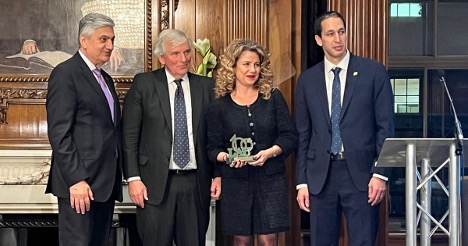 Maktabi also appealed to attendees to support LAU and Lebanon, as “it is our mandate to keep education institutions in Lebanon on their feet during these trying times.”
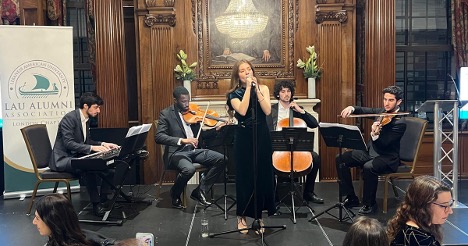
Musical Theatre Artist and alumna Dona Atallah (BA ’22) was joined by pianist Sami Saade and violinist Leyth Almani for a performance at the event that was supported by the Peace and Prosperity Trust.
An Act of Kindness Initiates a Full-Fledged Relief Operation
Five USAID scholars unite and launch a humanitarian aid project, translating their civic engagement skills and passion into real-world impact.
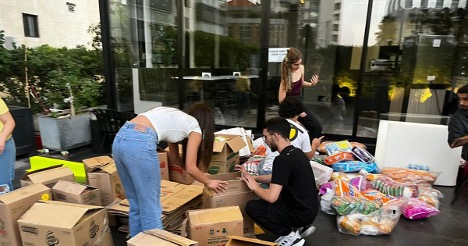
Back in September, as the war disrupted classes and confined students to their homes and dormitories, Elise Moussa, Mayssa Merie, Farah Ktaish, Farah Nassar and Tala Hareb—all USAID-Higher Education Scholarship Program (USP) scholars—chose to channel their feelings of helplessness into action.
Despite the escalation in their hometowns in the south, this group of like-minded altruistic LAU students came together to help alleviate the hardships of hundreds of displaced individuals in Beirut. Pooling their limited resources, they began distributing water bottles and cakes to families sheltering in the Manara area of Beirut.
Encouraged by the gratitude they received, they formalized their efforts and founded Youth for Lebanon, a humble initiative aimed at providing essential food, water and hygiene products to those in need.
“We organized ourselves into functional teams: tech, media, design, finance, outreach, management and logistics,” explained Moussa, a third-year marketing student at the Adnan Kassar School of Business and one of the five co-founders of the initiative responsible for its media communications.
To ensure transparency, the group created public spreadsheets to track every cent donated, detailing the types and quantities of items purchased and their recipients. “We maintain a well-organized system of collaboration, meeting three to four times a week—both online and in-person—to divide tasks, set priorities and monitor progress,” explained Nassar, a third-year marketing student responsible for the project’s logistics.
In just three months, the group exemplified the power of collective effort by raising over $2,000, enabling the distribution of more than 120 meal boxes, feeding approximately 1,200 individuals, and delivering over 100 hygiene kits.
“The drive to make a difference—even in the smallest way—became our guiding force,” said Merie, a third-year psychology student, who connects with families in need, understanding their specific requirements while coordinating with her team members to ensure they receive the necessary items.
Additionally, the group drew on their diverse educational backgrounds and the experience gained through the Community Service & Engagement (CSE) program at LAU, which equips students, including USAID scholarship recipients, with the tools, opportunities and guidance needed to excel academically and become active, compassionate and socially responsible leaders within their communities and beyond.
“Since our first year at LAU, the CSE program has encouraged us to engage in social responsibility and volunteering,” Kteish, a third-year banking and finance student who took care of the project’s finances, shared. She added that “having volunteered for over two years, co-founding Youth for Lebanon became much easier as I was already used to this type of work.” She also noted that the program had supported their efforts by featuring their initiative in its magazine, helping to raise awareness and broaden their outreach.
When it came to balancing the project’s growing demands and their academic responsibilities, the group decided to have joint study sessions, a shared space that allowed them to emotionally process the ongoing crisis while staying focused on their studies.
“We used to have study nights, half of which were spent studying and the other half discussing Youth for Lebanon,” said Hareb, a third-year computer science student who was responsible for setting up the project’s website. In addition to her tasks, she also shared duties with other members, including packing and delivering donation boxes.
Now, as the situation has shifted with people returning to their homes, the team has quickly embarked on a new mission: clearing up the spaces that had served as shelters.
Need-Based Financial Aid
At LAU, we believe that all eligible students deserve an excellent education, regardless of financial limitations. LAU allocated a generous budget, possibly the highest in the region, for financial aid and scholarships for the upcoming academic year. LAU is committed to helping you fund your education regardless of your nationality, race, gender, religion or ethnicity.
We encourage you to apply for financial aid as early as possible.
Financial Aid is a package composed of the following elements:
LAU Grants
LAU provides the following grants to students who fall into the bottom 20% of household income groups:
LAU Grants: Awarded to students showing an element of need in accordance with specific need categories.
Hardship Grants: Awarded to students with extreme need. The grant may cover up to 100% of the students’ tuition.
Triplets Grant: This is an additional percentage that may be given to triplets demonstrating financial need and enrolled simultaneously at LAU.
Program Grants: Awarded to students majoring in programs requiring special promotional support in line with university enrollment goals.
Special Grants: These grants are awarded to selected students according to special agreements approved and signed by the LAU President and external donors or organizations. Applications, if required, are to be filled in the initial stage only.
Donors’ Grants
These grants are created through the generous donations of LAU benefactors.
- LIFE Annual Scholarship:
- Scholarship amount: To be determined by the donor
- Eligibility: Open to Lebanese students with high academic standing demonstrating financial need and enrolled in one of the following majors: Business (excluding marketing), Economics, Engineering, Computer Science, Bioinformatics, or Mathematics
- Selection process: recipients will be selected by the donor.
- Duration of grant: renewed until graduation if eligibility is maintained
- Application: Apply for this grant through LIFE
- Tomooh/PepsiCo Scholarship
- Scholarship Amount: To be determined by donor
- Eligibility: Students demonstrating financial need. Open for all majors
- Selection process: recipients will be selected by donor
- Duration of grant: renewed upon the discretion of the donor
- Application: Apply for the Tomooh/PepsiCo Scholarship
- Deadline: Passed
- The Alexis & Anne-Marie Habib Scholarship
- Scholarship Amount: To be determined by donor
- Eligibility: Open to Lebanese students with high academic standing demonstrating financial need. Open for all majors
- Selection process: recipients will be selected by donor
- Duration of grant: renewed upon the discretion of the donor
- Application: Apply to Habib Foundation Scholarship
- The Centre of Lebanese Studies Scholarship
- Scholarship Amount: Full or partial coverage as determined by donor
- Eligibility: Open to students normally living in Lebanon with high academic standing demonstrating financial need. Only for Social Science & Humanities Majors
- Academic Level: Undergraduate students in their final year or accepted to a Master’s program at LAU
- Selection process: recipients will be selected by donor
- Duration of grant: 1 year
- Application: Apply for the Center of Lebanese Studies Scholarship
- KANIA COLLECTIVE Annual Scholarship
- Scholarship amount: To be determined by donor
- Eligibility: Open to Lebanese students who have completed at least 66% of their program demonstrating financial need to complete their studies.
- Selection process: recipients will be selected by the donor.
- Duration of grant: Until graduation if eligibility is maintained.
- Application: Apply for this grant through KANIA COLLECTIVE
Educational Loans
LAU is the only educational institution in Lebanon to offer educational loans as an additional financial support for its students.
The educational loan helps plan the financing of up to 10% of tuition fees. It carries zero interest while the student is registered at LAU, and a minimal interest rate (usually half the market rate) after he/she graduates, with a grace period of 9 years.
The loan does not replace financial aid; it is in addition to the financial aid package that students receive.
US Federal Aid
US Federal Aid: are fixed-rate student loans from the US Department of Education for undergraduate and graduate students attending university at least half-time. Subsidized, Unsubsidized, and PLUS loans can be granted to students from the United States of America who choose to study at LAU. View the details of the US Federal Aid.
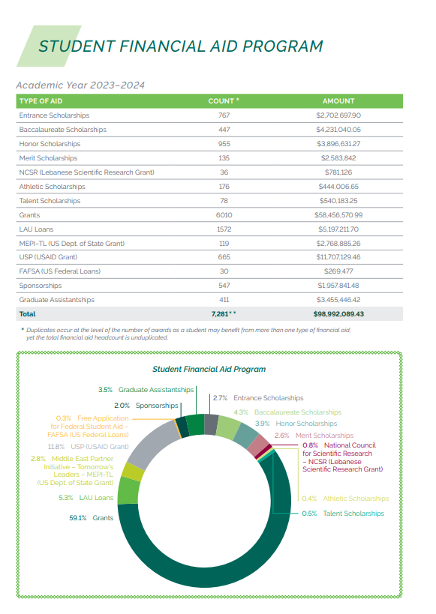
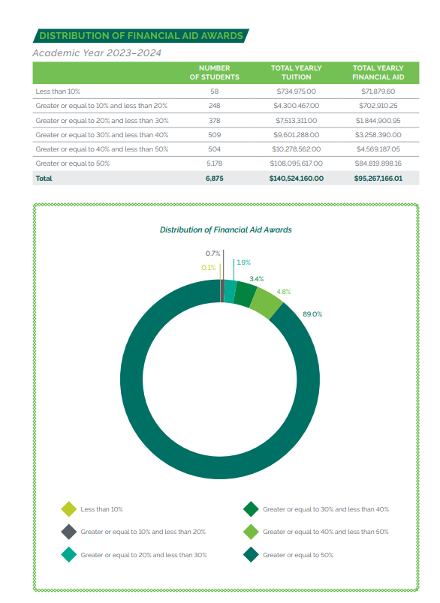
Financial Aid Granted to students AY 2023-2024
The following figures are drawn from the LAU Fact Book for the Academic Year 2024–2025, which provides verified institutional data and statistical information about the university. The presented data specifically relate to financial aid and reflect LAU’s official reporting for that academic year.
USAID Higher Education Scholarship Program
USAID provides merit-based scholarships to financially needy and academically eligible public school graduates from across Lebanon, including the most disadvantaged corners of the country. These scholarships enable students, often from marginalized families that would otherwise have no possible means to attend these schools, to study at the highest-quality Lebanese universities. These universities offer an American-style education that promotes critical thinking, leadership skills and community service.
Our impacts in this sector include:
- A higher education scholarship program that provides full, four-year scholarships to more than 600 Lebanese public school graduates.
- Grants awarded through the National Academies of Science to five Lebanese scientists from prominent Lebanese universities to complete specialized research on water and air pollution, wildfires and landslides. The grants promote direct cooperation with American scientists and access to cutting-edge research as part of the Washington-based Partnership for Enhanced Engagement in Research (PEER).
Our Programs
University Scholarship Program
(USP)
For Lebanese Nationals
Refugee/Displaced Scholarship Support (RSS)
For Non-Lebanese Nationals
MEPI Tomorrow’s Leaders Program
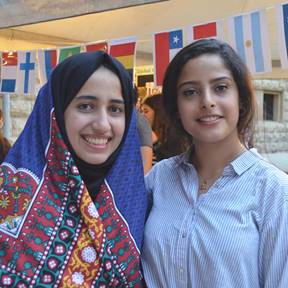
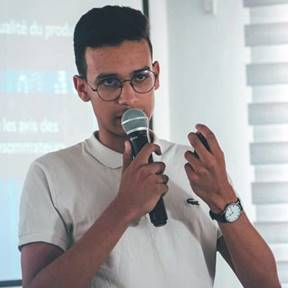
The Tomorrow’s Leaders Program (TL) is an initiative of the United States Department of State U.S.-Middle East Partnership Initiative (MEPI) that supports capable and highly motivated young scholars from underserved backgrounds in the Middle East and North Africa (MENA) region by providing a fully funded undergraduate level academic matriculation, civic education, and leadership development. The full-coverage scholarship aims at investing in Arab youth’s unexplored capacity and strengthening their leadership skills to become drivers of change and catalyze social progress in their home community.
The TL program has been implemented and overseen by LAU since its launch in 2008.
Programs for Future Students
|
TL Undergraduate Program (TLU) Scholarships for high school students |
TL Graduate Program (TLG) Scholarships for master’s programs |
Programs for Current Students
|
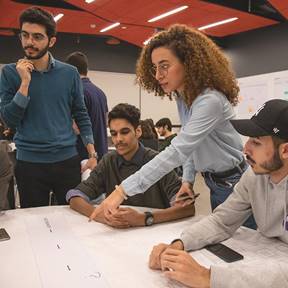
TL Gender Scholars Program (TLS) Scholarships for currently enrolled LAU students |
TL College to Work Pipeline (TLP) Helps TL students find meaningful employment in the region upon graduation |
Students interested in learning more about applying to LAU should get in touch with the Student Recruitment Office.