Open Events to the Public
LAU frequently hosts events open to the general public. These events include public lectures, workshops, conferences, art exhibitions, and cultural performances. These initiatives foster intellectual exchange, community engagement, and cultural enrichment, making LAU a vibrant hub for learning and creativity.
As a middle-school or high-school student, you will find in these programs a launchpad to build leadership, research, debate, public speaking, problem-solving, and writing skills — all essential tools to help them succeed academically and professionally. Through these programs, and since 2005, the university has helped empower a generation of youth leaders.
Use of LAU Facilities also extends to alumni
Active alumni (i.e. having a membership and ID) are entitled upon presentation of the membership cards, alumni are also entitled to the following benefits on both campuses.
General Visitors:
The LAU Libraries exist primarily to meet the needs of the students, faculty and staff of Lebanese American University. We also regularly serve alumni and special guests of the university.
Other visitors are welcome to use the Libraries’ on-site facilities and resources for research and educational purposes, generally for limited periods of time depending on individual need.
Visitors from other institutions in Lebanon or abroad working on a special research, Ph.D. or masters’ thesis project are entitled to subscribe (for a fee) to the Library after providing a formal letter from their institution proving the field of study and specifying the time needed to use the Library.
Once the guest’s eligibility status is confirmed and approved by the Library administration and the subscription fee is paid at the Business Office, the LAU Security Office will be informed in order to facilitate the guest’s entrance to the Library.
Exceptional cases will need the approval of the Library Director and the Provost.
Library staff will assist visitors in using the Library’s resources as time and workload permit.
To facilitate the on-site use of materials photocopy machines and scanners are provided at various locations inside the Library.
The computers in the Libraries are for use by LAU students. Their primary purpose is for academic applications, with an emphasis on Library-related applications such as searching the online catalog, electronic resources or other online research activities. Questions may be directed to the Circulation Desk staff.
Visitors’ Library privileges may be terminated at the discretion of any librarian for violation of policies, disruptive behavior or any activity deemed detrimental to the Library or our primary users.
Focus and Scope: Al-Raida Journal
Al-Raida, The Pioneer, is a bi-annual interdisciplinary semi peer-reviewed journal published by the Arab Institute for Women (AiW) at the Lebanese American University (LAU) in Beirut, Lebanon. Access to these educational papers published is open to the general public.
The Institute strengthens research on and by women in the Arab region at national, regional, and international levels and provides much-needed perspectives to global discourses on women and gender equality in the Arab region. Al-Raida is the Institute’s signature journal, and has been in publication since May 1976.
Aqlam Publications
The Arab Institute for Women regularly publishes scholarly papers and action research on topics across a wide range of disciplines pertaining to women’s empowerment and gender equality in the Arab region. Within this framework, AiW aims to widen the scope of research on women and gender issues, both in the Arab region and in the Arab diaspora. Access to these educational papers published is open to the general public.
 For Aqlam: Occasional Paper Series, AiW welcomes submissions from academics, researchers, activists, and practitioners on current issues related to women’s rights and gender equality wthin the Arab world.
The AiW Aqlam Submission Guidelines can be requested from aiw@lau.edu.lb.
- Aqlam Publications in 2016
- Aqlam Publications in 2017
- Aqlam Publications in 2018
- Aqlam Publications in 2019
- Aqlam Publications in 2020
- Aqlam Publications in 2022
- Aqlam Publications in 2023
Simulation Programs Close Off Another Youth Leadership Development Year
MUN, MAL and MEU recognize their top delegates and celebrate ever-growing programs.
Since 2005, LAU’s simulation programs have become a staple of student leadership across Lebanon, led by the university’s Outreach and Civic Engagement (OCE) Department. On Sunday June 16, Beirut campus buzzed with excitement as the programs’ school students, LAU student-secretariat, faculty, staff, representatives from non-profit organizations, and parents arrived to celebrate the closing of Model United Nations (MUN), Model Arab League (MAL) and Model European Union (MEU).
- Speaking at the ceremony, Assistant Vice President for OCE Elie Samia declared that “we have built bridges for optimism, connection, and diplomacy, from Sidon, to Beirut and Byblos and all the way to New York City.” To the sound of echoing cheers from the audience, he announced that an additional program, the Model African Union (MAU), will be introduced next year.
- Samia further commended the delegates for well-earned 569 awards as well as 212 university scholarships. Addressing the students, Samia called on them to embrace the age of “SMAC: that is, you becoming Social, Mobile, Analytic and Cloud – meaning digitally connected.”
- The three secretary generals for each of the programs then spoke about the collective efforts it took to reap success, and recognized members of their secretariat and student awardees for their hard work.
- The program with the highest reach, and the biggest MUN cohort worldwide, Global Classrooms LAU MUN trained 3,300 students this year on both campuses under the slogan “We Believe in YOU(TH).” Secretary General Alec Hagopian thanked advisors for “having faith in student leadership,” and affirmed that for a program that “loves to fall in love with problems, it has inspired students to come out with innovative solutions of their own.”
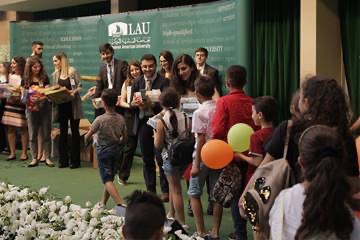 |
The three simulation programs initiated a drive to “Plant a Smile on a Child’s Face.” The donations collected from student-delegates and their schools were used to buy toys for orphans from Dar Al Aytam Islamiya, Maytam Saida and SOS. |
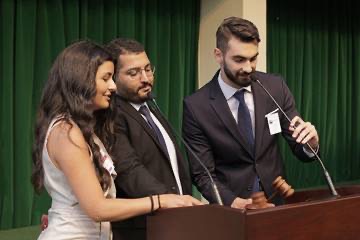 |
The three secretary generals strike their gavels announcing the year’s closing: (From left) MAL Secretary General Maya Makarem, MEU Director General Mohamad Ali Kalassina and MUN Secretary General Alec Hagopian. |
- For MAL, the theme for the year was Reviving Arab Leadership and has included 1,300 students who trained at LAU Beirut and the LAU Outreach and Leadership Academy (OLA) in Sidon. Secretary General and LAU alumna Maya Makarem spoke in Arabic in line with the program’s call for preserving the Arab identity. She dubbed the simulation programs a school of thought that leaves a mark of civic responsibility in each of its veterans, who turn the lessons they’ve learned into life-long convictions.
- As for MEU Director General Mohamad Ali Kalassina, every single region in Lebanon has potential to become “a standard for diplomacy, an example for democracy, a hub for diversity, and a stage for development.” This year, MEU ran its training in both English and French across both campuses and trained 500 delegates.
- Walking in procession, school students received numerous awards and certificates, which were presented by members of the LAU student-secretariat of the corresponding program.
- The ceremony also featured a performance by Rudy Abi Hanna from Sagesse Brasilia School, and was emceed by Sarah Boustany, who was the deputy secretary general for GC LAU MUN.
LAU Simulation Models
LAU Simulation Models are entirely student-led and organized. The training content is prepared, delivered and managed by LAU students – themselves a large, diverse group of motivated youth who are majoring in different disciplines but united in their vision and mission to promote youth leadership. They meticulously manage school relations, prepare the training content that they deliver, provide technical support, organize special events within the programs, and ensure that the work runs seamlessly. These programs target more than 3,000 school students from all over Lebanon on a yearly basis.
The physics program organizes summer camps for high school students (Grade 11), offering them a unique opportunity to explore captivating subjects such as electromagnetism, Einstein’s theory of relativity, and quantum physics. Moreover, the camp delves into a wide range of energy resources and technologies, encompassing fossil fuels, nuclear power, hydropower, geothermal energy, wind power, and solar energy. The camp is designed to provide an immersive learning experience through interactive lectures, experiments, and documentaries. In addition, students conduct a residential energy audit, uncovering best practices for reducing their carbon footprint
Youth Leadership Simulation Programs
As a middle-school or high-school student, you will find in these programs a launchpad to build leadership, research, debate, public speaking, problem-solving, and writing skills — all essential tools to help them succeed academically and professionally. Through these programs, and since 2005, the university has helped empower a generation of youth leaders.
The Impact Since 2004
300 Participating high schools
15,765 LAU student leaders
62,905 High school student leaders
By Students, for Students
All five LAU Simulation Models are entirely student-led and organized. The training content is prepared, delivered and managed by LAU students – themselves a large, diverse group of motivated youth who are majoring in different disciplines but united in their vision and mission to promote youth leadership. They meticulously manage school relations, prepare the training content that they deliver, provide technical support, organize special events within the programs, and ensure that the work runs seamlessly.
Many LAU student leaders are selected to participate in the annual Global Classrooms International Model United Nations Program in New York City, which brings together middle school and high school students from all over the world to role-play and train as ambassadors.
Through the Simulation Programs, You…
Step into the shoes of ambassadors
You learn how international diplomacy works.
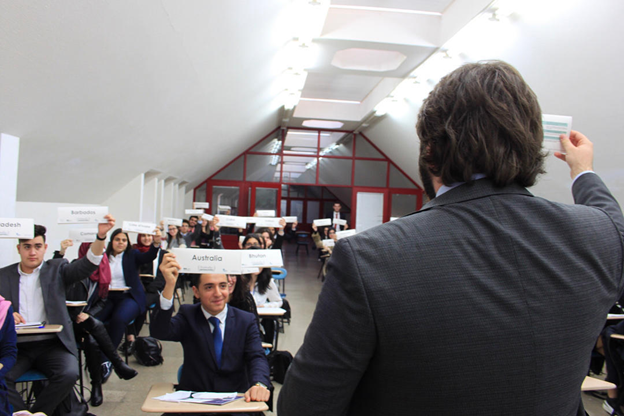
Get hands-on training
For a few months, you come to LAU to get training in research and interpretation, rules of procedure, writing position papers, public speaking, role playing, conflict resolution, negotiations, caucusing, and more.
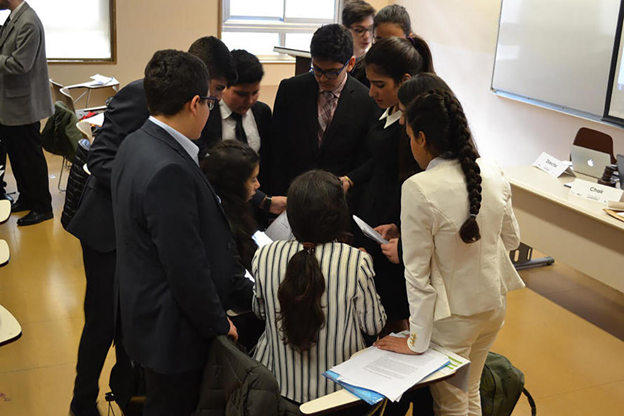
Learn technical skills
You’ll have fun and learn about procedures, institutions, functions, human rights, and inter-cultural dialogues.
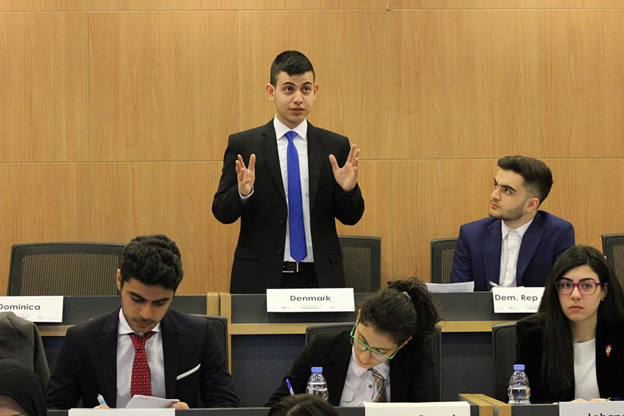
Turn theory into practice
It ends with a big conference where you take the role of an ambassador from a country and get involved in a current issue or situation.
Two-minute tour of LAU simulation programs
A preview of the middle and high schoolers’ experiences across the LAU Youth Leadership Simulation Programs.
Why Take Part in LAU’s Simulation Programs?
You will immerse yourself in the culture of the United Nations, Arab League, European Union, African Union and Good Governance. You will come out of the programs stronger at:
Art of Public Speaking
Dynamics of Debate
Tactics of Role-Play
Process of Conflict Resolution
Essence of Research
Your doorway to a scholarship
In line with its vision to seek and reward talented students, LAU allocates 50 and 25 percent scholarships every year to middle and high schoolers who show exceptional skills in the simulation programs.
Our Flagship Programs
Ever year thousands of middle and high schoolers flock to both LAU campuses to take part in the simulation programs. Find out more and choose the program that is right for you:
Global Classroom International Model United Nations (GCI MUN)
Global Classroom LAU Model United Nations (GC LAU MUN)
LAU Model Arab League (LAU MAL)
LAU Model European Union (LAU MEU)
LAU Model African Union (LAU MAU)- Not offered this year
This program empowers our LAU students by entrusting them to manage, assess, and modify huge educational and leadership events for maximum impact. Our students become administrators, teachers, IT experts, accountants, mentors, public speakers … In brief, they become confident, inspirational leaders. The skills they practice will be with them their entire lives, so it’s no surprise that they land top jobs, get into leading universities and are the recipients of global awards.
Dr. Elise Salem, Vice President for Student Development and Enrollment Management
Contact Us
Academy of Continuing Education
Mission & Vision
The Lebanese American University Academy of Continuing Education (LAU ACE) marshals LAU by encompassing all schools in reaching out to communities for the purpose of adult education, professional enhancement, applied research and impact creativity. Through LAU ACE, LAU as an institution of higher learning is committed to community engagement on the broadest scale, in the interest of sustainable knowledge driven by socio-economic developments.
Vision
LAU ACE aims to improve the quality of professional and personal lives by promoting knowledge, skills, and educational opportunities through the delivery of impactful lifelong learning for individuals, companies, and communities.
Mission
Through building and constantly nourishing links with multiple communities of practice, LAU ACE’s mission complements LAU’s by providing state-of-the-art academic and technical training for lifelong learners in the form of courses, workshops, diplomas, and professional certifications, leading to the betterment of employment opportunities or improvement of job performance, reflected in both personal and professional growth, across Lebanon and the region.
Core Values
Educational Excellence: in tandem with LAU’s vision, we provide a superior educational experience to our learners in terms of faculty selectivity, content quality, and service excellence.
Flexibility and Adaptability: we regularly update our offerings to reflect socio-economical changes in the marketplace. Additionally, we provide flexible solutions, schedules, and locations to cater to our learners’ needs.
Learner Centricity: we put our students first; we provide them with all the support needed, we listen to them and take their feedback seriously with the aim of enhancing the overall learning experience.
Innovation: we encourage innovation and creativity. We anticipate changing demands that might reflect on our courses in order to provide the most innovative learning solutions.
Social Responsibility: we collaborate with different NGO’s and organizations on many levels as part of our contribution to corporate social responsibility initiatives.
Summer and Boot Camps
LAU SoAS Summer and Boot Camps
Exploration, Learning, and Innovation at the LAU School of Arts and Sciences Summer and Boot Camps!
For an unforgettable summer experience that combines learning, creativity and hands-on exploration, The School of Arts and Sciences at LAU invites middle school and high school students every year to dive into an exciting selection of summer and boot camps designed to spark curiosity, enhance skills, and provide real-world experiences in cutting-edge fields.
With expert faculty, state-of-the-art facilities and engaging activities, our summer and boot camps are the perfect opportunity for students to gain valuable knowledge, develop leadership skills, and have fun with like-minded peers. Whether the students are passionate about science, technology, the arts or global diplomacy, there’s a camp for it!
Why Join an LAU Summer/Boot Camp?
- Hands-on Learning – Engage in interactive experiments, workshops and real-world applications.
- Scholarships – Win up to 30% scholarships toward your chosen major at LAU.
- Top-Tier Faculty – Learn from LAU’s distinguished professors and industry professionals.
- Cutting-Edge Facilities – Work in state-of-the-art labs, media studios and research centers.
- University Experience – Get a taste of college life at LAU’s Beirut and Byblos campuses.
- Expand Your Network – Connect with passionate students who share your interests.
- Lifelong Connections - Build friendships and networks with like-minded peers from diverse backgrounds.

Action: TV and Film Summer Camp
Beirut campus

Bioinformatics Boot Camp
Beirut Campus
Byblos Campus

Chemistry Summer Camp
Byblos campus
 Code and Fly: The Drone Programming Experience Boot Camp
Beirut campus
 Drama Queens and Kings: Theater Summer Camp
Beirut campus
 Game and Code: Computer Science Boot Camp
Beirut campus
 Live Broadcasting Summer Camp
Beirut campus
 Math, Music and AI Summer Camp
Beirut campus
 Model United Nations (MUN) Diplomacy Summer Camp
Beirut & Byblos campus
 Nourish and Learn: Nutrition and Food Science Summer Camp
Beirut campus
 Physics Summer Camp
Beirut campus
 Pre-Medical Boot Camp
Beirut & Byblos campus
 Psyched for Success: Psychology and Education Boot Camp
Beirut campus
 Public Speaking Summer Camp
Beirut campus
 Renewable Energy Boot Camp
Beirut campus
 The Write to Heal: Creative Writing Summer Camp
Beirut campus
High Schoolers Dive Into STEM at Engineering Summer Camp
Two hundred high-school students from local and international schools experience LAU’s collegiate life by exploring its engineering disciplines and building connections with peers and faculty.
By Sara MakaremJuly 15, 2024
Preparing leaders for a future of complex challenges begins with inspiring young minds. To that end, the School of Engineering organized its second annual LAU Discover Engineering Summer Camp, where aspiring high-school students spent a week at the Byblos campus, gaining first-hand experience in various engineering disciplines while getting a feel of LAU’s vibrant college life.
From June 23 to July 24, the school dedicated its resources—including the drilling simulation lab, mechatronics lab, experimental fluid dynamics lab, and many more—to 200 high-school students, divided into five cohorts, from Lebanon and abroad.
The initiative aimed to instill in students a lasting interest in STEM (science, technology, engineering and mathematics) by engaging them with real-life applications and ultimately helping them choose their ideal engineering major.
Associate Dean Caesar Abi Shdid, Principal Engineering Lab Supervisor Nicole Jureidini Wehbeh, along with a team of current engineering students and LAU faculty and staff, ensured the seamless execution of lab and entertainment activities and lectures for the participants. These sessions provided theoretical knowledge and technical skills essential for a career in engineering.
Furthermore, working in teams of four, the students participated in an engineering design competition, evaluated by faculty throughout their stay, which aimed to enhance their problem-solving and critical thinking abilities.
“Since I was a kid, I enjoyed building things,” said Kelly Ziadeh, a grade 11 student who also won first place with her three team members. “We worked on many interesting projects, such as concrete buildings, robot grippers and airplane wing designs.”
According to Associate Professor and Associate Dean of the School of Engineering Caesar Abi Shdid, many students go into engineering without knowing what it involves. “Attending lectures by the faculty and getting hands-on experience in labs, such as those offered at the camp, help them make better-informed decisions,” he added.
Dr. Michel Khoury, the school’s dean, encouraged the students to challenge themselves and hoped that the experience they gained at the camp would further inspire their interest and curiosity in the field.
“I hope that what you’ve done at the School of Engineering has really sparked your interest and curiosity,” he said, addressing the participants at the closing ceremonies, “and you are walking out today with new horizons, new aspirations and insights about what each engineering field entails.”
In addition to sports activities, games and field trips, students enjoyed an informal barbeque gathering with faculty and staff, which helped them develop a stronger affinity with both the university and its community.
The Rewarding Experience of Summer Camps
The School of Arts and Sciences’ summer camps aimed to give high-school students a head start in their chosen field of study at LAU.
By Luther J. Kanso July 19, 2024
As the university prepares for a new academic year, the School of Arts and Sciences (SoAS) rolled out a series of interdisciplinary summer camps designed to offer students a university-level experience and prepare them for a potential education toward their chosen major at LAU.
The camps took place over the course of five days, from July 1 to 5, and were dispersed across different buildings on both the Beirut and Byblos campuses.
Attendance this year surpassed last year’s figures, with more than 100 Grades 10 and 11 participants from schools across Lebanon. Upon completion and assessment of the camp content and participation, students could earn scholarships covering up to 30 percent of their tuition.
This year, 21 students were rewarded for their performance and commitment with scholarships that corresponded to the specific camps they participated in.
In line with its commitment to social engagement and outreach, the school reintroduced three popular summer camps this year, mathematics, public speaking and creative writing, in addition to the chemistry and food science and nutrition camps that take place almost annually.
The structure of this year’s camps was put together by faculty members at the school with two goals in mind: to equip students with practical skills and knowledge that are directly relevant to their prospective careers, and to make the experience as profound as possible.
“I would go as far as to say that the summer camps of 2024 have been some of, if not the most organized camps we’ve had to date,” said Assistant Dean and Associate Professor Robin Taleb, who oversaw their planning. “Not only that, but the content they brought in terms of knowledge and learning was truly impressive.”
For instance, the chemistry camp, which took place on both campuses, offered hands-on laboratory experience where students got to work with advanced chemical instrumentation and conduct multiple experiments. This sort of engagement is crucial for careers in scientific research, medicine, pharmaceutical and industrial processes, noted Assistant Professor Elias Akoury.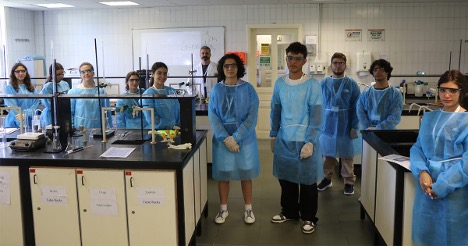 By providing an understanding of the real-world applications of chemistry, students felt more prepared for the challenges of university-level science courses as well as scientific inquiry and industry practices.
Similarly, the nutrition and food science camp in Beirut included workshops and informative lectures on the roles of nutrients and principles of food processing with emphasis on the UN Sustainable Development Goals (SDGs), thereby offering a comprehensive understanding of the field through evidence-based practices and critical thinking.
“The collaborative environment within the camp really prepared us for success in both academic and professional settings,” said high-school student Leen Moussa, who won a 30-percent scholarship for her active involvement in the camp. ”This knowledge is important for careers in dietetics, nutrition and the food industry.”
In the creative writing camp, students were encouraged to develop their literary skills and storytelling abilities by writing non-fiction and fiction pieces inspired by personal experiences, so that they may appreciate the iterative process of writing and build their confidence in articulating their ideas.
“These competencies are beneficial for both academic success and professional communication, and are crucial for careers in journalism, publishing and any field requiring strong communication abilities,” said Instructor Nayiri Baboudjian. “I was happy to see the students feel a sense of catharsis and safety in expressing themselves at our university and can only hope that they get to experience that daily when they enroll.”
Participants in the public speaking camp which had the highest number of students, were trained in persuasive communication and effective presentation techniques for careers involving public interaction.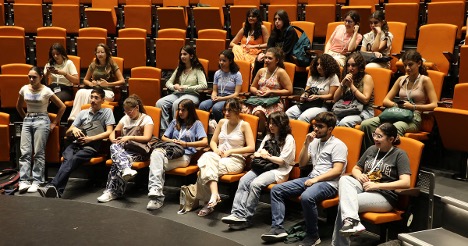
By mastering persuasive speaking and learning to manage stage fright, said senior instructors Hala Daouk and Dana Eido in a joint statement, students became more confident and articulate speakers. “These skills are highly needed in university settings, where presentations and group discussions are frequent, and in professional environments where effective communication is key to leadership and success,” they added.
Student Roy Anthony Mawad, who also won a 30-percent scholarship, particularly enjoyed speaking and connecting with people in an age mostly dominated by artificial intelligence where human interaction is minimal, he said. “Developing my soft skills both practically and theoretically has pushed me to go beyond what I thought I could do,” he added.
Over at the mathematics camp, the instructors introduced students to complex numbers and their applications and guided them through analytical theories and problem-solving skills.
In addition to these foundational skills for careers in engineering, finance, technology and quantitative analysis, “exploring advanced mathematical concepts and their practical applications helped develop the students’ understanding of the subject’s relevance to various fields in the industry,” said mathematics graduate Hedi Jaza (BS ’24), who helped give courses to the students alongside President of the Mathematics Club Mahabba El Sahili.
“We also wanted to make math entertaining,” El Sahili said, “and teach everyone how to approach the subject in ways that they wouldn’t otherwise learn at school.”
In a fitting end to a series of enriching educational experiences, the camps concluded with an awards ceremony at the Adnan Kassar School of Business, attended by the camp participants and faculty members.
Summer Camps: Enhancing High Schoolers’ Learning Experience
The School of Arts and Sciences offers 11th graders university-level online courses and partial scholarships.
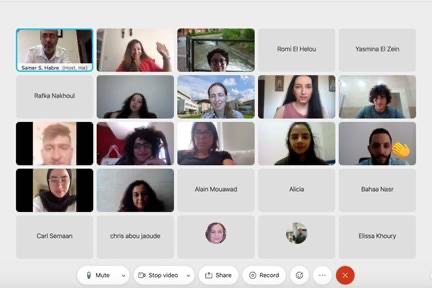
LAU’s School of Arts and Sciences (SoAS) held the ninth edition of its summer camps online, attracting enthusiastic students from across Lebanon to learn about their favorite subjects in a stimulating and interactive environment.
The camps are among the school’s social engagement and outreach activities that aim to inform Grade 11 students about education opportunities during a week of university-level courses offered in subjects of their interest.
The free camps spanned translation, English creative and speech writing, computing, nutrition and food science, chemistry and the newly added mathematics.
By the end of the week, up to six students from each camp won partial scholarships to LAU for their final projects.
The high schoolers’ attendance, despite the deteriorating situation and constant power cuts, was commended by SoAS Dean Cathia Jenainati.
“There are many reasons why many of you could have dropped out of the camp. There are many reasons why this could not go on,” she said during the online closing ceremony. “But despite all of this, here you were. You enjoyed the camps and our dedicated instructors as usual turned up to run them.”
It is the young people’s “strong spirit,” added Dr. Jenainati, that enriches education. “We are feeding on your spirit, your enthusiasm, your hope and your dedication and all of that energy that you bring to us.”
Thanking them for their participation, Dr. Jenainati pointed out that the camps reflected “one percent of the kind of fun and intellectual engagement you will have at LAU were you to join us in the future.”
Assistant Dean Samer Habre reaffirmed the school’s commitment to the summer camps regardless of the dire conditions in the country, hoping they would be “a learning curve for the students and also a rewarding experience in terms of the knowledge they gain and in terms of the scholarships they win.”
Each camp introduced the participants to principles of the subject they are studying.
In chemistry, campers discovered diverse experimental procedures, virtually isolated natural products and synthesized medicinal active ingredients. In the nutrition and food science camp, modules included macro and micronutrients, energy balance and weight regulation, nutrition-related diseases, physical activity, eating disorders and food safety.
“I was so surprised,” said Emma Sleiman, a chemistry camper. “Who would have thought that during only five days, you, professors [Elie] Akoury and [Brigette] Wex, have succeeded in giving us the vision, and that vision is seeing ourselves as chemists.”
A student in the nutrition and food science camp, Rasha Saad, expressed her gratitude for the opportunity to take part in the course, describing it as organized and informative.
“The information I learned from this was not just applied; it was one that I could talk to other people about, as nutrition is a part of our lives,” she said, adding that the camp was also an opportunity to share a class with students from across the country.
Instructors from the Department of Computer Science and Mathematics introduced students to Python – one of the most commonly used programming languages – and in Logic and Proofs covered the rules of logic in distinguishing between valid and invalid mathematical arguments.
“This experience with LAU was very engaging, intensive and very challenging,” said computing student Ghassan Abboud. “There was some advantage to it being online because we were able to start coding right away and better understand the concepts involved.”
What he liked most about the camp, he added, was the fact that “not only did it teach you how to code in Python, but also how to learn Python on your own, how to figure out the resources.” Experimenting with the actual process of developing an idea, designing the code and fixing any bugs left him with a sense of achievement.
In the newly introduced mathematics camps, Riham Al Bayaa said that despite the poor internet connection, instructors always provided a solution through recorded sessions.
The English speech writing camp trained campers to communicate with better clarity and impact, while the English creative writing sessions were designed to foster an appreciation of literary works and help students refine their creative writing skills.
“I loved the activities, how they challenged you on the spot and how they kept everything on blackboard so that you could always go back to them anytime. Our instructors were more like friends,” said camper Nancy Slim. “I felt I really belonged here, with the groups of amazing students and teachers.”
Last but not least, the translation summer camp familiarized students with a rich array of texts, including journalistic, legal, scientific, technical and business, in addition to some approaches in translation.
“This program introduced us to LAU and the translation camp educated us in different fields and topics, such as coronavirus, fake news and more. It was also a chance to make new friends. It was fun and helpful; I would recommend others to enroll next year,” said camper Roumi El Helou.
The summer camps have proven to be an excellent tool to attract high-achieving students and to provide education opportunities through scholarships.
“Summer camp students who later join LAU, especially the ones who win scholarships, are a sample of the student population we are seeking to expand,” said Dr. Habre.
“Campers have shown since the inception of the camps nine years ago that they rank among the best, earning high GPAs, winning best capstone awards, and being academically engaged in their fields. Many of them have pursued graduate degrees, which attests to their academic excellence,” he added.
International Dance Day Festival in Lebanon
International Dance Day Festival in Lebanon
Events:
The 14th International Dance Day Festival - Pulse of Resilience: Where Do We Start?
April 22–27, 2024
LAU Beirut and Byblos Campuses

In recognition of its centennial year, LAU invites you to the 14th International Dance Dav Festival in Lebanon. Join the Department of Communication, Arts and Languages as it brings together artists and enthusiasts from around the world to celebrate the artistry and cultural richness of dance.
Schedule
——————————————
- Monday, April 22, Frem Civic Center, Byblos campus, at 06:00 p.m.
The festival begins with the opening ceremony, The Body I Live In by Zaher Kais, setting the stage for a series of performances and activities that highlight the diversity in the world of dance, with music and vocals by Hiba Radwan.
- Friday, April 26, Gulbenkian Theater, Beirut campus, at 07:30 p.m.
The Gala Performance includes four original pieces that have been specially created to honor LAU’s 100 years of commitment to education.
- Saturday, April 27, from 10:00 a.m. until 09:00 p.m.
The Community Day unfolds with a variety of workshops and events, particularly the Choreography Feedback Session, offered for the first time in Lebanon.
Guests
——————————————
- Dr. Matthew Henley, Associate Professor of Dance Education at Teachers College, Columbia University, USA.
- Prof. Catherine Cabeen, Associate Professor of Dance at Marymount Manhattan College (MMC), USA.
- Dr. Aadya Kaktika, Associate Professor at Shiv Nadar University, India.
“We are a group of people (Dancers, Dance enthusiasts, Supports of the Arts, Educators and so on) who are concerned with Dance and its situation in Lebanon and its exposure to dance abroad. Our goal is to see the Lebanese dance field grow and expand its roots nationally and internationally as well.”
Founder and Director: Dr. Nadra Assaf
Previous Events
International Dance Day Festival in Lebanon 2020: Lockdown edition

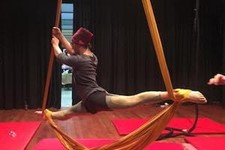
International Dance Day Festival in Lebanon 2019
\
International Dance Day Festival in Lebanon 2018
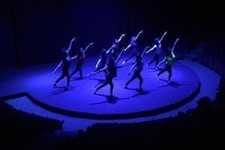
International Dance Day Festival in Lebanon 2017
Gender in Development and Humanitarian Assistance (GDHA) Certificate
Overview
In collaboration with The Arab Institute for Women (AIW) at the Lebanese American University (LAU), the Gender in Development and Humanitarian Assistance (GDHA) Certificate is a continuing education program designed for students, practitioners, and policymakers. The program addresses gender issues in development and humanitarian settings. GDHA innovatively incorporates academic knowledge with high-level expertise to create a new standard in gender education for development and humanitarian professionals. The standards are in-line with internationally-recognized practices. Moreover, the program builds local capacity to address local issues, building a cadre of motivated professionals in the Arab region.
Content
The program involves an active learning approach with practical workshops. It also emphasizes reflective and collaborative learning. Participants may choose to take individual courses or to complete the full set. Upon completion of all ten courses, participants receive a certificate.
Objectives
- Address the full range of gender issues in development and humanitarian contexts
- Build Arab capacity to address Arab development and humanitarian challenges
- Provide technical, marketable skills in gender programming to address gender inequalities
- Establish foundational knowledge in global and regional best practices on gender equality and women’s rights
Contact us
Email: joanna.fayad@lau.edu.lb
Phone: +961 1 786 456, ext. 1106
Free Webinars and Events Archive
2024
7Jun
Graduate Fashion Show: IN SIGHT Ceremonies Corm Foundation, Beirut
4–13Jun
Vick Vanlian Interior Design Awards Competitions | Exhibits Gezairi Art Gallery, Beirut Campus
1Jun
You@LAU - Centennial Edition Fairs & Expos LAU Byblos Campus
29May
LAU Fashion Design OMT Frontliners Uniform Design Competition Awards Ceremony Competitions LAU Beirut, Gezairi Building, Art Gallery
13May
Alien Intelligence: An Introduction to AI for Architects Workshops & Seminars Beirut Campus, Gezairi building, Room 403
23Apr
Saloua Raouda Choucair’s Sculpture Memorial Plaque Unveiling; Exhibition & Book Launch Exhibits Beirut Campus, Orme-Gray Garden, and Art Gallery at the Gezairi Building
29–1 Feb–Mar
Teaching Graphic Design History in/of the Arab World: Narratives and Practices Conferences & Symposia Online
28Feb
Like the Delayed Rays of a Star: A Photographic Installation Exhibits Gezairi Art Gallery
2023
7Nov
An Encounter With Raoul Verney, The Man, The Architect, The Educator Conferences & Symposia LAU Beirut Campus, Gezairi Building, Chafica Balaa Lecture Hall 403
27Oct
Managing Stress in Uncertain Times Webinars Webex
24Oct
Talk to the Experts: Workshop to Help You Cope Workshops & Seminars LAU Byblos campus, Frem 505
23Oct
Talk to the Experts: Workshop to Help You Cope Workshops & Seminars LAU Beirut campus, WKSC 201
19–20Oct
Teaching Graphic Design History in/of the Arab World: Narratives and Practices (Postponed)Conferences & Symposia Online
23Sep
Open Days, Open Doors Fairs & Expos LAU Byblos Campus
16Sep
Open Days, Open Doors Fairs & Expos LAU Beirut Campus
12Jun
Graduate Fashion Show: Real Time Exhibits Gezairi Building Rooftop, Beirut Campus
2May
Institute of Art in the Arab World Inaugural Event Talks Gezairy Building 403 Lecture Hall
9Mar
Celebrating Niemeyer’s Tripoli World Fair Fairs & Expos Beirut Campus, AKSOB 0904
22Feb
Arabic Comics and Conflicts: Ideological Indoctrination vs Individual Need for Change Talks LAU Beirut Campus, Gezairi Building 403
2022
18–26Nov
ROOTING: A Solo Exhibition by Alumna Rana Raouda Exhibits LAU Beirut Campus - Safadi Fine Arts Building - Sheikh Zayed Exhibition Hall
16Nov
Poetics of Structure Webinars Online via Webex
22Oct
Open Days…Open Doors Fairs & Expos LAU Beirut Campus
10–25Oct
X-Tended Reality Competition - Dare to C Competitions Online
24–27Jun
BioFashion Factory ExhibitionExhibits600A, Gezairi Building, Beirut Campus
23Jun
Graduate Fashion Show: Ignite Ceremonies Level 7 - Ground Floor, Gezairi Building, Beirut Campus
21–25Jun
Graphic Design ExhibitionExhibits605, Gezairi Building, Beirut Campus
23–25May
Zero Waste Fashion: An Eco-Design Marathon Workshops & Seminars Beirut Campus
24Mar
DESIGN TO CARE? Webinars Online
17Mar
A History of Arab Graphic Design: Q&A with Haytham Nawar Webinars Online
11Mar
Hidden Portraits & the Pertinence of Individuality Webinars Online
23Feb
On How Things Meet: A Career Introspection Webinars Online
2Feb
Architecture in the Age of Artificial Intelligence: An Introduction to AI for Architects Webinars Online
27Jan
1Jan
Interpretations, Reinterpretations Webinars Online
2021
24Nov
Carrying Images - Thoughts on Graphic Design Webinars Online
11–13Nov
International Workshop Beirut - SynErgy in the City - On DIY Mobility and Energy Infrastructure Conferences & Symposia IUA ALBA, Sin el Fil
3Nov
Infrastructural Webinars Online
27Oct
Counter Mapping & Identity Representation Webinars Online Via Webex
20Oct
How to Look at Architecture? Webinars Online
13Oct
Triggering the Empirical Space Webinars Online Via Webex
29Sep
Neoliberalism, Globalization, and the Ecological Crisis Conferences & Symposia Online Via Webex
22Sep
SUrF Webinars Online Via Webex
16Sep
Dialogues in Time: Light, Time and Architecture in Art Webinars Online Via Webex
9Sep
Art and Architectural Education in Times of Pandemic Webinars Online Via Webex
30Jun
“Rise” Exhibits Online
6May
A Different Kind of Climate Change Webinars Online
29Apr
Digital Fashion Webinars Online Via Webex
23Apr
Architectural Paths Webinars Online
22Apr
Photography as Storytelling Webinars Online
21Apr
Beyond Campus Gates: Redefining the Role of Universities Webinars Online
15Apr
Real Virtuality and Immersive Storytelling Webinars Online
10Apr
Bits to Atoms Webinars Online
10Apr
The Wonderful World of Rana Salam Webinars Online
9Apr
RE: WORK Webinars Online
8Apr
Relevance v/s Difference Webinars Online
1Apr
Flirting with Middle Eastern Modernity Webinars Online
26Mar
OMA / AMO in the Middle East Webinars Online
19Mar
Critical Imaginations Webinars Online
19Mar
Fallen Fashion Webinars Online
26Feb
Beirut-Rotterdam: Complex Urban Recoveries Webinars Online via WebEx
18Feb
Anthony Caro: The Onward of Art Webinars Online
12Feb
Panser la Ville Naturelle Webinars Online
5Feb
Giancarlo Floridi Webinars Online
29Jan
Second Hand Webinars Online
LAU hosts a plethora of educational and entertainment events every year which are open to the public. The events that took place in the academic year 2023-2024 are as follows:
SARD Events:
The School of Architecture and Design at LAU hosts several events at the university that are open to the general public with the majority of such events being lectures. Throughout the academic years 2021–2022, 2022-2023, and 2023-2024such lectures were held as open-to-the-public online webinars and live workshops as follows:- Alien Intelligence: An Introduction to AI for Architects – Beirut Campus, Gezairi Bldg, Room 403 – May 13, 2024
- A History of Arab Graphic Design: Q&A with Haytham Nawar – Online Webinar – Mar. 17, 2022
- Hidden Portraits & the Pertinence of Individuality Webinars – Online – Mar. 11, 2022
- On How Things Meet: A Career Introspection – Online – Feb. 23, 2022
- Architecture in the Age of Artificial Intelligence: An Introduction to AI for Architects – Online – Feb. 2, 2022
- Majoring in Architecture | Graphic Design | Interior Design | Fashion Design | Fine Arts: What You Need to Know – Online – Jan. 27, 2022
- Interpretations, Reinterpretations - Online Webinar – Jan. 01, 2022
- “Art and Architectural Education in Times of Pandemic” Online Webinar — Sept. 9, 2021
- “Dialogues in Time: Light, Time and Architecture in Art” Online Webinar — Sept. 16, 2021
- “SurF” Online Webinar — Sept. 22, 2021
- “Triggering the Empirical Space” Online Webinar — Oct. 13, 2021
- “How to Look at Architecture?” Online Webinar — Oct. 20 2021
- “Counter Mapping & Identity Representation” Online Webinar — Oct. 27, 2021
- “Infrastructural” Online Webinar — Nov. 3, 2021
- “Carrying Images: Thoughts on Graphic Design” Online Webinar — Nov. 24, 2021
- “Interpretations, Reinterpretations” Online Webinar — Jan. 1, 2022
- “Architecture in the Age of Artificial Intelligence: An Introduction to AI for Architects Webinars Online Feb. 2, 2022
- “On How Things Meet: A Career Introspection” Online Webinar — Feb. 23, 2022
- “Hidden Portraits & the Pertinence of Individuality” Online Webinar — Mar. 11, 2022
- “A History of Arab Graphic Design: Q&A with Haytham Nawar” Online Webinar — Mar. 17, 2022
- “Design to Care?” Online Webinar — Mar. 24, 2022
| DA&D Events - 2024 | |||
| Name | Type | Artist | Date |
| INTERFACE-7 | Exhibition | DA&D Students | February 6, 2024 |
| Postnatural Design | Lecture | Filippo Nassetti | February 6, 2024 |
| Like the Delayed Rays of a Star: A Photographic Installation by Heather O’Brien | Discussion and Exhibition | Prof. Heather M. O’Brien-Takahashi-(Southern Illinois University Carbondale, USA) – Professor and Exhibiting Artist, Panelist Presenter | February 28, 2024 |
| - Dr. Nadya Sbaiti- (Georgetown University Doha, Qatar) – Professor, Panelist Presenter | |||
| - Mr. George Hanna- Graphic Designer/Exhibition Design, Panelist Presenter | |||
| - Dr. Yasmine Nachabe Taan-(Lebanese American University) Director, Institute of Art in the Arab World, Panel Chair | |||
| Teaching Graphic Design History in the Arab World: Narratives and Practices | Online Research Symposium | The Institute of Art in the Arab World at the School of Architecture & Design | February 29 and March 1, 2024 |
| In Between by Cristiano Lippa | Lecture | Cristiano Lippa | February 29, 2024 |
| Dans Le Creux Du Chaos | Lecture | Bassam Geitani | March 6, 2024 |
| Troubling the Canon | Lecture | Stephanie Dadour | March 12, 2024 |
| Sailing to Jbeil: Egypt, Lebanon and the Bronze Age Timber Trade | Lecture | Dr. Anna-Latifa Mourad-Cizek | March 15, 2024 |
| From Calligraphy to Typography | Lecture | Rana Abou Rjeily | March 15, 2024 |
| Alien Intelligence: An Introduction to AI for Architects | Lecture | Dr. Neil Leach | May 13, 2024 |
| Sky Diary- A Solo Exhibition | Exhibition | Bettina Khoury Badr | October 3, 2024 |
| DA&D Events-2023 | |||
| Name | Type | Artist | Date |
| Diversity Equity Inclusion | Students Poster Competition | DA&D Students | October 1, 2023 |
| Divergence & Convergence in a Double Diamond World | Lecture | Nivine El Kuzbari | February 16, 2023 |
| ARABIC COMICS AND CONFLICTS: IDEOLOGICAL INDOCTRINATION VS INDIVIDUAL NEED FOR CHANGE | Lecture | George Khoury-Jad | February 22, 2023 |
| Highschool GD Workshop | Workshop | Dahlia Khodur/Araz Kelian | April 3, 2023 |
| The Philosophy of Art & Mysticism in Arabic Calligraphy | Workshop | Nassib Makarem | March 17, 2023 |
| Ornamenting the Everyday | Lecture | Eddie Abd | March 30, 2023 |
| The Fickleness of the Film Strip | Lecture | Ziad Antar | June 4, 2023 |
| Wildlife photography and Conservation | Lecture | Michel Zoghzoghi | April 13, 2023 |
| Interface 5 | FA Graduates Exhibition | FA Graduates | February 5, 2023 |
| Interface 6 | FA Senior Exhibition | FA Seniors | May 15, 2023 |
| The Journey to One’s Self | Lecture | Hayla Saab | May 26, 2023 |
| Maintaining the Chaos in One Self | Lecture | Bernard Haddad | May 26, 2023 |
| Captured Perspectives | Exhibition | Photography Students | September 20, 2023 |
| Brazilian Embassy-Tripoli Fair | Lecture/Presentation | Brazilian Embassy | September 11, 2023 |
| The Big Picture | Lecture | Nathalie Fallaha | November 14, 2023 |
| MAPPING, NARRATING, REPRESENTING AS ACTION | Lecture | Nadine Bekdache | November 21, 2023 |
| Risograph Workshop | Workshop | November 24, 2023 | |
| GRDE 2023 | Exhibition | GD Senior Students | November 28, 2023 |
| Incorporating Diversity & Culture into Graphic Design | Lecture | Diala Nammour | May 12, 2023 |
Faculty Personal and Professional Development
The School and University are heavily vested in supporting the personal and professional development of faculty. These can be through programs that are school-sponsored, LAU’s Office of Graduate Studies and Research and Center for Innovative Learning, partnerships such as with the National Council for Scientific Research, and with funds allocated by the school research committee for faculty research, training, attendance of professional meetings, and reimbursement of publication fees. Application to these grants follow the guidelines of the School Research Committee.Professional Development Committee
The Professional Development Committee is composed of representatives of School administrators, full-time and adjunct Faculty and staff. Its main duties are to identify the professional development needs of faculty and preceptors, and coordinate the delivery of continuing education and professional advancement activities.
School-Sponsored Professional Development Seminars and Workshops
| Topic | Date |
| Assessment Best Practices-Updates from the UAE Workshop | 13/11/2024 |
| Best Practices in Online Education | 30/10/2024 |
| Virtual Training on FreeStyle Libre Continuous Glucose Monitoring (CGM) Kit | 29/10/2024 |
| Bioequivalence and Generic Drug Products: Scientific and Regulatory Considerations | 22/10/2024 |
| Maximizing Accesspharmacy for Pharmacy Education and Practice | 08/10/2024 |
| A Glimpse of Health Economics: The Science of Choice and Incentives in Health and Healthcare | 12/09/2024 |
| AI in Pharmacy Education - Updates from the AACP AI Institute | 28/05/2024 |
| Navigating the Future of Pharmacy: An Introduction to Health Informatics and Digital Health | 23/04/2024 |
| The Role of Nonclinical Testing in Drug Development | 16/04/2024 |
| Introduction to Digital Health: Evolution, Impact, and Challenges | 08/04/2024 |
| Building Resilience and Developing a Growth Mindset | 14/03/2024 |
| Clinical Paths in the Modern Treatment of Multiple Sclerosis | 13/02/2024 |
| Supporting DEIA at LAU’s School of Pharmacy | 07/12/2023 |
| Knowing Self & Others (Johari Window Model) & Receiving Constructive Feedback | 30/11/2023 |
| Self-reflection in Healthcare Settings: Aims & Practices | 20/11/2023 |
| DEIB: Addressing Microaggressions in Clinical Education & Practice | 09/11/2023 |
| Digital Health in Clinical Settings | 31/10/2023 |
| Cancer Immunotherapy Research | 26/09/2023 |
| Real world evidence as a tool to inform decisions throughout the lifecycle of medicines: A perspective from the pharma industry | 17/05/2023 |
| Lebanese Army Healthcare System and Pharmacy Services | 28/04/2023 |
| Dealing with Imposter Syndrome | 04/04/2023 |
| Drug Development in the US | 31/03/2023 |
| Cochrane Reviews | 28/02/2023 |
| The Power of Low-Ego, High Drive Leadership: Humbitious | 16/02/2023 |
| Tools for Preceptors to Turn Challenges into Opportunities | 12/10/2022 |
| Cultural Competency: A must to Optimize Care in a Diverse Healthcare System and Patient Population | 11/04/2022 |
| Clinical Updates in Heart Failure | 15/03/2022 |
| Clinical Updates in Diabetes | 07/04/2021 |
| Role of Pharmacists in Crisis / COVID-19 | 14/01/2021 |
| Antimicrobial Resistance and Stewardship in the Era of a Pandemic | 03/12/2020 |
| IPE education: best practices for curriculum integration, assessment & accreditation | 16/11/2020 |
| Online course delivery | 08/09/2020 |
| PPCP integration in pharmacy curricula | 26/02/2020 |
| Systematic review | 27/01/2020 |
| Flipped classroom | 11/08/2019 |
| Crucial conversation: giving feedback | 03/05/2019 |
| Power of learning (OCEs-led workshop) | 25/04/2019 |
| Antibiotics refresher* | 29/01/2019 |
| Making IT healthy: medication safety and rise in technology (ACPE CE credits)† | 07/11/2018 |
| The power of innovation | 21/05/2018 |
| Updates in infectious disease-clinical pearls* | 03/05/2018 |
| Evidence-based research: how to design search strategies for systematic reviews | 10/04/2018 |
| Lean Pharmacy management† | 05/12/2017 |
| PCSK9 Inhibitors: where do we stand?† | 05/12/2017 |
| Tips for success in academic publishing | 27/11/2017 |
| Introduction to OSCEs | 18/10/2017 |
| Code of ethics for drug promotion* | 11/04/2017 |
| Clinical (pharmacy) research initiatives* | 06/04/2017 |
| Research design | 13/02/2017 |
| Management of non-small cell lung cancer* | 26/05/2016 |
| Teaching and learning in the 21st century | 13/05/2016 |
| Sedation, analgesia and delirium in the ICU: what’s new?* | 05/05/2016 |
| Insights in simulation-based education | 25/04/2016 |
| Publishing educational papers | 08/04/2016 |
| Quality assessment of publications | 07/12/2015 |
| Pharmacoeconomics† | 03/11/2015 |
| Treatment and prevention of thrombosis* | 29/10/2015 |
| Biostatistics application (series of 7 sessions) | 03/09; 16; 23; 04/20; 05/04; 13; 27/2015 |
| Highlights in antithrombotic therapy* | 26/03/2015 |
| Management of febrile neutropenia* | 29/01/2015 |
| Ebola virus disease† | 29/01/2015 |
†Held at the Annual Preceptors Appreciation Event.
Professional Development Resources
Faculty Development in Teaching
Faculty Development in Clinical Skills
Faculty Development in Soft-Skills / Leadership
Faculty Development in Research
Faculty Mentoring
The School of Pharmacy values and supports the continuing professional development and career advancement of its Faculty. In order to achieve these goals, annual funds are allocated to support individual full-time faculty members in further developing their skills and abilities in the areas of teaching, research, service and leadership. Furthermore, faculty members especially junior faculty who have identified needs for professional development are assigned a senior faculty mentor who will provide formative mentoring and guidance on career development in accordance to a formal Individual Faculty Mentoring and Development Plan document.
The Arab Institute for Women
Project: Violence Counts! Strengthening Arab Regional Capacity to Collect Data on Violence against Women
The AiW, in partnership with the Global Women’s Institute (GWI) at the George Washington University, received a grant in December 2020 funded by UN Women and the World Health Organization for the purpose of building the capacity of Arab experts to collect data on violence against women (VAW). Though quality, reliable data on VAW is essential for developing policies and interventions to achieve gender equality, a substantial gap remains in the collection of prevalence data on VAW in regions across the world, particularly in the Arab States. This gap is due to stigma regarding VAW, underreporting, lack of reporting mechanisms, difficulty accessing justice for survivors, lack of services and support, and other factors. This gap is also due in part to the technical capacity required to collect these prevalence data in accordance with global, methodological, ethical, and safety standards.
The AiW and GWI developed a training curriculum and implemented a pilot training within the context of this grant for the purpose of building the technical capacity of a selected number of Arab experts to collect these prevalence data on VAW. A secondary goal of this program was to widen the currently limited pool of researchers who can collect these data in a high-quality and ethical way. This ensured that there was a wider base of Arab experts who were able to undertake data collection on VAW. Data is critical in strengthening prevention and response, and so The AiW aims to integrate this training curriculum within its sustainable development projects.
The Food for Thought series at LAU’s Arab Institute for Women (AIW) is a monthly event designed to spark critical thinking and dialogue on various topics related to gender, women’s rights, and social justice. These sessions typically feature guest speakers, panel discussions, and open forums, providing a platform for diverse perspectives and engaging conversations.
The topics covered in the Food for Thought series are wide-ranging and often address pressing social issues. Some past topics have included:
Webinar: “Gender and the Environment” (24/02/2023)
Webinar: “Call to Action: Women’s Leadership in Lebanon’s Crisis and Recovery” (07/12/2022)
Webinar: Personal Status Laws: Amending the Codes (05/07/2022)
Webinar: Stand Up Against Street Harassment (05/07/2022)
Why Gender Justice Matters (09/11/2021)
Sexuality Matters (09/06/2021)
Work That Breaks Gender Barriers (29/04/2021)
Gender Discrimination: Legal, Political and Economic Implications (05/01/2021)
The Pandemic, The Blast and Their Effects on Gender Rights (02/12/2020)
Women in Decision Making (01/10/2019)
Taking Up Space! (01/05/2019)
Women’s Empowerment Challenges (14/02/2019)
Safety is Bold, Guard Yourself! (04/02/2019)
Fighting Stigma and Discrimination (30/11/2018)
From Spring to Autumn (01/10/2018)
The Arab Institute for Women (AIW) at the Lebanese American University (LAU) is dedicated to advancing gender equality and empowering women in the Arab world. To achieve this mission, AIW focuses on several key thematic areas:
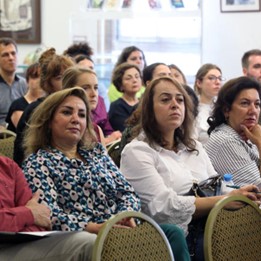
Advocating for Equality in Legislation
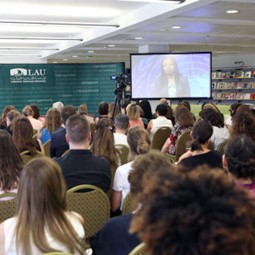
Engaging Women in Peace & Security
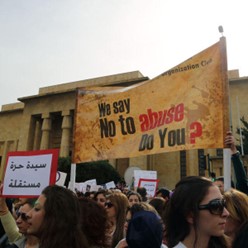
Preventing Gender-Based Violence
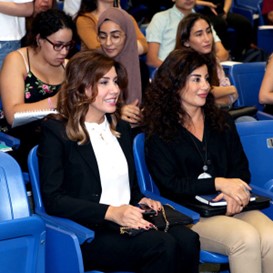
Promoting Women’s Political Participation
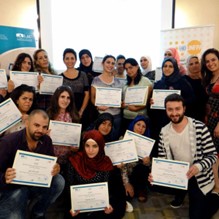
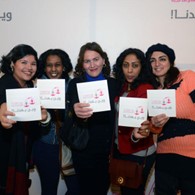
As part of The AiW’s continuing dedication to promoting rigorous intellectual and academic work on the issues of gender equality and women’s rights, the Institute organizes its annual Dr. Suad Joseph Distinguished Lecture Series. The aim of the series is twofold; first, to bring speakers who highlight important topics or themes in the field of gender and women’s studies globally, with the aim to contextualize this to the Arab region and second, to provide graduate students from across the university and specifically, from the MA in Interdisciplinary Gender Studies the opportunity to liaise directly with such high-level academics and researchers. https://aiw.lau.edu.lb/news-events/suad-joseph-lectures/
* The AiW organizes an informal speaking series entitled Food 4 Thought (F4T), a discussion space focused on students but open to the entire LAU community to address current topics related to gender. These discussions are facilitated by different speakers for each session and have included grassroots activists, visiting scholars, media professionals, and others. https://aiw.lau.edu.lb/news-events/food4thought/
2024 events included:
- Women Deliver Panels
- Panel Discussion: “Women in Diplomacy”
- Signing Ceremony: Intisar Foundation’s Gift to AiW
- Honoring event: Saloua Raouda Choucair
- Honoring Ceremony: “Dr. Samira Aghacy”
- International Women’s Day: “Accelerating Gender Equality Through Economic Empowerment of all Women and Girls”
2023 events included:
- Panel Discussion: “Frontiers of Gender Equality in the Arab Region”
- Launch Ceremony: “Women in Leadership” Project
- International Conference: “Anti-Feminist Backlash in the Global South: Cross-Regional Discussions, Strategies, and Innovative Practices”
- Book Launching: “Gendering Civil War: Francophone Women’s Writing in Lebanon”
- Book Launching: “Routledge Handbook on Women in the Middle East”.
- Paper Launching: “Media Hostility: Case Studies on Backlash in the Lebanese Media”
- Paper Launching: “Lebanon: Understanding Anti-Feminist Backlash”
- Play: “Let us Play House (Beit Byout)”
- Athena40-5th Global Conversation: “Innovation, Change, & Education for Women in the Digital Age”
- International Women’s Day: “Gender Equality and Technology: Women’s Inclusion in the Digital World”
- Regional Workshop: “Women’s Political Participation in the Arab Region”
- Panel on: “Mapping the Production of Knowledge on Women and Gender in the Arab Region”
- Film Screening: “Octopus”
- Panel discussion “Sextarianism” book https://aiw.lau.edu.lb/news-events/activities/panel-discussion-sextarianism.php
- Regional workshop: “Women’s Political Participation in the Arab Region” https://aiw.lau.edu.lb/news-events/activities/regional-workshop-womens-politic.php
- Panel discussion: “Gender Equality and Technology: Women’s Inclusion in the Digital World” https://aiw.lau.edu.lb/news-events/activities/international-womens-day-gender-.php
- Panel discussion: “Innovation, Change, and Education for Women in the Digital Age” https://aiw.lau.edu.lb/news-events/activities/athena40-5th-global-conversation.php
- Panel discussion: “Lebanon: Understanding Anti-Feminist Backlash” https://aiw.lau.edu.lb/news-events/activities/paper-launching-lebanon-understa.php
- Launching event and panel discussion: “Routledge Handbook on Women in the Middle East” https://aiw.lau.edu.lb/news-events/activities/book-launching-routledge-handboo.php
- Launching event and panel discussion: “Gendering Civil War: Francophone Women’s Writing in Lebanon” https://aiw.lau.edu.lb/news-events/activities/book-launching-gendering-civil-w.php
- Launching event and panel discussion: “Frontiers of Gender Equality: Transnational Legal Perspectives” https://aiw.lau.edu.lb/news-events/activities/panel-discussion-frontiers-of-ge.php
- Panel discussion: “International Humanitarian Law and the Gendered Implications of Conflict”
Design Culture Day — Fall 2022
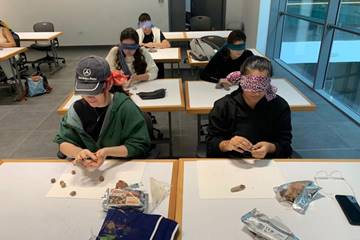
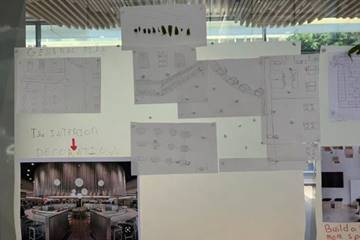
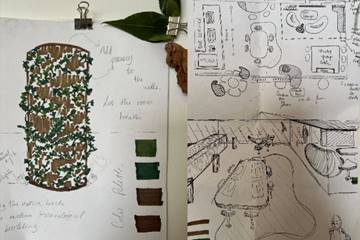
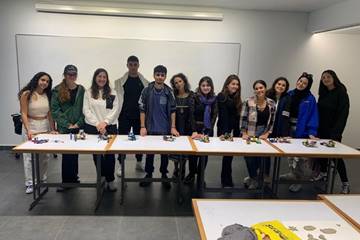
The School of Architecture and Design’s Foundation Program held its bi-annual Design Culture Day for the Fall 2022 semester on October 29th. The event involved eight different workshops each focusing on notions of placing-making, belonging, and inclusivity. The Gezairi Building, a recently inaugurated building on LAU’s Beirut campus housing the School of Architecture and Design, provided the setting and backdrop for the workshops. Lead by various mentors, the workshops engaged more than one hundred first-year students from programs in art, architecture, and design at LAU. Through the workshops the students considered their sense of belonging to the Gezairi Building as a new space.Several of the workshops served as design interventions. For example, Elie Baroud mentored a group of students in the creation of a proposal to transform an unused area, the sidewalk outside the building, into a functional, inclusive, and lively space. On the other hand, Elie Mouhanna guided students in making renovations to the student lounge. George Hanna worked with students in proposing plans to improve building’s cafeteria while, students in Cedric Jacquemyn’s workshop examined the design possibilities of the building’s rooftop, a space that was still incomplete.
However, not all the workshops intervened on specific spaces. For instance, Mabelle Sawan’s workshop addressed the building more comprehensively through environmental graphic design and wayfinding. Mayda Freije’s workshop “If Vision Was Not an Option” took a different approach as students were guided through a series of exercises that considered the perceptions of visually impaired individuals. Lastly, Carla Hage and Melissa Plourde Khoury worked with a group of students to collectively write a manifesto representing their expectations of the Gezairi Building. Click here to read the Manifesto
 |
 |
 |
 |
International Conference: Women, Religion, & Human Rights
On June 27 and 28, 2022, The AiW and the Department of Social & Education Sciences, co-organized with Adyan Foundation, and Danmission an International Conference on: “Women, Religion and Human Rights” at the Lebanese American University (LAU). The conference convened scholars and different religious figures to discuss the stance of women in the interpretations of biblical and qur’anic texts and in personal status codes in Lebanon, the Arab World, and South Asia (particularly Hinduism).
On June 27, the first panel titled “Reading and Reinterpreting Scriptures”, considered the possibilities of re-interpreting the scriptures of holy books to deconstruct the patriarchal understandings of biblical and qur’anic texts. Then, the second panel titled “Unreading Patriarchy and Producing Feminist Knowledge” discussed, in an attempt to uplift the status of women in religion, possible alternative feminist interpretations of traditional and conservative exegeses. Building on the rereading of holy texts, the third panel titled “Negotiating with the Discourse and the Perception of Women” assessed the social and legal statuses of women in religious texts with respect to the private and public spheres. Finally, the fourth panel titled “Different Stakeholders in Conversation: Religion, State, CSOs and International Documents” discussed the work of different organizations, of which are religious institutions, in developing strategies to accommodate and safeguard women’s rights in religion, yet through an acknowledgment of equality standards and human rights.
On the second day, on June 28, the first panel titled “Between Theory and Practice: Personal Status Laws in Lebanon” ushered an in-depth discussion of women’s rights in marriage, divorce, and custody in Muslim and Christian courts. This discussion set the ground for the second and third panels titled “Reforms in Personal Status Laws: Examples and Best Practices” and “Possible Reforms in Personal Status Laws and their Challenges” which addressed the challenges to instate an absolute recognition of women’s rights in personal status codes. Finally, the last panel titled “Raising Awareness and Advocating for Change” presented prospects for legal reforms and for countering misunderstandings and patriarchal interpretations of holy texts.
On a final note, the conference organizers shed light on some of the most important ideas shared, presented their concluding remarks and agreed to produce future publications on the topics discussed. They further reiterated the importance of pursuing collaborative work between Adyan and LAU.
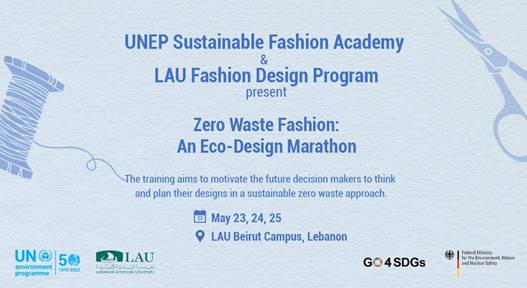
Zero Waste Fashion: An Eco-Design Marathon
The Fashion Design Program is holding a workshop in collaboration with the United Nations.
The training aims to motivate the future decision makers to think and plan their designs in a sustainable zero waste approach.
The event will feature lecturers and experts on the topic, as well as hands on activities, to offer to the students an innovative, inspiring, and immersive experience.
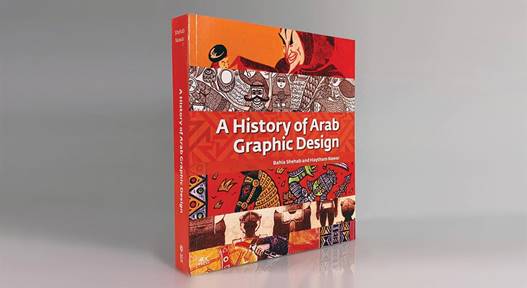
A History of Arab Graphic Design: Q&A with Haytham Nawar
Haytham Nawar is a practicing artist and designer, as well as a scholar in the fields of art and design. He has built his professional and academic career over the past two decades simultaneously fulfilling the different roles. While Nawar’s extensive experience spans continents, in 2014, he pursued his academic career as an Assistant Professor of Design at the American University in Cairo (AUC), where he served as Director of the Graphic Design Program from 2016 to 2019 before holding the post of Chair of the Department of the Arts at AUC since 2019. Nawar is a two-time Fulbright Grantee. Besides his academic career, Nawar is the founding director of Cairotronica, Cairo International Electronic and New Media Arts Festival, Egypt. Cairotronica is a biannual festival that takes place in Cairo since 2016. He is also the author of Language of Tomorrow and the co-author, with Bahia Shehab, of A History of Arab Graphic Design.
Panel Discussion - Healthy Eating and Weight Management Mythbusting by Experts
The Alumni Relations Office in collaboration with the Nutrition Program at the Department of Natural Sciences, School of Arts and Sciences, organized a panel discussion on the Beirut campus on June 23, 2022.
The event started out with dietitians who are LAU alumni, and who were available for individual consultations on proper diet programs. Followed by a panel discussion, which featured:
Dr. Nadine Zeeni, Associate Professor of Nutrition at LAU, Dr. Myriam El Khoury Malhame, Assistant Professor and Program Lead of Psychology at LAU and Dr. George El Khoury, Clinical Assistant Professor, Division of Minimally Invasive and Bariatric Surgery, LAU Medical Center - Rizk Hospital. The panel was moderated by Dr. Hussein Hassan, Director of Academic Compliance, Provost’s Office and Associate Professor of Food Science and Technology.
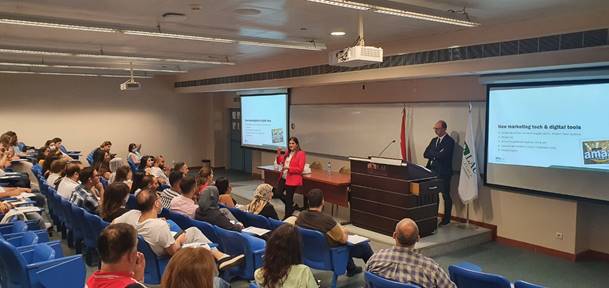
KEEP LEARNING Alumni Lecture: The Future of Marketing
KEEP LEARNING alumni lecture: The Future of Marketing by Dr. Zahy Ramadan & Dr. Maya F. Farah
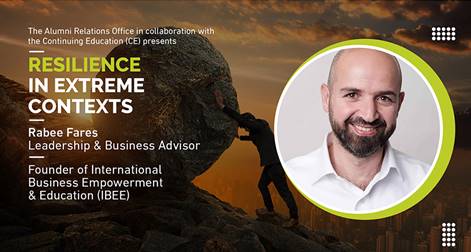
Keep Learning Alumni Webinar: Resilience in Extreme Contexts by Leadership and Business Advisor: Rabee Fares
International award-winning leadership coach Rabee Fares offered an eye-opening session that was of great benefit to all those in executive or leadership positions across industries.
Rabee spoke about extreme events and extreme contexts, adapting to extreme contexts and how to bring out your best and the best of others in extreme contexts.
Silicon Valley Tech Learning at LAU
Holberton software engineering school brings its capacity-building programs to Lebanon in partnership with the university.
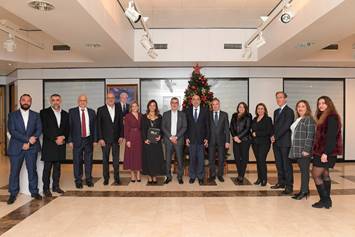
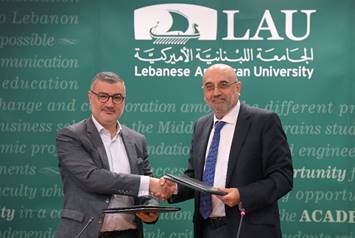
In its latest move to enhance the career prospects of Lebanese youth in a globally competitive job market, LAU has signed an agreement with Holberton, a software engineering school founded in Silicon Valley with 27 campuses in five continents. The partnership was made possible by Lebanese businessman Alexandre Harkous who gifted LAU the Holberton Lebanon license he held through his fintech company StartechEUS.
With student employability at the heart of Holberton’s approach, its graduates have landed jobs in software engineering across all industries and at top tech companies such as Google, Apple, Facebook, LinkedIn, IBM, Tesla and the like.
The Holberton learning method provides Silicon Valley-level training for software development jobs. Based on the premise that computer engineering involves a mix of technical and soft skills, the school offers a collaborative project-based environment where students work with their peers across campuses. Students also have access to the Holberton network and alumni community.
The courses are practical and are not taught by teachers. Instead, much like a real-job tech setup, students are given increasingly difficult tasks to solve. Guided by experts or faculty members, they draw on their soft skills – such as problem-solving, critical thinking, communication and teamwork – and rely on peer collaboration across campuses. In the process, they are continually upscaling their skillset.
Classes are intensive and held daily. The admission process, like the learning methodology, consists of a series of mini-challenges that the student must complete to qualify.
By opening a Holberton school in Lebanon, one of the best capacity-building and training programs in computer engineering, LAU would be “empowering Lebanese technology-driven students, and giving them the opportunity to grow, thrive and realize their potential by equipping them with the required skills to compete in the local, regional and international markets,” said Dr. Elie Badr, vice president for Business Development and Global Affairs.
In the current situation in the country, he added, “we believe that the impact of Holberton school programs will provide a positive role in the Lebanese economy.”
The programs will be housed at LAU’s Academy of Continuing Education, based on the Beirut campus, where a dedicated team of faculty and staff will provide support from a local perspective to software engineering issues, onboarding assistance during the first week, monitoring and guidance during Peer Learning Days, and mock interviews.
The Holberton specialization programs, all based on three-month modules, are Machine Learning & AI (artificial intelligence), AR/VR (augmented and virtual reality), Web React, Blockchain & Cryptocurrency, Front-End Web Development and Back-End Web Development.
As students gain deep knowledge in computer science, they will be able to build web servers or websites, implement a blockchain, create a mobile app or CRM dashboard, configure a bot or a chatbot, devise facial recognition and object detection codes, create video games, build marketplaces, create VR / standing VR experiences, and more.
LAU-ACE is offering the programs at a more affordable price than any other Holberton campus around the world, and the university is working on securing full scholarships from different foundations to help Lebanese tech students enroll.
Launched in July 2020, Holberton Middle East has so far trained more than 90 students enrolled in different specialization programs. The first upcoming cohort at LAU-ACE will be starting with Blockchain as of March 6, 2023.
At the signing ceremony on December 20, Provost George E. Nasr, representing LAU President Michel E. Mawad who was called away on a trip, conveyed the president’s delight in the university’s association with Mr. Harkous and in this collaborative agreement “which is aligned with the university’s mission to help the workforce of tomorrow and meet the requirements of the new generation.”
Mr. Harkous, who left Lebanon in 1985 for Paris and worked as a computer engineer in Europe and the US, returned to Lebanon in 2019, when he decided to purchase the Holberton Middle East license through his company StartechEUS. His reasons for doing so, he said, were because he “wanted to give back to his country and the Lebanese youth, secondly because nothing happens without technology nowadays, and thirdly because one had to be surrounded by the best people to deliver.”
Holberton, he added, is a sustainable school that is growing, and he was “more than happy to give it to LAU because we trust you to make sure that it helps the next generation.”
While Holberton Lebanon was Mr. Harkous’ gift-in-kind to LAU, thanks to him and his team the university has also signed an agreement to operate Holberton New York on LAU’s academic center in Manhattan as of June 5.
Commenting on these new venues, the CEO of the Holberton School Network Florian Bucher recently said: “We are very proud of this partnership with a great organization and great people at LAU. With these two new openings In Lebanon and New York, I really want to establish a strong partnership with LAU to join our strengths. We have more than 10 years’ experience training great software engineers in Silicon Valley, Europe and Latin America, and LAU has a very strong network and a great community of students in the Middle East.”
 |
 |
Online Learning “Media and Palestine”
From LAU’s first course for Open, Online Learning “Media and Palestine”.
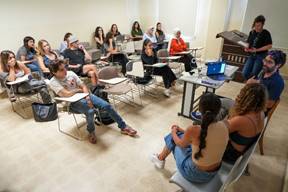
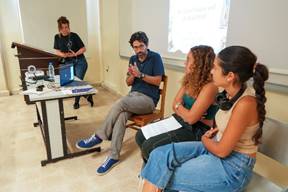
We are glad to announce that the “Media and Palestine” fully online, 30 hours, free of cost Course, currently has 81 participants from #Lebanon, #Jordan, #Morrocco, #Palestine, #Syria and other #countries, registered for the Fall 2023 semester.
To all aspiring journalists and Palestinian studies enthusiasts, the course will be available again in the Fall 2024 semester!
 |
 |
The Readers’ Club Engages Youth in Local Communities
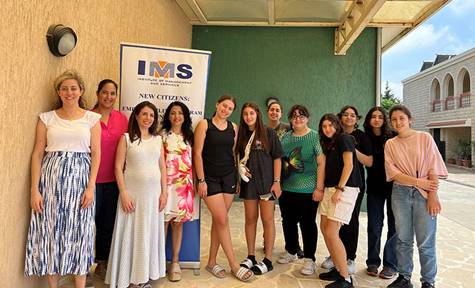
In pursuit of its mission to grow its national outreach and empower readers, the LAU Libraries Readers’ Club partnered with the Institute of Management and Services to host a roundtable book discussion for young girls in Maad village, Byblos. In line with the LAU Libraries’ strategic goal to promote social responsibility, the club anticipates sparking further intellectual dialogues and building connections within rural communities around the country.
Roundtable Discussion Spotlights Corporate Social Responsibility
Faculty and students from the Adnan Kassar School of Business examined sustainability and development initiatives in Lebanon and the region together with industry stakeholders.
Academics, consultants, business executives and students joined a roundtable discussion at the Adnan Kassar School of Business (AKSOB) on sustainability and Corporate Social Responsibility (CSR) initiatives in the Lebanese market and opportunities for further collaboration.
Underlining the university’s firm belief in CSR, Dean Wassim Shahin spoke about how it has been “embedded in raising responsible leaders,” as LAU remains committed to the UN Sustainable Development Goals (SDGs), and to building robust collaborations with key players in the industry to help achieve those goals.
Sharing the global perspective, Chair of the Marketing Department and Associate Professor Maya Farah touched on how businesses have been integrating CSR activities in operational and strategic work plans. “While the MENA region is keeping up faster than expected, CSR undertakings in Lebanon unfortunately remain sporadic,” added Dr. Farah.
The roundtable discussion was attended by representatives from Egypt-based firm, Aspire, and Dubai-based agency, Blue Green Consultancy, who expanded on how their organizations have been fostering sustainability and development ideas.
From Lebanon, CEO of Cedar Environmental Park Ziad Abi Chaker explained how they had revived the glass-blowing craft to minimize waste, empower craftspeople and build sustainable solutions to address the garbage crisis in the country.
CSR Manager at Fattal Group Ghida Ibrahim shared multiple initiatives by the company that are geared toward building awareness, educating youth and empowering people to adopt sustainable solutions.
Similarly, L’Oréal empowers different communities in unique ways by linking beauty to sustainability and social responsibility, said the company’s Corporate Affairs and Engagement Director Samira Franjieh. Worldwide, the multinational company had contributed to reducing carbon emissions by 48 percent by adopting proper plans in their freight carriers and shipments.
Several LAU staff, faculty and students highlighted the different efforts exerted by the university, especially through campus life initiatives by student clubs. Assistant to the President for Special Projects Saad El Zein further discussed the various community health activities that LAU’s medical centers have led, including PCR testing and vaccination campaigns, and the pioneering LAU Mobile Clinic.
Associate Professor Grace Dagher also explained how AKSOB embraces a CSR approach across both its academic and non-academic programs.
At the school, added Assistant Professor of Practice Dunia Harajli, “social responsibility is integrated into the curriculum through a mandatory civic engagement course for all LAU students to help build a better future for the country.”
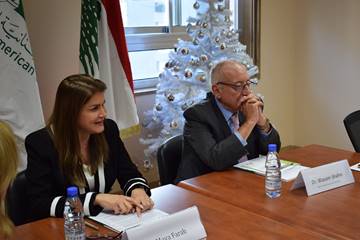 |
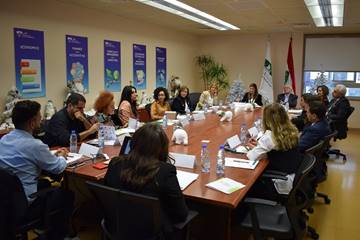 |
Dr. Abi-Gerges Presents Research on Diabetes and Cardiovascular Diseases
A research project conducted by Assistant Professor of Physiology at the Gilbert and Rose-Marie Chagoury School of Medicine Aniella Abi-Gerges has been selected for an oral presentation at the French-Lebanese Day for Research organized by the French Embassy. Funded by the Partenariat Hubert Curien Cèdre, Dr. Abi-Gerges’ research focuses on how cardiac phosphodiesterases are differentially increased in diabetic cardiomyopathy.
Sustainability at the Academy of Continuing Education
The LAU Academy of Continuing Education (ACE) contributes to the UN Sustainable Development Goals (SDGs) through the content and outcomes of its diverse programs. It offers more than 65 courses in various modalities: remote, in-person, hybrid and asynchronous. Through these offerings, the academy contributes to SDG 4: Quality Education as they are presented to the public and the community beyond the university’s student body. They also address SDG 17; Partnership for the Goals as they tackle and promote the SDGs.
Two of the academy’s offerings stand out as having demonstrated a far-reaching impact in Lebanon. The Crafts, Arts and Vocational programs have, for two years now, encouraged women to develop their own enterprises in partnership with artisans and entrepreneurs. A similar program, the Women Entrepreneurship Diploma Program, advocates for gender inclusivity in the Lebanese labor market, by offering women in rural and peri-urban areas the opportunity to build their skills and identify their business niche. Each of these programs has reached more than 200 women across the country, contributing to SDG4: Quality Education and SDG5: Gender Equality.
Increased power cuts in Lebanon over recent years due to the economic and financial crises have led to a demand for alternative power sources, particularly solar power. In the context of an unorganized market and a shortage of trained professionals, ACE developed a training program to build the capacities of photovoltaic (PV) technicians in the solar energy market. The program encompasses around 100 hours of training on design and engineering, installation and safety, commercial and legal aspects, and work ethics, addressing SDG7: Affordable and Clean Energy.
On the inclusivity front, ACE has established a number of programs to help build effective, accountable and inclusive institutions across the board. A couple of programs stand out.
The second is a specially designed teacher-training program for every cohort of Teach for Lebanon fellows, namely fresh graduates who go on to teach in underserved schools across the country. Through this, the academy serves SDG1: No Poverty and SDG10: Reduced Inequalities as the program seeks to improve access to basic services for all. Both programs also attest to the academy’s contribution to SDG16: Peace, Justice and Strong Institutions.
A wide array of other courses, certificates, diplomas and training programs at ACE also attest to SDG3: Good Health and Well-Being, such as the Food Safety Program, offered to industry professionals in collaboration with the ministries of Industry and Agriculture. Other programs promote fitness, mental health and risk management, and are offered to healthcare professionals, health coaches and psychologists.