Gathering or Measuring Data for the SDGs
LAU actively participates in international collaboration to gather and measure data related to the Sustainable Development Goals (SDGs). These efforts span research projects, partnerships, and programs that align with global efforts to address sustainable development challenges. Below are examples on LAU’s participation in data gathering aligning with its commitment to advancing the SDGs through data collection and measurements. (More initiatives, could be found at the LAU News link and its research repository).
LAU’s Office for Sustainability
https://sustainability.lau.edu.lb/about/
The Office for Sustainability (OfS) leads and coordinates university-wide efforts to implement LAU’s Sustainability Strategy, aligning academic programmes, research, operations and outreach with sustainable development goals.
OfS is responsible for developing policies and practices, coordinating the university’s sustainability framework, and overseeing the implementation of strategic actions. It also supports curriculum redesign (e.g., education for sustainability), research partnerships, and capacity-building for sustainability across the institution.
The Office’s activities provide strong infrastructure and mechanisms that support data measurement, monitoring, and alignment with international sustainability frameworks:
- By developing and publishing LAU’s SDG Report and Sustainability Plan (which include data, indicators, and performance metrics) the OfS helps create an institutional dataset aligned to global SDG standards.
- Because OfS oversees policy-and-practice alignment across teaching, research, outreach and operations, it provides the structural basis for multi-sectoral data collection (e.g., embedding SDG-outcomes in curricula, tracking sustainability metrics in operations, coordinating research outputs).
- The office’s role in capacity-building and convening dialogues (for instance the university’s sustainability strategy and outreach under OfS leadership) positions LAU to engage in international benchmarking, data-sharing, and comparative measurement across institutions and regions.
Department of Institutional Research and Assessment (DIRA)
DIRA is the central office at LAU that collects, analyses, warehouses and disseminates data across academic, administrative and support functions of the university. Its mandate is to ensure integrity and consistency of information for institutional reporting, and to support decision-makers in planning, policy formulation, assessment and institutional effectiveness initiatives.
The department publishes detailed reports and data dashboards:
- DIRA’s core function of data management, monitoring, reporting & analysis strongly supports data measurement processes which are foundational for any SDG-related monitoring.
- DIRA publishes a “Fact Book” covering multiple indicators (enrollment by level, gender breakdowns, retention, continuation) which helps generate institutional datasets that can feed into broader benchmarking efforts (including SDG 4 – Quality Education, SDG 5 – Gender Equality, etc.).
- DIRA houses comprehensive data on institutional performance, this positions LAU to engage in cross-institutional benchmarking or international data collaborations by providing reliable base data.
DIRA maintains and publishes a comprehensive Common Data Set (CDS) that provides standardized institutional statistics across areas such as student enrollment, gender distribution, graduation rates, financial aid, and faculty demographics. The CDS follows internationally recognized higher-education reporting formats, ensuring comparability of data with peer institutions and accreditation bodies. By collecting, verifying, and publicly sharing these datasets, DIRA contributes directly to data transparency and evidence-based benchmarking, supporting indicators linked to education quality, gender equality, and institutional effectiveness. This activity positions LAU as an active participant in the global higher-education data ecosystem, reinforcing its capacity to align with and inform SDG-related monitoring and reporting frameworks.
“Assessing the Progress of Arab States Toward the Sustainable Development Goals: The Role of Social Expenditures” (April 2023)
In April 2023, LAU hosted a seminar that presented the report titled “Assessing the Progress of Arab States Toward the Sustainable Development Goals: The Role of Social Expenditures.” The study introduced a data-driven framework to monitor social spending across seven key dimensions aligned with the SDGs, enabling tracking of both inputs (social expenditure) and outcomes (inclusive growth, poverty reduction). This collaboration involved LAU economists and regional experts, offering a concrete example of LAU’s engagement in measuring and monitoring SDG-linked data at a regional scale. Link to article
LAU’s Center for Policy Action (CePA).
“Quantifying Turbulence: Introducing a Multi-Crises Impact Index for Lebanon”
https://link.springer.com/article/10.1007/s11205-024-03426-4
This policy indicators and crisis-metrics was published in a peer-reviewed international venue (2024), through the. The index operationalizes multi-domain indicators (health, education, nutrition, financial stability) to model scenarios and track interventions, offering a transferable methodology to international policy and research communities.
LAU’s Arab Institute for Women
AIW collaborated with the Global Women’s Institute at George Washington University on a project aimed at improving regional capacity for collecting data on violence against women. This initiative, supported by UN Women and the World Health Organization, developed training curricula for Arab experts to collect prevalence data on violence against women, essential for policymaking and SDG progress, particularly on gender equality (SDG 5)
Project: Violence Counts! Strengthening Arab Regional Capacity to Collect Data on Violence against Women:
https://aiw.lau.edu.lb/projects/project-violence-counts-strength.php
The AiW, in partnership with the Global Women’s Institute (GWI) at the George Washington University, received a grant in December 2020 funded by UN Women and the World Health Organization for the purpose of building the capacity of Arab experts to collect data on violence against women (VAW). Though quality, reliable data on VAW is essential for developing policies and interventions to achieve gender equality, a substantial gap remains in the collection of prevalence data on VAW in regions across the world, particularly in the Arab States. This gap is due to stigma regarding VAW, underreporting, lack of reporting mechanisms, difficulty accessing justice for survivors, lack of services and support, and other factors. This gap is also due in part to the technical capacity required to collect these prevalence data in accordance with global, methodological, ethical, and safety standards.
The AiW and GWI developed a training curriculum and implemented a pilot training within the context of this grant for the purpose of building the technical capacity of a selected number of Arab experts to collect these prevalence data on VAW. A secondary goal of this program was to widen the currently limited pool of researchers who can collect these data in a high-quality and ethical way. This ensured that there was a wider base of Arab experts who were able to undertake data collection on VAW. Data is critical in strengthening prevention and response, and so The AiW aims to integrate this training curriculum within its sustainable development projects.
Institute for Migration Studies
LAU contributes to poverty data collection and analysis through its Institute for Migration Studies, which collaborates with international organizations to understand the socioeconomic impact of migration on vulnerable populations in Lebanon and around the world:
The Refuge Reports
https://soas.lau.edu.lb/academics/centers-institutes/ims/the-refuge-reports.php
While refugees in protracted crises exist all over the world, coverage, reporting, aid, resettlement and humanitarian assistance remain inequitable and unequal in different settings, regions and conflict settings. And while refugees from specific communities do grab the international media’s attention for short-lived periods of time when the conflict remains recent and ongoing, refugees across the globe remain in displacement settings long after the cameras stop rolling and funding priorities shift. For twelve weeks, the IMS at LAU will partner with organizations around the world to shed light on twelve refugee communities’ experiences of refuge and displacement, with the aim of shifting the focus back to the conflicts that no longer make the headlines. This initiative aims to serve as a database for scholars, researchers, writers and media personnel that work on/and cover the refugee landscape so that they too can continue to draw attention to the plight of the refugees who have not yet made it to safety.
More could be found at IMS webpage: https://soas.lau.edu.lb/academics/centers-institutes/ims/
LAU Gilbert and Rose-Marie Chagoury School of Medicine:
The Gilbert and Rose-Marie Chagoury School of Medicine participates in international collaborations that contribute to gathering and measuring data for the SDGs. Faculty members are involved in global research networks and partnerships with organizations such as the World Health Organization (WHO). These collaborations often focus on critical health issues, like antimicrobial resistance and public health interventions, which align with SDG 3 (Good Health and Well-being) and SDG 17 (Partnerships for the Goals). These efforts support data collection and analysis to monitor progress towards achieving the SDGs.
Revamped GTCA Database: Systematic Repository of Disease, Gene, & Variant Bibliographic Data from the Arab World
https://eventscal.lau.edu.lb/event.php?evt=20220126_revamped-gtca-database-systemati
January 27, 2022
The Research Office and the Continuing Medical Education Office at the LAU Gilbert and Rose-Marie Chagoury School of Medicine invite you to take part in this workshop that is presented by:
- Pratibha Nair, Senior Researcher
- Sami Bizzari, Database Curator and Researcher, Centre for Arab Genomic Studies, Dubai, United Arab Emirates
- Moderated by: Andre Megarbane, MD, Professor/Assistant Dean for Research, Department Head of Human Genetics, LAU Gilbert and Rose-Marie Chagoury School of Medicine
This webinar will allow all healthcare providers and researchers to have a general idea on all the genetic diseases already described in the Lebanese population and to quickly have access to the various references and publications. A link to the data of other Arab countries is possible, allowing rapid determination of the frequency of a disease in the Arab world.
Target Audience: Healthcare professionals conducting research.
Support to the Ministry of Education and Higher Education
https://www.lau.edu.lb/files/institutional-self-study-2024-comprehensive-evaluation.pdf
LAU has commonly used trend analysis as an approach to assess performance improvements over time, primarily due to the absence of comprehensive national and regional databases that provide reliable information. Acknowledging the limitations of trend analysis, LAU is advocating for the development of reliable national databases. To support the Ministry of Education and Higher Education (MEHE) in this endeavor, DIRA assistance will be provided.
Labor Market Readiness
Through its Business School and collaborations with international economic forums, LAU collects labor market data to support employment strategies in Lebanon.
LAU Response to the Challenge of Labor Market Readiness
https://www.lau.edu.lb/about/governance/president/presidents-forum/response-to-the-challenge-of-labor-market-readiness/
The higher education sector is currently undergoing cataclysmic changes. In part, these changes are related to the quest for Labor Market Readiness given the radical changes that have all but changed the employment landscape. The scene today is transitional, moving from a discipline-specific paradigm to interdisciplinary approaches emphasizing readiness for meeting Labor Market Challenges head-on. Universities are coming up with various responses to reinforce their relevance to a future labor market that is still something of an enigma to most of us. The difficulty derives from having to respond to challenges that are still in the making. A heated debate on market readiness is currently raging in the US among major universities and casting a shadow on the entire higher education scene. Our concern in this issue of the Forum is with specific steps that have been/are being taken by LAU in response to this same challenge of market readiness. The broad header is future-proofing our graduates for a world we know little about where new skills and competencies will be needed.
Strategic Responses by LAU
The strategic response of LAU to the labor market challenges created by sweeping digital changes falls into four distinct categories:
- Introducing new Interdisciplinary majors and spreading awareness about them. The list includes AI, Data Analytics, Machine Learning, Genetics, and Cybersecurity. These majors are interdisciplinary and often inter-school, calling on us to find new ways for integration and problem-solving that are not part of the classical wisdom in academic organization. Efforts are currently underway for adding these majors which will produce graduates at the cutting edge of the know-how that drives the current and future labor market. Some are already available as online programs.
- Working on introducing Stackable Certificates and Diplomas that LAU students can enroll in alongside their “mainstream” study to acquire additional labor market-relevant skills. Some of these certificates and diplomas will be made available through our Academy for Continuing Education (ACE), while others might be offered by one or more schools. On the training board currently are certificates/diplomas in all the digital areas listed above as well as some “soft skills” certificates. The list could include Communication, Soft Skills, Emotional Intelligence, and Self-Leadership. In parallel, we could also offer a number of free workshops covering Presentation Skills, Public Speaking, and the preparation of Résumés.
- Making Experiential Learning a cornerstone experience for LAU students. Over the past few years, LAU pioneered Experiential Learning in a number of Schools including Medicine, Pharmacy, Business, and Architecture and Design. It was for us a way to build into the educational experience of our students’ hands-on skills and market reality before they graduate. Every bit as much, it was a way for our students to put what they were studying in perspective, assess adjustments they will have to make in the world of practice, and hit the ground running with the benefit of experience gained while still studying.
- Underscoring the need to equip students with soft skills, including emotional intelligence, effective communication, public speaking, team building, etc.
LAU plans to expand the domain of the four new areas listed to practically cover the entire gamut of our academic menu. This will go hand in hand with expanding the domain of experiential learning to include self-awareness skills, organizational behavior skills, communication skills, and expectations management skills. We expect our capacity-building efforts in the domain of experiential learning to receive major reinforcement through two related steps already in place but still undergoing expansion.
The first of these two steps was creating the Industrial Hub on the Byblos campus as a sustainability-driven partnership between LAU and industry. We have already signed with some companies and negotiations are underway with others. When it is in full bloom, the LAU Industrial Hub will be a major building on the Byblos campus bearing testimony to the depth of our commitment to working with industry, particularly in the information and IT sectors. To the same degree, it will also be a major hub for experiential learning and a key differentiator offering our students a clear career edge. It will serve as a center for fusing study and experience in one integrated learning track for a creative interplay between theory and practice. In the same spirit, the PMRC (Bioequivalence) Center on the Byblos campus as well is already in progress.
The second step is expanding the domain of leadership training available on our campus with a view to further instilling values of responsible citizenship, civic duty, commitment to sustainability and readiness for change.
A Word of Caution
The urgent need to rethink the dominant paradigm in higher education to bring it closer to present and future labor market reality does not in any way diminish the role of a modern university as a learning community. The reform needed should not be understood as a call to turn universities into training centers for the labor market. They will, of course, continue to be major hubs for creating new ideas, making spectacular advances, and shaping the future. What the reform drive aims for is narrowing the gap between “gown” and “town” by bringing about closer alignment of skills and expectations. It is simply a reminder that we should, as an academic institution, do our part in the midst of a massive transformative change where only the direction is known but not the destination.
Toward a Market-Readiness Index
The trend toward greater university emphasis on market readiness is already apparent at many universities. At LAU, it is a commitment and a major pillar for our future planning. One key manifestation of this commitment is working on an institutionally developed market readiness index that would serve as a guideline to gauge our efforts in this direction. Several elements will go into computing the market readiness index. They include inter-alia:
- Percent of curriculum/courses taken that are market readiness oriented. Experiential Learning is part of this.
- Market input into the learning process offered to students through guest speakers, site assignments, special projects, etc.
- Employability rates within six months of graduation.
- Tracking career progress of graduates five or more years after graduation.
- Employers’ feedback garnered through surveys and interviews.
- Alumni feedback and testimonials.
Given that other universities will in all likelihood be doing something similar, there should be room for comparisons and benchmarking.
LAU is amply aware that what we have already done barely amounts to first shy steps along the long road to the future. We are determined, however, to create conditions that will allow what is now a mere drizzle to grow into a torrent that will make us early adopters of the future face of higher education.
Carbon Emissions Monitoring
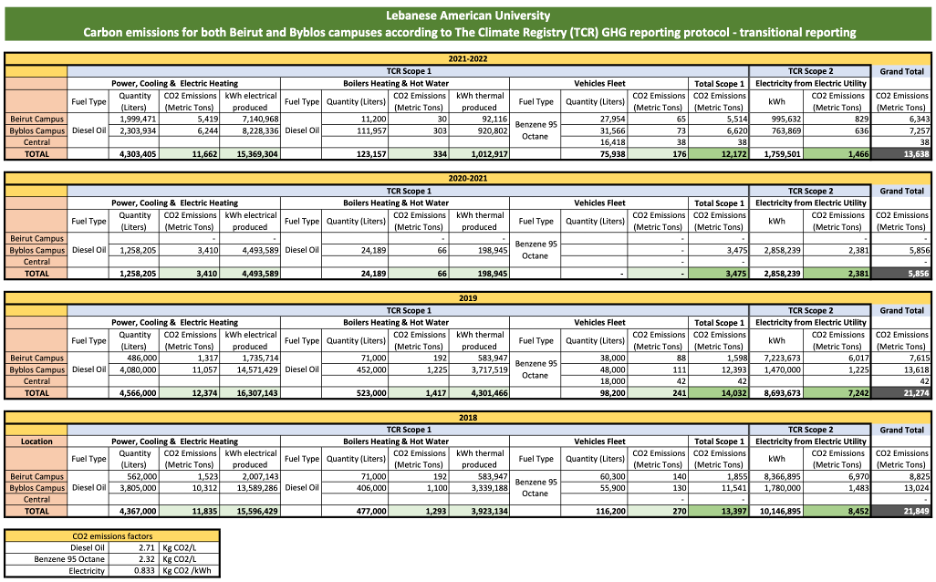
Moreover, LAU actively tracks and reports its carbon emissions (Scope 1 and Scope 2) for its Beirut and Byblos campuses as part of its sustainability efforts. This data collection aligns with global methodologies like those of The Climate Registry, supporting SDG 13 (Climate Action) by informing strategies to reduce emissions and achieve carbon neutrality.
Carbon Emissions:
https://www.lau.edu.lb/sustainability/articles/carbon-emissions.php
LAU is keen on tracking its carbon emissions in an effort to reduce them and ultimately become carbon neutral. The below table summarizes the Scope 1 and Scope 2 emissions for Beirut and Byblos campuses as of 2018.
WOMEN DELIVER 2023 CONFERENCE
The AiW director participated in an international meeting titled “Upholding bodily autonomy, rights, and choices” where she presented The AiW’s collaboration agreement with EPF in the development of the Contraception Policy Atlas MENA. During the 2023 Women Deliver Conference (WD2023) in Kigali Rwanda, the AiW director participated in the launching event of the Global Contraception Policy Atlas and led a presentation on the MENA Region Atlas.
The Women Deliver 2023 Conference (WD2023) took place in-person in Kigali, Rwanda, as well as virtually, from 17-20 July 2023. As one of the largest multi-sectoral convenings to advance gender equality, WD2023 convened 6,300 people in Kigali and 200,000+ people online through the virtual Conference and six-month Global Dialogue leading up to the Conference. WD2023 enabled inclusive and co-created spaces that fostered solidarity for sustainable solutions on gender equality.
WD2023’S OBJECTIVES:
- Catalyze Collective Action to Advance Gender Equality
- Hold Leaders Accountable
- Empower the Feminist Movement
- Reframe Who Leads
- Create Space
The vision, theme, and objectives of the Conference were selected by the WD2023 Advisory Group, in consultation with over 5,000 advocates — spanning 166 countries, generations, and sectors — who participated in design sprints and Women Deliver’s Global Community Consultation.
WHO PARTICIPATED IN WD2023:
 |
6,300+ feminists representing 170 countries |
 |
240+ journalists and content creators |
 |
600 scholarship recipients |
 |
87+ sponsors and funders |
 |
over 10,000 people joined us online |
Global Affairs Service Center Hosts UNDP’s Agents of Change
Young entrepreneurs nationwide gather at LAU to collectively generate ideas and work on sustainable development projects.
Attaining the United Nations Sustainable Development Goals (SDGs) that target pressing global challenges like climate change, poverty, well-being and inequality, among others, is a shared responsibility that transcends borders. The youth, in particular, play a pivotal role in achieving those goals by driving innovative solutions and mobilizing their communities to ensure a sustainable and equitable world for future generations.
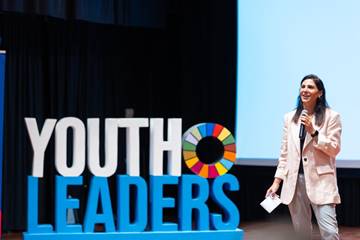
To help foster a community of change-makers dedicated to fulfilling the SDGs, the Global Affairs Service Center (LAU GASC) – an advocate of leadership and youth empowerment – recently hosted the ninth cohort of the United Nations Development Programme (UNDP) Youth Leadership Program (YLP).
This collaborative effort between the LAU GASC and UNDP YLP aligns with the university’s strategic plan to strengthen its external partnerships with local and international organizations invested in youth development and to promote the university as a hub for networking and building a resilient community of entrepreneurs.
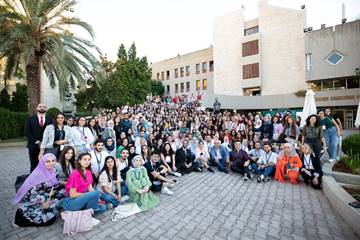
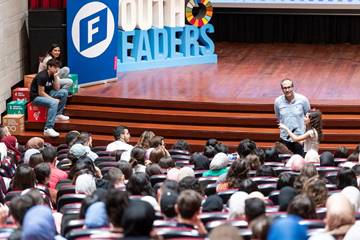
More than 350 participants from diverse academic, cultural and social backgrounds in Lebanon flocked to the LAU Byblos campus for the two-day boot camp on September 16 to 17, during which they exchanged their experiences and discussed their visions for creating sustainable projects under two overarching themes: Rebuilding Solutions for Lebanon and Economic Empowerment.
This year’s YLP edition was organized in partnership with the Friedrich Naumann Foundation for Freedom (FNF), a supporter of Lebanese startups, civil society organizations, and LAU’s own simulation models.
LAU alumnus Bahaa Hajir, a YLP sixth cohort participant, still serves as a member of the program’s advocacy board. His project was shortlisted in 2020 when he pitched a bottle cap recycling initiative with his team.
“YLP facilitated my career launch,” he said, “I ended up getting recruited as a project support officer at one of the NGOs we worked with during the program.”
First-time attendee Mahassen Sleiman, a 23-year-old from Baalbeck, was “eager to connect with individuals who share similar interests and are committed to bringing about positive change in marginalized communities,” she said, adding that she is already experienced in social work.
Since 2015, the UNDP YLP has assisted Lebanese youth through its annual program, open to individuals aged 19 to 29. Carried out in partnership with youth-serving organizations, it features a flexible curriculum led by experienced trainers and business experts, allowing participants to create and execute innovative, impactful and sustainable development solutions for the betterment of their communities.
The boot camp was launched with opening remarks from Lead Director of Global Affairs Service Center at LAU Suleiman Barada, Youth Focal Point Officer at UNDP Nada Sweidan and Youth Development Delegate at UNDP Hany Anan, followed by back-to-back training sessions, including some that were given by LAU faculty members and alumni.
According to Dr. Sweidan, this dynamic initiative breaks cultural barriers, and its positive impact is felt in the youth’s personal lives, careers and communities for years to come. “The event accelerates the implementation process of the youth’s innovative projects … the youth is the NOW and not the future,” she said.
Such events, said Barada, can also enhance the employability of youth. Providing the youth with networking power to boost their career prospects is paramount, he added, and “by strengthening ties, establishing alliances and collaborations, we narrow the gap between academia and industry, and this strategic collaboration with UNDP is a perfect example.”
 |
 |
 |