SDG 11: Sustainable Cities & Communities
LAU’s Commitment to Advancing SDG 11: Sustainable Cities and Communities
LAU is steadfast in its dedication to fostering sustainable, inclusive, and resilient communities in alignment with SDG 11. This commitment is exemplified through a dynamic blend of sustainable design, community engagement, and the integration of art and culture into its initiatives.
Sustainable Design and Construction
LAU demonstrates leadership in environmentally responsible practices through projects like the Architecture L1 renovation and the Wadad Sabbagh Khoury Student Center renovation. These projects prioritize energy and water conservation and reflect LAU’s progress toward green design guidelines, which aim to institutionalize eco-friendly principles in all future projects. This long-term vision underscores LAU’s role in creating campus environments that are not only functional but also sustainable and inclusive.
Art for Community Engagement and Activism
The university leverages art as a powerful medium for activism, education, and community connection. Initiatives such as the 16 Days of Activism Arts Competition and theatrical performances like “Let Us Play House (Beit Byout)” highlight social issues, including gender-based violence, and engage the public in meaningful dialogue. Similarly, film screenings such as “Octopus” and showcase LAU’s efforts to preserve cultural narratives and address critical societal challenges.
These initiatives actively involve students, faculty, and external audiences, creating spaces for shared learning and community participation. LAU’s use of the arts demonstrates its holistic approach to achieving SDG 11 by fostering cultural enrichment and advocating for social change.
Community-Focused Facilities
LAU enhances its commitment to sustainability by opening its facilities to the public, including libraries, industrial hubs, museums, and event spaces. The university’s residence halls, such as the Siran Towers and Santona Residence, offer safe, well-maintained living spaces that foster academic, emotional, and social growth for students.
Furthermore, initiatives like the partnership with Monsif International School exemplify LAU’s dedication to accessibility and inclusion, allowing school students to benefit from LAU’s extensive library resources. This step promotes not only quality education (SDG 4) but also sustainable community-building (SDG 11).
Empowering Change Through Art and Leadership
From hosting the Arts Competition annually to supporting women artists in Lebanon and beyond, LAU highlights the intersection of art, sustainability, and activism. These efforts amplify underrepresented voices, particularly women, and drive dialogue on critical global and local issues. The university’s focus on women’s contributions to contemporary art in the Arab world further strengthens its role as a cultural and educational leader.
A Holistic Vision for Sustainable Communities
Through sustainable campus practices, cultural initiatives, and robust community engagement, LAU exemplifies its commitment to SDG 11. By integrating sustainability into its infrastructure and operations, fostering artistic expression, and actively engaging with the broader community, LAU continues to create vibrant, safe, and sustainable environments that inspire both academic and cultural advancement.
Art for Activisim
- Arts Competition: 2024 Winners (09/01/2025)
- Arts Competition 2023 Winners (11/01/2024)
- Arts Competition 2022 Winners (09/12/2022)
- 16 Days of Activism Arts Competition 2022! (06/10/2022)
- Arts Competition 2021 Winners (16/12/2021)
- 16 Days of Activism Arts Competition 2021! (30/10/2021)
- Arts Competition Winners! (05/01/2021)
- 16 Days of Activism Arts Competition! (26/10/2020)
- Screening of Ayyoubé (20/12/2019)
- Film Screening: “Women in Time” (03/06/2019)
- Festival Next: A Busy and Boisterous LAU Production (01/04/2019)
- Play: “Ana Mou Mazharieh” (30/01/2019)
- Arts Competition Winners! (24/12/2018)
- Theater Performance: The Rite of Spring (16/10/2018)
- Ta’ Sakena (24/09/2018)
- The Hunting Ground (18/04/2018)
Women Artists in Lebanon
Some research of contemporary art in the Arab World has been done, but the specific exploration of women’s participation in this field is a unique feature of this study. The author traces the background and development of these artists and documents their present status with specific reference to those who have made significant contributions in painting, sculpture, graphics, and ceramics.
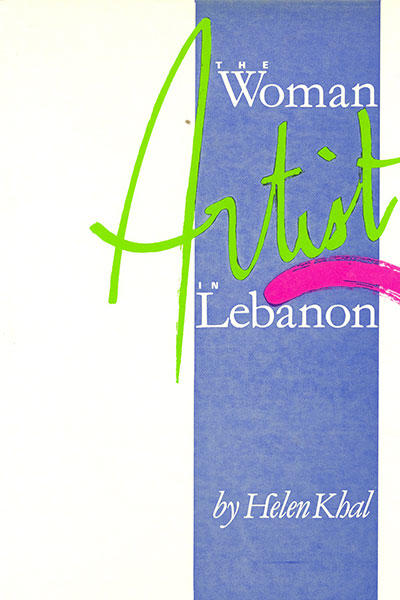
Year of publication: 1987
LAU’s Architects Compete to Preserve and Develop UNESCO Site
Alumni from the School of Architecture and Design win at an international workshop focused on heritage conservation, sustainability and cultural landscape design in KSA.
By Sara MakaremAugust 1, 2024
To further enrich the educational experiences and career prospects of its alumni, the School of Architecture and Design (SArD), through its Institute for Environmental Studies and Research (IESR), invited architecture graduates from the classes of 2022 and 2023 to participate in a six-month exchange workshop in Diriyah, Saudi Arabia, from January to June 2024.
Organized by the Diriyah Architecture Lab (DAL) and the Diriyah Foundation in Riyadh, the workshop titled Learning from The Past, Shaping the Future: Interventions in Wadi Hanifa Cultural Landscape brought together recent graduates from international universities to research and design solutions for developing the Wadi and Al Turaif UNESCO site while preserving its historical integrity.
Eight LAUers were selected by the IESR and DAL to take part in this collaborative initiative. Guided by David Aouad, director of LAU’s IESR, and Roula Khoury, associate professor of architecture at SArD, they worked with students from Saudi and Spanish universities on various projects related to the critical field of architecture and cultural landscape interventions within sensitive heritage sites.
The multi-lens approach to the subject matter enriched the workshop and dialogue, securing a design vision rooted in the context while incorporating international design innovation and research.
“Besides examining environmental issues and their impact on the region’s long-term sustainability,” said Aouad, “the IESR connects SArD faculty, students and alumni with event organizing committees and high-caliber industry leaders, providing valuable exposure and networking opportunities.”
The workshop, added Aouad, allowed the graduate students “to develop competitive ideas and Research-by-Design proposals for various landscapes within the Kingdom and reveal them to the public.”
In preparation for the kick-off symposium in Riyadh, the IESR conducted a series of lectures, readings and working sessions for the participants. After three visits to Riyadh from January to June 2024, the LAU team presented their final design to a panel of six jurors on June 7 in Diriyah in the presence of executives, students and guests.
Four LAUers were among the winners announced during a public projects’ exhibition marking the final phase of the workshop.
Zayna Youssef (BArch ’23) and Carole El-Farraji (BArch ’23), along with their Spanish and Saudi team members, won in the Best Research category. Similarly, alumni Pascale El-Maalouf (BArch ’23) and Alec Jil Hagopian (BArch ’23) also claimed the Best Design project for their individual work. Winners have been offered internship positions at Norman Foster and Ricardo Bofill, two globally leading architecture firms.
Reflecting on her experience, El-Farraji wrote, “…we visited and studied several sites along Wadi Hanifa, and this experience gave us a new understanding of the intricate connections between societies, heritage and landscape.”
“We also met and collaborated with like-minded architects and designers from different backgrounds and architectural schools in Riyadh and Barcelona, who became great connections but most importantly, friends,” she added.
The initiative also featured prominent experts in conservation, landscape architecture and sustainability as jurors and lecturers, including Dr. Zaher Othman, head of the Center for Local Governance in Riyadh, Professor in Practice of Landscape Architecture at the Harvard University Graduate School of Design Martha Schwartz, Paulette Wallace and Paola Pesaresi from the Diriyah Gate Development Authority and Prince Fahed Bin Naif Al Saud.
The LAU Libraries: A Century of Cultural Heritage in the Making
The beating heart of LAU celebrates its 100 years of research culture, knowledge and history in a three-week exhibit at both campuses.
By Sara Makarem March 20, 2024
From its origins in 1934 as a single entity housed in Sage Hall, then known as the “Administration Building,” the LAU libraries have undergone a remarkable evolution over the past century.
What once served as a modest physical study space for the students at the American Junior College for Women has transformed into three digitally enhanced research, informational and archival hubs—the Riyad Nassar Library, the Joseph G. Jabbra Library, and the Health Sciences Library—spanning two campuses and transcending the limitations of traditional library spaces to cater to the needs of students, faculty, staff, alumni and the broader community.
To acknowledge and honor the pivotal role that these libraries continue to play in shaping LAU’s academic culture and legacy, a three-week exhibit titled Centennial Exhibition: 100 Years of Knowledge is being held at the Riyad Nassar Library on the Beirut campus and the Joseph G. Jabbra Library on the Byblos campus. The exhibition runs from March 12 to 28.
Featuring photographic timelines, yearbooks, old university publications, card catalog cabinets, and an array of audiovisual materials used to store information, such as vinyl, cassettes, microfilms, overhead projector slides and floppy discs, the exhibit traces the evolution of multimedia and resource access for visitors while paying tribute to the libraries’ leaders.
“We wanted to honor the role of the LAU libraries from their establishment to the present, focusing on their history, interiors, materials, and equipment that have evolved over the past 100 years,” said Antoinette Kattoura, senior library archives manager at the Riyad Nassar Library and chairperson of the exhibit’s organizing committee.
Dr. Jordan Ludders Srour, assistant provost for educational resources and innovation at LAU, remarked that it was “quite astounding that a small university in a country with such a tumultuous history would make it a priority to invest in and remain current with the best, state-of-the-art tools in library science.”
“The exhibit serves to highlight this investment, which is truly a gift to the community of scholars who benefit from searching and accessing its collection,” she added.
The LAU libraries house an extensive collection of research materials including around 400,000 print materials, 600,000 e-books, and 136,810 e-journals, and provide access to 180 online databases and 17,651 audio-visual materials. These comprehensive resources extend to the students the tools needed for academic excellence while offering faculty top-notch, up-to-date materials for their research.
Additionally, the libraries provide archiving and digitizing services to broaden the community’s access to historical records and resources and preserve valuable materials for future generations while facilitating easy retrieval and dissemination of information.
“As part of our other centennial project for this year,” explained Kattoura, “we are working on digitizing the university’s yearbook, Trireme, and a previous university magazine, Durub, published by BCW, which featured articles written by women, making them accessible to LAU’s community and the public.”
Revealing Colonial Shadows in Arab Graphic Design Education
LAU and Kingston University prompt critical discussions on confronting colonial influences in Arab graphic design.
By Luther J. Kanso March 19, 2024
In an era where the colonial legacy still looms large over many aspects of education and practice, the world of graphic design is no exception.
In a recent symposium organized by Associate Professor at the School of Architecture and Design and Director of the Institute of Art in the Arab World Yasmine Nachabe Taan and Senior Lecturer at Kingston University London, former LAU Lecturer in Graphic Design, Dr. Lina Hakim, a discourse unfolded on the long-standing colonial influences shaping how graphic design is taught and practiced in the Arab world.
Titled Teaching Graphic Design History in/of the Arab World: Narratives and Practices, the two-day symposium, from February 29 to March 1, represented a collective investigation by scholars, educators and practitioners from both universities into the dominance of Eurocentric perspectives in graphic design history.
At the heart of the discussion was a rallying cry for a more inclusive and equitable approach to graphic design education in the Arab world. Dr. Taan stressed the need to link design practice with cultural heritage and understand one’s cultural context to craft design solutions that truly resonate and make a difference.
The event also delved into the hurdles that impede researching and documenting the history of Arab graphic design, such as restricted access to archives and the pervasive marginalization of non-Western viewpoints. Such obstacles have hindered efforts to uncover and preserve the region’s design heritage.
The inaugural panel featured presentations by Dr. Taan, along with Assistant Professor of Graphic Design at the University of Arkansas Dina Benbrahim, Associate Professor of Design at the American University in Cairo Haytham Nawar, and Founding Creative Director of The Khatt Foundation Huda Smitshuijzen AbiFarès.
On the second day, the lineup of speakers comprised Co-founder and Creative Director of Pan-Arab Quarterly Bidayat Jana Traboulsi, Founder of Design Repository Moe Elhossieny, Assistant Professor of Graphic Design at Virginia Commonwealth University School of the Arts in Qatar Basma Hamdy, and Teaching Assistant at Rutgers University and former LAU Lecturer Lara Balaa.
In a statement, Chair of the Department of Art and Design Chahid Akouri noted the importance of incorporating narratives from marginalized communities into the curriculum and challenging the traditional focus on white-centric design history. “It’s essential to consider approaches to the study of graphic design and the Arab world with a focus on the cultural, social, linguistic and historical context of the region,” he said.
Dr. Taan also advocated for designers to engage in rigorous research and writing and understand that “good design is grounded in intellect and thoughtful analysis,” she said.
“The goal of the symposium,” she added, “is to invite designers and students to do more research on their work and chart a new course for the future of graphic design in the Arab world.”
Exploring practical strategies to promote inclusivity in design education, presenters urged educators to adopt a more critical and creative approach to teaching design history by questioning dominant narratives and embracing diverse perspectives. This can be done by centering marginalized voices and challenging colonial frameworks.
“Through this,” commented Dr. Hakim, “we hope to foster a more equitable and empowering learning environment for future generations of designers.”
Students need to be introduced to the richness of Arab design and heritage in this discipline, said Dr. Taan. “Discussions on how to transition from traditional calligraphy to modern typography, for example, should be amplified, given that a delicate balance is required to modernize Arabic script while preserving its rich heritage.”
“Talking about this makes the acknowledgment of cultural nuances in design processes all the more important,” she said.
In light of this, institutions and practitioners committed to advancing discussions and collaboration on such topics. Attendees even expressed interest in making the symposium an annual occurrence to promote interdisciplinary conversations and knowledge-sharing in academia.
Looking ahead, Dr. Taan and Dr. Hakim are exploring avenues for publication and further collaboration. According to Dr. Taan, the event’s success sheds light on the potential for design education to “transcend geographical boundaries and foster a deeper understanding of cultural identity in graphic design.”
LAU Centennial Revives the Era of the Rahbani Brothers and Fairouz
The Center for Lebanese Heritage pays tribute to the trio’s musical and cultural influences.
By Raissa BatakjiMarch 13, 2024
As part of its series of events marking the university’s centennial year, the LAU Center for Lebanese Heritage (CLH) shed light on the formidable cultural influence of the Rahbani brothers and Fairouz over three thought-provoking panel discussions, poetry recitals and a concert on March 4 on the Beirut campus.
“For 100 years, LAU has dedicated itself to serving higher education and Lebanese heritage,” said LAU President Michel E. Mawad in his opening remarks at the conference. Thanking CLH Director Henri Zoghaib for organizing the event, he noted how it “embodies the spirit of excellence that the university continues to pursue to enrich the country’s education, culture and art.”
Zoghaib’s efforts to commemorate the Rahbanis stems from his belief in the timelessness of celebrating their legacy and drawing inspiration from it. “This event is a reflection of a noble cultural heritage, from a glorious past to a future of hope, because creativity, upon which this country thrives, will endure,” he asserted.
Through a recorded message, Director Emeritus of Cancer Research at Baylor/St. Luke’s Episcopal Hospital in Houston Philip A. Salem shared personal stories about his friendship with the Rahbani brothers.
“Assi and Mansour were one spirit in love, brotherhood and creativity,” he said. “Theirs is a life-spanning story of culture and heritage that touched my life, and when ‘Lebanon’s first lady,’ Fairouz, joined them, together they formed a holy trinity that elevated the country to new heights.”
For composer and singer Marcel Khalife, the Rahbani brothers transformed the way songs were written because the music influenced the lyrics, and that by and of itself freed the artist performing it.
“They were able to bring historical tunes from the East to the forefront, from Byzantine and Syriac times to Christian carols and Islamic chants, all the way to colloquial tunes that were recomposed into elegant orchestral music encapsulating beauty,” he said.
Offering some historical perspective, Father Badih El Hajj spoke about Fairouz’s early beginnings where she sang on the Lebanese Broadcast radio channel.
“In one of his interviews in 1977, Mansour Rahbani commented on her talent, saying that her voice and quality of performance only became better with time and that she has one of the widest vocal ranges for a female artist,” he said.
Quoting Rahbani from a later interview, El Hajj added: “We would not have been able to compose the way we did if it were not for Fairouz’s unique talent—there are certain songs that can only be performed by her.”
Author Fares Youakim delved into how the Baalbeck International Festival contributed to the Rahbani brothers’ success since the mid-1950s. “Their first musical, Mawsam Al Ezz, starring the late artists Sabah and Wadih Al Safi, formed the springboard for the success of the musicals that followed,” he said.
The pioneering beat of Ziad Al Rahbani, said researcher Hala Nohra, served his mother’s talent. “This brought Fairouz closer to the younger generations and created a new fanbase, while elevating both artists’ talents and unlocking a new chapter of musical innovation, catering to both elite and populist audiences,” she said.
The three-panel discussions featured Rahbani poetry recitals by Zoghaib, which transported the audience into their literary realm, independent of their music. The day culminated in an enchanting evening concert at Irwin Hall by the Philokalia Institute’s Ashtar Ensemble, conducted by Sister Marana Saad.
Film Screening: “Octopus”
January 30, 2023
On January 20, 2023, The Arab Institute for Women (AiW), in collaboration with the Alumni Relations Office at the Lebanese American University (LAU), hosted the screening of the award-winning documentary “OCTOPUS” by Mr. Karim Kassem (BA ‘12).
The documentary “OCTOPUS” distinctively captures the traumatic moments which many have endured shortly post the Beirut Blast, yet in a very silent, poetic, and sensitive representation. The film reproduces the events in the aftermath of the blast through the portrayal of a pattern of scenes which allows the audience to recall and rethink a moment of terror and what has now become a dividing line in the history of the country.
In an opening word, Assistant Vice President for Alumni Relations Mr. Abdallah El Khal expressed his sincere appreciation for Mr. Kassem’s work of art and offered him, on behalf of the LAU Alumni Relations office, an honorary award. Then, Director of The AiW, Ms. Myriam Sfeir, shared her acknowledgement of the film’s warm, sentimental, and powerful message, and emphasized the need to never forget the Blast’s existential impact on Lebanon and its people.
At the end of the screening, amid rounds of applause, the audience shared with Mr. Kassem their many opinions and feelings. As many explained, the film reawakens the quiet thoughts of those who have survived the Blast’s shock waves and provides a metaphysical perspective to remember a devastating episode in the history of Lebanon.
The screening concluded with a Q&A session.
Play: “Let us Play House (Beit Byout)”
March 14, 2023
On March 9, 2023, The Arab Institute for Women (AiW) in collaboration with GIZ Lebanon, hosted the theatre play “Let us Play House (Beit Byout)” – written and directed by Dr. Lina Abiad. The play, performed by LAU Performing Arts students, showcases the real stories of women survivors of violence.
In an opening word, Director of The AiW, Ms. Myriam Sfeir, welcomed the audience, underpinned The AiW’s long-standing commitment to raising awareness on gender-based violence, shared her acknowledgement of the play’s powerful message, and emphasized the role which art can play in encouraging the young generation to take action and support survivors of violence. Then, Dr. Abiad, in few words, introduced the play’s rationale and urged the audience to emotionally and critically engage with the performance.
The play is a harrowing portrayal of a cruel and pervasive social issue in Lebanon: violence against women. Through the reproduction of the raw and horrific stories of women survivors, who were the victims of emotional and physical abuse, the play invites the audience to confront the disturbing reality of domestic violence. By recalling the journeys of these women, the theatre play acts as a powerful tool to break the stigma on violence, empower women victims, and harness community support.
At the end of the play, amid rounds of applause, the attendees, many of whom were moved to tears, shared with Dr. Abiad, Ms. Sfeir, and the performers their opinions and reflections. As most expressed, the play is as emotional as provocative and sparks a sense of collective responsibility vis a vis violence against women.
Living at the LAU Residence Halls (Dorms) in Beirut
Dorm life helps students establish strong communities and supportive relationships as they make the transition from home to university life. The facilities, security, and care provided by LAU’s residence halls, will help smooth that transition, while encouraging academic, emotional, and social growth. The residence halls are supervised by LAU staff.
View the fees for academic year 2024 - 2025
Siran Towers
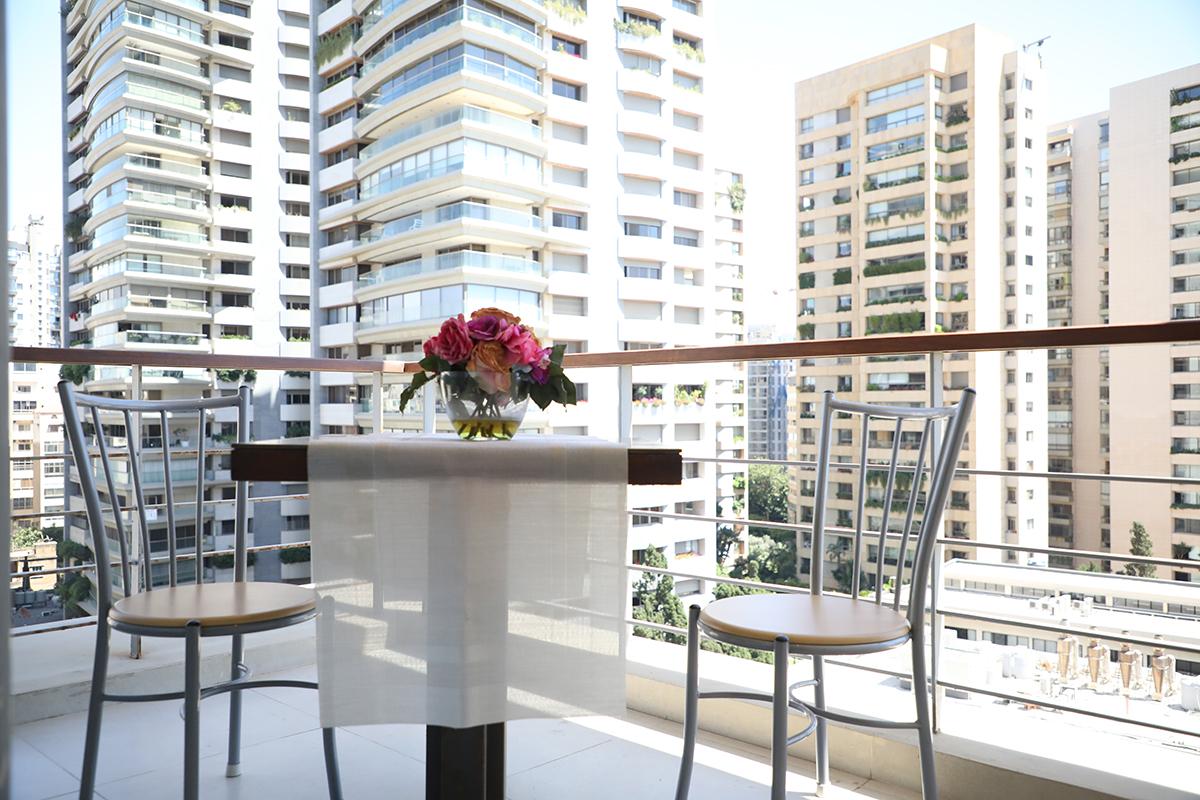
This facility is an off-campus residence building providing a unique luxury living experience to meet the students’ housing needs. A supervisor and a team of assistants manage these dormitories. It provides residents with a wide variety of services to make their stay convenient and comfortable for all LAU students’ academic and social needs. Rooms are neatly furnished with beds, desks, cupboards, safe boxes, bed sheets, and covers. Each room includes a private toilet and kitchenette with a small living room. Cable TV, Internet connection, internal phone lines, laundry facility, housekeeping, and maintenance are also provided. The first level includes a 24/7 reception area with CCTV surveillance and a lobby. Siran Towers is conveniently located at 2-minute’s walking distance from LAU, in a secure area of Madam Curie Street in Koreitem.
Santona Residence
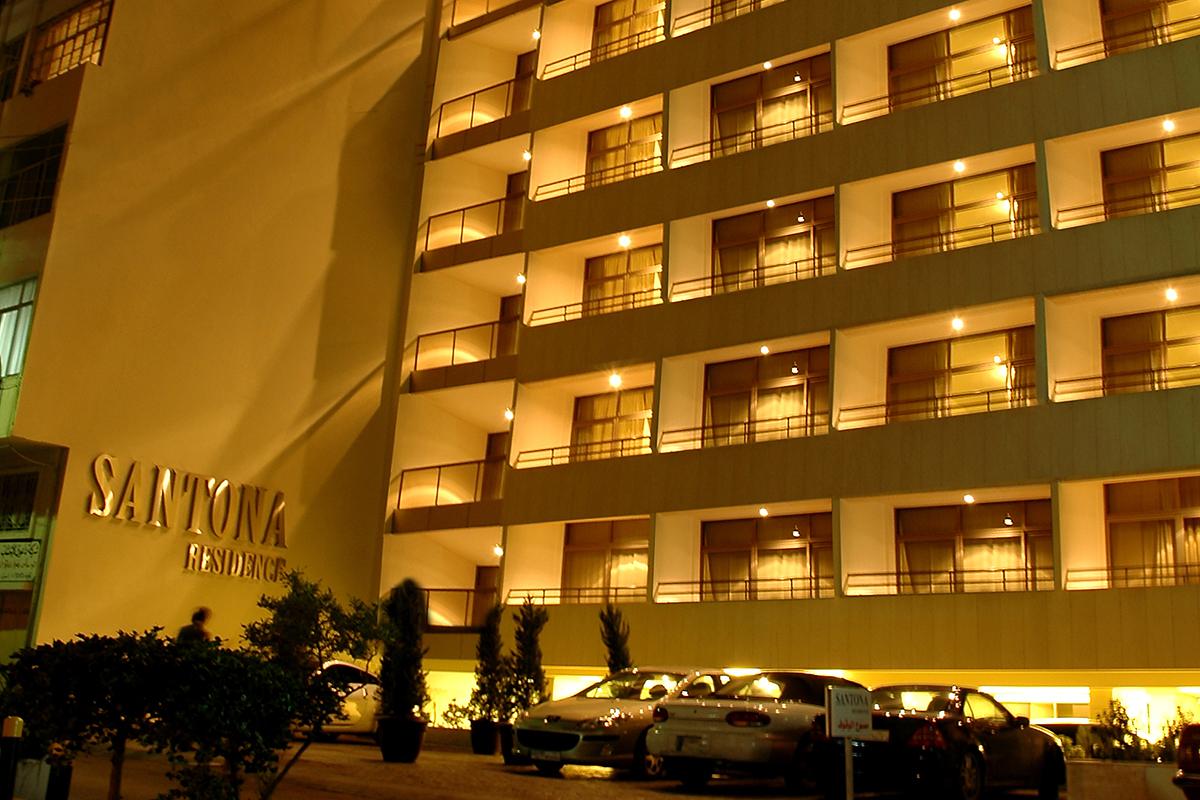
This facility is an off-campus residence building providing state of the art dormitories to meet the students’ housing needs. A supervisor and a team of assistants manage these dormitories. It’s a comfortable and trendy accommodation convenient for all LAU’s students’ academic and social needs. Rooms are neatly furnished with beds, desks, cupboards, safe-boxes, bedsheets and covers. Each room includes a private toilet and kitchenette with a small living room. Cable TV, Internet connection, and internal phone lines are also provided. The first level includes a reception area with 24/7 CCTV surveillance and a nicely furnished multipurpose lounge. Santona residence is conveniently located at 7-minutes walking distance from LAU, in a secure area of Leon street in Hamra.
LAU Libraries Enter New Partnership that Gives Access to School Students
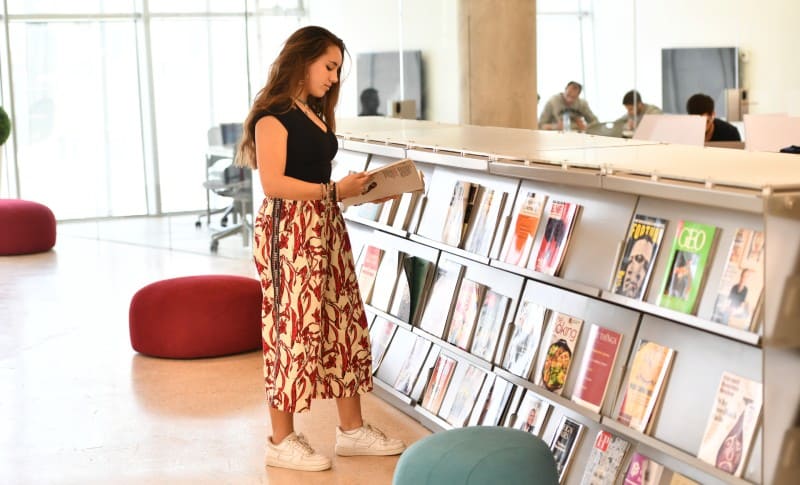
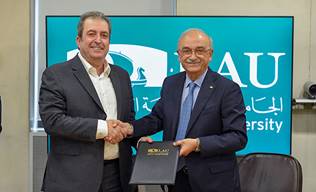
Students from the Monsif International School can now access LAU Libraries through a formal subscription plan signed with the university, which includes training and information sessions on how to use the library facilities. This step underscores the university’s commitment to Quality Education and Sustainable Cities and Communities, two of the United Nations Sustainable Development Goals (SDGs); SDGs 4 and 11, respectively.
Saloua Raouda Choucair’s Sculpture Memorial Plaque Unveiling; Exhibition & Book Launch
April 23, 2024 5:30 PM
Beirut Campus, Orme-Gray Garden, and Art Gallery at the Gezairi Building
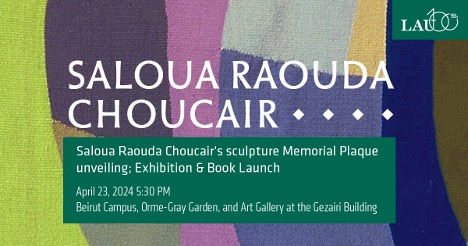
On the occasion of LAU’s centennial year, the Institute of Art in the Arab World at the School of Architecture and Design in collaboration with the Alumni Relations Office and the Arab Institute for Women cordially invites you to an event in honor of renowned painter and sculptor Saloua Raouda Choucair (AA ‘38).
Join us for the unveiling of the memorial plaque on Choucair’s sculpture in Orme-Gray Garden, followed by the opening of an exhibition of her work and a book launch at the Art Gallery in Gezairi Building.
Graduate Fashion Show: Real Time
June 12, 2023 7:30 PM–9:30 PM
Gezairi Building Rooftop, Beirut Campus
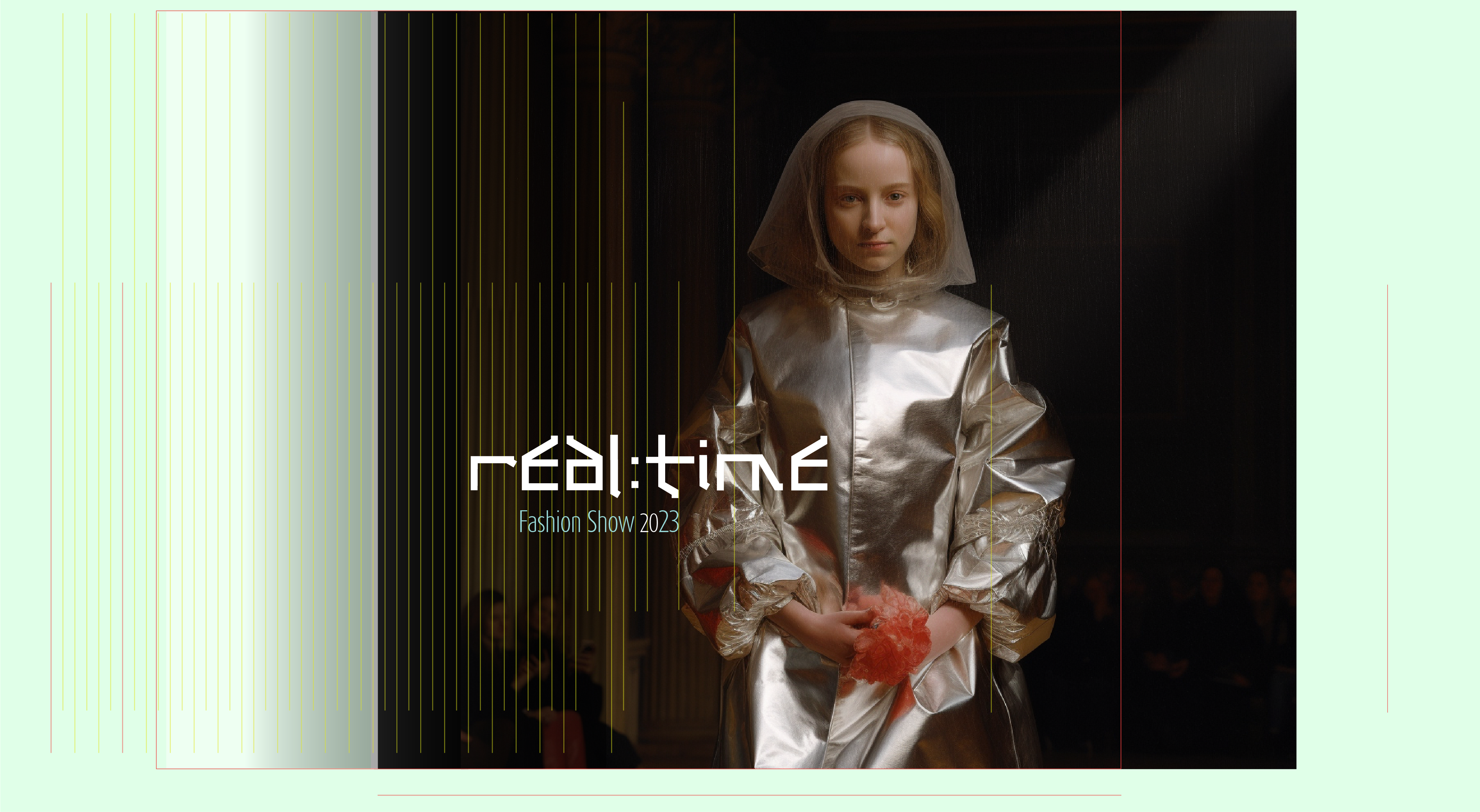 LAU is proud to be organizing a fashion show celebrating the work of its Class of 2023. The show will feature the collections of its 10 graduates of the BFA in Fashion Design in collaboration with ELIE SAAB.

LAU Fashion Design OMT Frontliners Uniform Design Competition Awards Ceremony
May 29, 2024 5:00 PM
LAU Beirut, Gezairi Building, Art Gallery
The Fashion Design program is holding an Awards Ceremony for the Year III Fashion Students at LAU who participated in reimagining the uniform for all OMT FRONTLINERS stationed at the Company’s branches across Lebanon.
The Award Ceremony will showcase five Finalists from which three outstanding winners will be announced, after meticulous deliberation by a Jury Panel.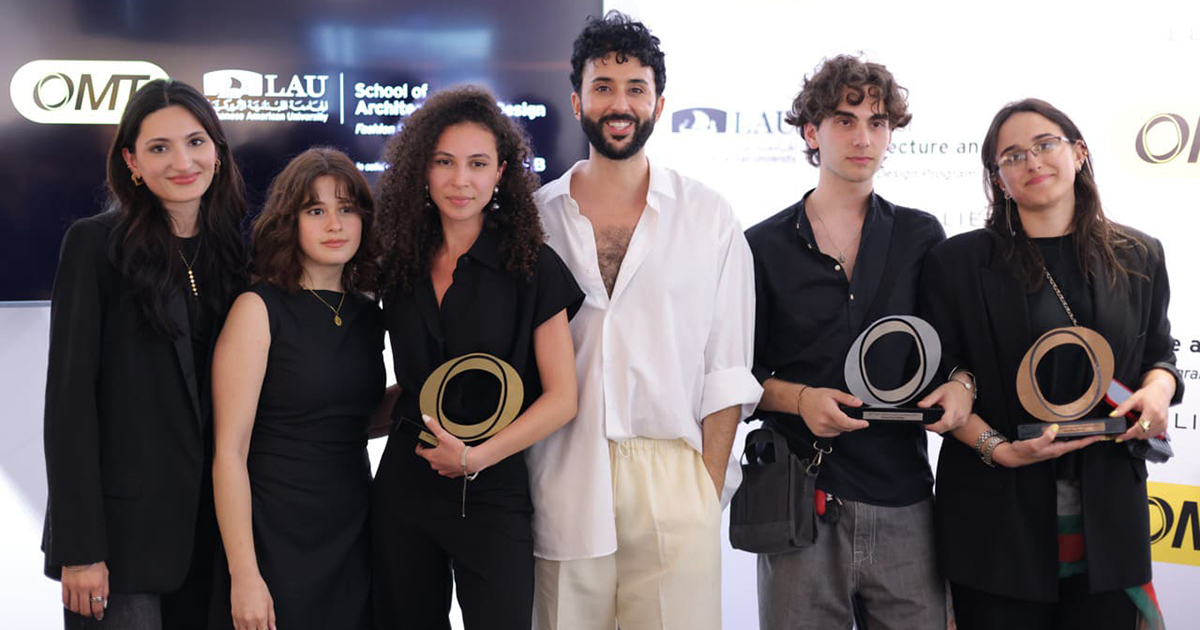
Sustainable Design and Construction
Green Building Certification
We are committed to developing sustainable buildings that reduce resource consumption while protecting the environment and providing a high indoor environmental quality. Increasingly, our building projects involve certifying our buildings by means of green building rating systems, thus obtaining recognition and creating further awareness.
On the Byblos campus, two buildings have recently followed this path:
The Library and Riyad Nassar Central Administration buildings were being constructed with USGBC’s LEED gold certification in mind.
The Tohme-Rizk building in Byblos has obtained the International Finance Corporation’s EDGE certification, becoming the first EDGE certified office building in Lebanon (PDF - 0.7MB). This will result in reductions of 41 percent in energy, 29 percent in water, and 34 percent in materials’ embodied energy compared to local benchmarks. It will reduce, at no additional capital cost, utility expenses for the building by around $600 each month, in addition to saving the environment 21 tCO2 per year.
High Performance Renovations
We aim at transforming LAU’s campuses into high performance facilities, one project at a time, without necessitating large budgets for the retrofitting or replacement of inefficient installations. For example:
- Byblos’ Architecture L1 renovation was designed and is being executed with energy conservation features.
- Beirut’s Wadad Sabbagh Khoury Student Center renovation was designed and executed with water and energy conservation features.
Green Design Guidelines
We are in the process of establishing guidelines for green criteria/systems to be adopted in all of our designs. These would consist of solutions that are most relevant to our culture and to our university’s context, most technically appropriate to each building type, and most financially feasible. We are currently identifying the appropriate systems and will launch this initiative in 2016.
Libraries’ Visitors Rules
- The LAU Libraries exist primarily to meet the needs of the students, faculty and staff of Lebanese American University. We also regularly serve alumni and special guests of the university.
- Other visitors are welcome to use the Libraries’ on-site facilities and resources for research and educational purposes, generally for limited periods of time depending on individual need.
- Visitors from other institutions in Lebanon or abroad working on a special research, Ph.D. or masters’ thesis project are entitled to subscribe (for a fee) to the Library after providing a formal letter from their institution proving the field of study and specifying the time needed to use the Library.
- Once the guest’s eligibility status is confirmed and approved by the Library administration and the subscription fee is paid at the Business Office, the LAU Security Office will be informed in order to facilitate the guest’s entrance to the Library.
- Exceptional cases will need the approval of the Library Director and the Provost.
- Library staff will assist visitors in using the Library’s resources as time and workload permit.
- To facilitate the on-site use of materials photocopy machines and scanners are provided at various locations inside the Library.
- The computers in the Libraries are for use by LAU students. Their primary purpose is for academic applications, with an emphasis on Library-related applications such as searching the online catalog, electronic resources or other online research activities. Questions may be directed to the Circulation Desk staff.
- Visitors’ Library privileges may be terminated at the discretion of any librarian for violation of policies, disruptive behavior or any activity deemed detrimental to the Library or our primary users.
For assistance, please contact:
- E-mail: circulation@lau.edu.lb
- Riyad Nassar Library circulation desk (Beirut Campus), ext: 1213
- Joseph G. Jabbra Library circulation desk (Byblos Campus), ext: 2280
- Health Sciences Library circulation desk (Byblos Campus), ext: 2977

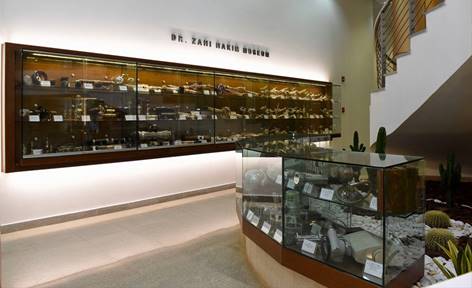
Dr. Zahi Hakim Museum
In the Spring of 2019, Dr. Zahi Hakim generously gifted the Lebanese American University the collection of X-ray tubes and radiology antiques he had painstakingly sought, acquired and maintained over more than 60 years. The collection is now on display at the Chagoury Health Sciences building in Byblos, next to the auditorium, where it can be viewed by visitors and LAU’s medical scholars.
Planning a visit?
The Dr. Zahi Hakim museum is open Monday to Friday from 10:00 am to 4:00 pm, and during the summer from 9:00 am to 1:00 pm.
The Museum closes only on weekends and official holidays.
Visitors can tour the museum but cannot access any other part of the LAU campus.
To book a visit to the Zahi Hakim Museum, kindly send an email to may.chahine@lau.edu.lb specifying details (date, time, number of visitors, names, etc.).
LAU Industrial Hub
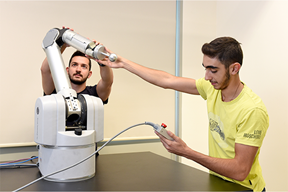
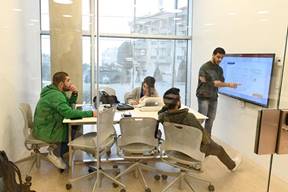
The LAU industrial hub is a one-of-a-kind physical and cyber hub for industry-academia collaboration. We provide services and products tailored to the industry’s needs using LAU’s community and high-tech infrastructure.
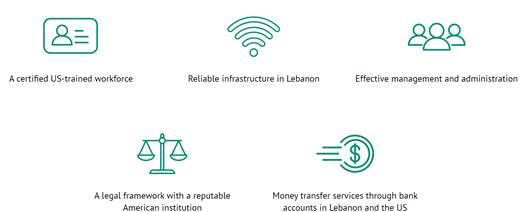
The added value of the industrial hub is its ability to provide a certified US-trained workforce, reliable infrastructure in Lebanon, effective management and administration, a legal framework with a reputable US-based institution, and money transfer services through bank accounts in Lebanon and the US.
 Industry Pods Industry Pods |
|
 Space Rental Space Rental |
 LAU Innovate LAU Innovate |
Key Features
Featured Clients
 Luxeed Robotics Luxeed Robotics |
 DLOC Biosystems DLOC Biosystems |
 WiFast WiFast |
 TopCat Industries |
 MET-CS MET-CS |
 Iteration 360 Iteration 360 |
News
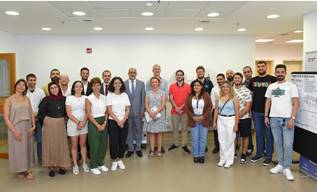 Australian Ambassador Visits the LAU Industrial Hub Australian Ambassador Visits the LAU Industrial Hub |
|
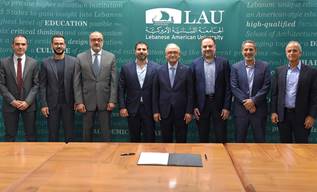
 Partnership to Boost Opportunities in Tech Partnership to Boost Opportunities in Tech |
|
Gezairi Building’s EDGE Certification
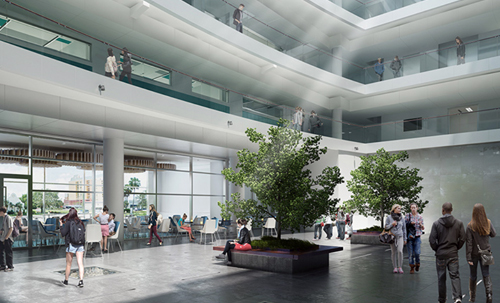
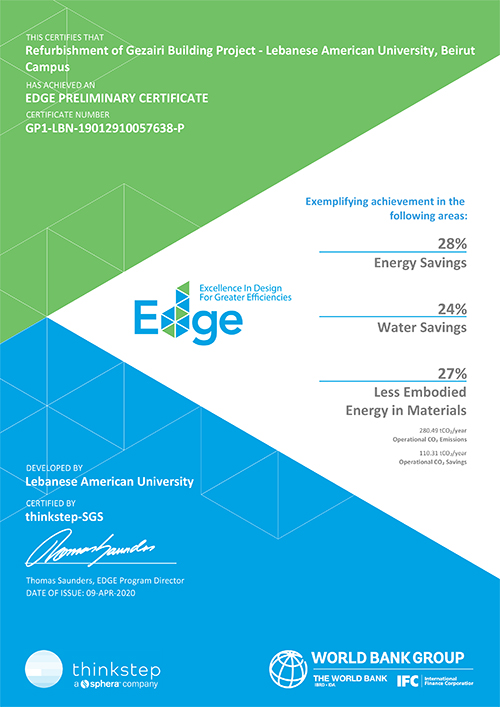
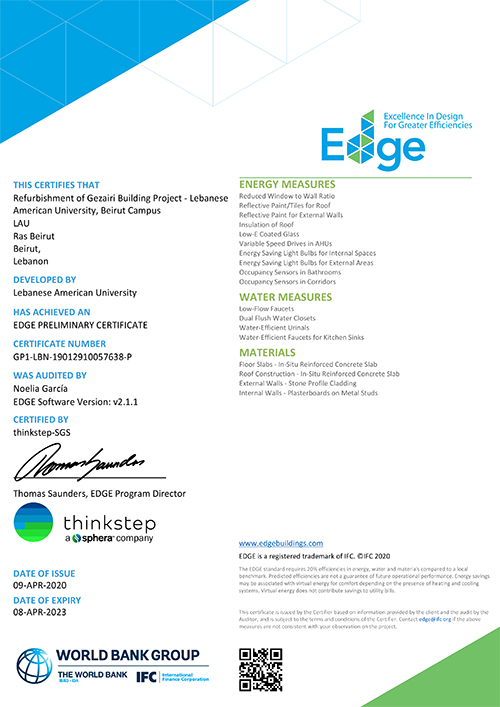
In another landmark project, and a proud LAU Facilities Management’s achievement, the Gezairi building has been awarded the EDGE Preliminary Certificate (Excellence in Design for Greater Efficiencies).
The EDGE certification confirms that the Gezairi building’s resource-efficient design will result in reductions of 28% in energy, 24% in water and 27% in materials’ embodied energy compared to a local benchmark. This new LAU building joins the Tohme-Rizk building in Byblos as the second LAU EDGE-certified facility, based on the guidelines of the IFC (the International Finance Corporation of the World Bank).
Our AVPFM, Georges Hamouche, accredits the effort of LAU Facilities Management’ team and everyone who was involved, since the inception stage, in the design and execution of this monumental and challenging project, for their innovative hard work and for their contributions in securing this inspiring certification, namely:
The Physical Plant-Beirut Engineers: Mr. Roger Haddad, Ms. Rania Tohme, Mr. Hady Nahas, Ms. Abeer Kalawoun, Mr. Emad Abdennour and the entire Physical Plant staff in Beirut, the PM&CA team: Messrs. Shaheen Boujawdeh and Nabil Bedran, The P&R team: Mr. Joseph Shebaya, Mr. Rabih Hosri, Mr. Rabih Nasr and Ms. Dania Dibsi and the entire FM staff who contributed, each in his capacity, in making this goal a reality.
The Consultant, IDEP Consult and their sub-consultants.
The Main Contractor and their MEP Subcontractors, Messrs. Mawad/Edde, ENG and SOGELEC.
The Project Management Firm, DG Jones & Partners.
The Technical Monitoring Office, APAVE Liban.