SDG 16: Peace, Justice and Strong Institutions
LAU actively contributes to SDG 16 by embodying principles of effective governance, justice, and accountable institutions across various facets of its operations. LAU’s governing bodies, including the Council of Deans, Student Affairs Council, Faculty Senate and Staff Advisory Council, play pivotal roles in advising on academic and student life matters, aligning with SDG 16’s focus on inclusive and transparent institutional governance. The Institute for Social Justice and Conflict Resolution (ISJCR) engages in dialogue on national policy issues, promoting justice and conflict resolution, while the Institute for Migration Studies (IMS) addresses displacement challenges, contributing to evidence-based migration policies. LAU’s Institute of Media Research and Training (IMRT) emphasizes transparency and trust in media, supporting SDG 16’s goal of accountable institutions. Additionally, LAU’s commitment to academic integrity and responsible research conduct further aligns with SDG 16, collectively reflecting the university’s dedication to fostering peace, justice, and strong institutions within its community and beyond.
Councils and Committees
Executive officers, faculty, staff, and student representatives, participate in university governance by serving on the following councils, committees, and other bodies. The mandates, compositions, terms, and methods of operation of these bodies are regulated by their respective bylaws.
President’s Cabinet
The President’s Cabinet acts as the top consulting and advisory body to the President on all matters that affect the well-being of the university. It ensures that the university is successfully meeting its mission, vision and goals. It has been operating since the summer of 2005.
Council of Deans
As the highest academic council, the Council of Deans leads all academic matters at the university, acting as:
An advisory body to the Provost and the President, and to other parties when it comes ot academic programs, processes, and procedures.
A liaison body among the heads of the academic units, promoting discussion and exchange of ideas on the effective management of their schools.
Student Affairs Council
As the highest student council, the Student Affairs Council acts as an advisory body to the Vice President for Student Development and Enrollment Management and the President, on all matters related to student life. It also serves as a liaison with all the relevant offices, regarding issues that affect student affairs on campus, to foster discussion and exchange of ideas on how to best serve students in a healthy and productive atmosphere.
University Planning Council
The University Planning Council serves as LAU’s collective think tank, bringing various entities together to discuss and develop methods and means that will assist the university in achieving its mission, vision and goals. It provides advice to the President on all matters relating to long- and mid-term planning, as well as strategic and conceptual university directives and goals.
Faculty Senate
The Faculty Senate, which includes some standing committees, is the main advisory body engaging faculty in LAU’s governance on issues such as academics, faculty status, operating budget, and more. It is composed of 34 members, equally allocated between the two campuses. In addition, each school elects departmental or divisional representatives to the Senate. For more information on the Senate functions, members, structure, constitution, bylaws, meetings, reports and relevant topics, visit the Faculty Senate website.
Student Council Elections 2023: A New Model for Shared Governance
LAU upholds its commitment to democratic student representation on the decision-making table with the election of a new university student council.
By Raissa Batakji October 6, 2023
In keeping with the university tradition of shared governance, a new Student Council was elected at LAU today with the participation of 67.41 percent of the eligible student body. The results were announced as preliminary, as some of the winners will be investigated for allegedly breaking electoral silence.
Thanking the students on both campuses for upholding the democratic process, LAU President Michel E. Mawad emphasized that “LAU is a microcosm of our society and we must be responsible civically toward our country.” He expressed his pride that LAU had pioneered the application of an online voting process back in 2016.
“I must emphasize that this process cannot have any blemish on it,” he added, affirming his support to “rectify any potential breaches.”
Previous councils have largely contributed to enhancing the LAU student experience, from expanding student employment opportunities within the university and extending library opening hours, to improving dedicated student spaces on campus and securing discount packages for their peers with off-campus vendors, among many others.
“We are learning from our own student body year-on-year, and we are constantly improving our student council election process as a result,” said the Dean of Students on the Byblos campus Jad Abdallah. “This reflects a healthy dynamic between the LAU leadership and the students, and reinforces the idea of democratic processes and builds trust,” he added.
As Dean of Students on the Beirut campus Raed Mohsen affirms, online voting has been secure and efficient, especially as it guarantees voters’ privacy. “Learning continued uninterrupted on campus today, as students exercised their democratic right,” he said, hoping that the LAU voting model extends beyond campus gates as it offers a good example for the country at large.
Standing University Councils of the Faculty
The standing university councils of the faculty provide policy and program leadership to all areas of the university. Faculty members of councils representing schools are elected by the school’s full-time faculty, while senate members of councils are chosen by the Faculty Senate. Student members of councils are elected by the students themselves. All elections of faculty members occur before the end of the spring semester, and new members assume their responsibilities at the beginning of the following academic year.
- Faculty Grievance Council
- Faculty Welfare and Promotion Council
- University Admission Council
- University Council for Financial Aid
- University Curriculum Council
- University Graduate and Research Council (UGRC)
- University Library and Information Resources Council
Staff Advisory Council
The Staff Advisory Council consists of elected representatives from each department to allow staff to participate in the governance of LAU. It serves as an advisory body and a forum for LAU staff members to voice their concerns.
Other Councils and Committees
- Campus Life Council
- Committees of Peers
- Institutional Review Board (IRB)
- Special Committees of the Faculty
The Student Councils
Every year, LAU students vote to elect 15 representatives to their “Campus Student Council.” Ten of the representatives also become members of the “University Student Council” that speak for all students when key decisions are made — for example matters related to financial aid, admissions, courses, campus activities, etc.
The representatives are available all year round to take suggestions from students.
Student Councils Representatives 2023–2024
University Student Council
| Position | Name | School | Campus |
| President | Paul Abi Younes | Engineering | Byblos |
| Vice President | Dani Al Jurdi | Adnan Kassar School of Business | Beirut |
| Secretary | Rafqa Rizk | Pharmacy | Byblos |
| Treasurer | Lynn Yamout | Adnan Kassar School of Business | Beirut |
| Officer at Large | Elia Abdelnour | Architecture & Design | Beirut |
| Representative – Curriculum | Yara Abi Fadel | Arts & Sciences | Beirut |
| Representative – Curriculum | Ralph Hanna | Arts & Sciences | Byblos |
| Representative – Financial Aid | Aya Serhan | Arts & Sciences | Beirut |
| Representative – Financial Aid | Joe Zgheib | Adnan Kassar School of Business | Byblos |
| Representative – Integrity | Sergio Thoumi | Graduate Programs | Beirut |
| Representative – Integrity | Kamal Dib | Architecture & Design | Byblos |
| Representative – Library | Rami Beainy | Arts & Sciences | Beirut |
| Representative – Library | Ralph Hanna | Arts & Sciences | Byblos |
| Representative – Admissions | Amir Dib | Adnan Kassar School of Business | Beirut |
| Representative – Admissions | Mark Al Skaff | Adnan Kassar School of Business | Byblos |
Academic School Council
| School | Name | Campus |
| Architecture & Design |
Sereen Ayyoub Kamal Dib |
Beirut Byblos |
| Arts & Sciences |
Aya Serhan Jonathan Maroun |
Beirut Byblos |
| Adnan Kassar School of Business |
Hassan Assaf Mark Al Skaff |
Beirut Byblos |
| Engineering | Paul Abi Younes | Byblos |
| Graduate | Mary Lynn Saad | Byblos |
| Alice Ramez Chagoury School of Nursing | Mohamed Antar | Byblos |
| Pharmacy | Rafqa Rizk | Byblos |
Beirut Campus Student Council
| Position | Name | School |
| President | Ali Yassine | Adnan Kassar School of Business |
| Vice President | Mohammad Hammoud | Arts & Sciences |
| Secretary | Hiba Hayek | Arts & Sciences |
| Treasurer | Razan Fakhry | Adnan Kassar School of Business |
| Officer at Large | Lynn Al Hadi | Arts & Sciences |
Byblos Campus Student Council
| Position | Name | School |
| President | Abdo El Hayek | Pharmacy |
| Vice President | James Gemayel | Architecture & Design |
| Secretary | Karen Sleit | Alice Ramez Chagoury School of Nursing |
| Treasurer | Jad El Chaar | Engineering |
| Officer at Large | Maria Hanna | Engineering |
Academic Integrity
At LAU, you are part of a large and diverse learning community that invites you to experience university life to the fullest: you are protected from all forms of discrimination, and you are welcome to think and express yourself freely.
With freedom comes responsibility, especially as LAU prepares you for the outside world. Below are some highlights from the LAU Student Code of Conduct to help you navigate this social contract.
Academic Violations: Table of Sanctions
LAU strongly encourages you to review the below listed violations regarding cheating as stipulated in Student Code of Conduct.
| Code # | Violation | First Offense | Second Offense |
| Cheating | |||
| 2.2.1 | Using material or equipment (including mobile phones, electronic tablets, i-pads, calculators, and other devices) that is not authorized by the instructor in an examination, project, or graded assignment | zero on the deliverable with a warning | F on the course with a warning |
| 2.2.2 | Cheating, copying, collaborating with or aiding another Student in a manner not permitted by the instructor on an examination, project, or other graded assignment* | zero on the deliverable with a warning | suspension |
| 2.2.3 | Distributing or aiding in the distribution of previous exams without authorization of the instructor | double warning – suspension | suspension – expulsion |
| 2.2.4 | Stealing, reproducing, or circulating an examination or other graded assignment before it has been administered | suspension | expulsion |
| 2.2.5 | Being the Administrator of a communication platform, adding names to a group communication platform, adhering to a group communication platform engaging in any form of cheating, reproducing exams, providing examination answers before, during, or after the examination has been administered | suspension | dismissal |
| 2.2.6 | Impersonating another Student or allowing another Student to impersonate one’s self during an examination, presentation, or other graded assignment | suspension for both | expulsion |
| 2.2.7 | Impersonating an assistant, staff member, or faculty member for the purpose of (a) proctoring examinations without authorization or permission or (b) obtaining confidential information regarding coursework or examinations | suspension – dismissal | dismissal |
Reach out if you need help!
Dedicated LAU counselors and academic advisors are available to help you with:
- Academic difficulties such as learning the language, test anxiety, or having second thoughts about your major.
- Building study habits, such as writing and note taking, time management, memory and concentration.
- Personal worries, such as health, relationship or financial stressors or balancing your time between work and studying.
New Center to Channel LAU Expertise Into National Policy
Economic policy expert Dr. Leila Dagher is poised to lay strong foundations for the new LAU Center for Policy Analysis.
By Dana K. Haffar February 13, 2024
Last fall, Dr. Leila Dagher joined LAU as assistant to the president for public policy with the mandate to establish the new LAU Center for Policy Analysis, an advanced think tank whose goal is to bridge the gap between researchers and policymakers.
“In addition to informing and improving public policy in Lebanon and the region through independent and objective policy-related research analysis and recommendations,” wrote Dr. Dagher, “the center will share data insights and guidance, which will help avoid the fragmented policymaking that resulted in our deep-lasting, multi-dimensional crises.”
The center is one of several initiatives launched by LAU President Michel E. Mawad to help avert future existential threats to the country and, by extension, the university. There is untapped potential in Lebanon for public policy think tanks, and the center can act as a catalyst to start an intellectual revolution that sets the stage for the policy debates of this century.
Before taking up her position at LAU as assistant to the president for public policy as well as an associate professor of economics at the Adnan Kassar School of Business, Dr. Dagher was an associate professor of economics at the American University of Beirut. A specialist in energy policy, she is currently an editor for Energy Policy and sits on the editorial boards of Finance Research Letters and Utilities Policy. She has also been an adjunct lecturer at George Washington University, Washington DC, since 2016 and is currently a co-author on the United Nations Environment Program flagship report, the Global Environment Outlook GEO-7.
Dr. Dagher has published more than 25 peer-reviewed articles, applying in her research her econometric knowledge to the areas of energy, environmental, and financial economics with a focus on producing policy-relevant studies.
In addition to her academic track record, Dr. Dagher is well-versed in policy implementation, having served as a committee member of the Lebanese delegation negotiating with the IMF in 2020 and has in total spent four years as an economic adviser to the government.
“I had the experience of trying to convince policymakers of the best set of policies, how to change existing policies, how to introduce new legislations, and so on,” she said. “It is a challenging environment, but you cannot just sit and do nothing.”
Members of the center will consist of multidisciplinary LAU faculty and staff, including experts in economics, education, demography, political science, governance, energy, sociology, public health and environmental resources, with a view to introducing external experts in due course, said Dr. Dagher.
Initially, the topics will focus on a limited number of tracks but Dr. Dagher expects that six—energy, economics, education, health, the environment, and social issues—will eventually be covered since they are interlinked.
The center will also encourage civic engagement by having students collaborate with researchers and analysts while facilitating internships at public institutions. “The youth are a significant portion of the population, so their engagement in the policymaking process is essential,” said Dr. Dagher.
To keep the research and analysis endeavors active, she added, not only should the topics be relevant and timely, and the research entirely objective, but the output should be adequately communicated to outside policymakers.
“This is why the first set of training I plan to introduce will involve experts who are at the same time scholars and have served in governmental positions to train Lebanese researchers in framing their work in a way that policymakers can understand and apply,” she said. “I think this is the most important aspect of all this work.”
Institute for Migration Studies
Overview
The Institute for Migration Studies (IMS) at the School of Arts and Sciences at LAU is an interdisciplinary, policy-driven and network-oriented research institute that develops research in the areas of Migration, Refugee and Displacement Studies. IMS serves as a resource center for graduate students, researchers, activists, policy analysts, humanitarian staff and scholars interested in the study of Migration and its various impacts on Lebanon and the MENA Region. In line with the overall mission of LAU, IMS aims to advance new narratives and intersectional approaches to the study of Migration through promoting research, generating studies, publishing the IMS’ working paper series and academic blog, organizing public webinars, conferences and workshops, as well as through its memberships in various regional and international networks.
Core Areas of Focus
Research
IMS provides multidisciplinary, independent and critical scholarship on factors determining and resulting from the migration and the forced displacement of populations. IMS drives scholarship and social scientific debates in the areas of Migration both through its own work and by fostering collaboration between graduate students, scholars and practitioners from a wide range of institutions and university departments. IMS additionally facilitates the research activities of local and international scholars and graduate students working on Migration and migrant communities in Lebanon and the MENA Region through connecting them to Key Informants, local actors and specialists working on the ground.
Teaching
The MA in Migration Studies at the Department of Social and Education Sciences at LAU is designed to support and develop the next generation of analysts, scholars and practitioners in the Migration, Refugee and Displacement spaces. IMS works closely with this program, and aims to foster a culture of critical reflection within the wider academic and humanitarian communities, and build upon theories of Migration to develop current and cutting-edge research that can serve as a foundation for later policy development. Along these lines, IMS hosts an annual Summer School, Internship Program, a Graduate Assistant Program, an Affiliate Program and a Visiting Fellowship Program (including at the Post-doctoral level).
Collaboration
IMS strives towards cooperation with international and local institutions, research centers and think tanks with similar agendas, as well as with Migration institutes in universities around the world. The objective is to establish an integrated institutional network for Migration research in Lebanon, the MENA region and beyond.
Dissemination
Through a variety of publications, webinars, workshops, conferences and networking initiatives, the IMS aims to foster engagement with a range of academics, policy analysts and practitioners.
LAU Navigates the Terrain of Climate-Induced Displacement
In collaboration with Rice University’s Baker Institute, the Institute for Migration Studies provided a medium for debate and proposed solutions to the challenges of migration in the MENA region.
Among the effects of climate change on the environment, it has become increasingly evident that the interplay between shifting climatic conditions and resource scarcity is shaping the patterns of migration.
In 2021, the World Bank’s Groundswell report revealed that climate change is one of the catalysts for migration and is projected to force more than 216 million individuals across six global regions to relocate within their national borders by the year 2050.
According to the report, the gradual onset of socially and environmentally damaging impacts left in the wake of climate change, among which are water scarcity, diminished crop productivity and rising sea levels, paint a daunting picture of displacement in the coming decades.
The urgency to address the intersection of climate, development, human rights and migration policy has never been more pressing given that a substantial proportion of individuals displaced by environmental changes are often compelled to cross international borders in search of safety and stability.
In an effort to address one of the gravest challenges of our time, the Institute for Migration Studies (IMS) at LAU partnered with Rice University’s Baker Institute to host a two-day workshop titled Climate-Induced Displacement in the Middle East and North Africa.
On October 9 and 10, the workshop dissected the multifaceted relationship between climate change and displacement, tackling topics on migratory patterns and the long-term effects climate-driven displacement has on the globe and its population.
The speakers also assessed host countries’ observance of the UNHCR’s 1951 Refugee Convention, an international treaty adopted in Geneva in July 1951 that sets out the legal definition of a refugee, enumerates their rights and privileges and outlines the legal duties and obligations of countries toward individuals who meet the refugee criteria.
IMS – an interdisciplinary, policy-oriented research institute – functions as a valuable resource hub for graduate students, researchers, policy analysts, humanitarian professionals and scholars with a vested interest in the study of migration and its implications in Lebanon and the MENA Region.
By inviting proposals for policy briefs and presenting them at the workshop, the institute aimed to encourage and facilitate collaboration among researchers and practitioners in the Middle East and North Africa who are actively engaged in the study and management of climate-induced displacement.
In panels featuring Professor in International Migration Law at the Faculty of Law at the University of Oslo Maja Janmyr, Deputy Director of Research at the Centre for Lebanese Studies Cathrine Brun and Community Standards Director Jennifer Skulte-Ouaiss, the participants discussed how the MENA region is a hotspot for such a phenomenon given that it is characterized by an overlapping dynamic between climate change and conflict.
Not only is the MENA region extremely vulnerable to climate change, they noted, but also to social, economic and political factors that, together with climate change, could increase the probability of migration under duress, creating growing challenges for human development and planning.
“Today’s workshop is a chance to further that discussion and find points of intersection and divergences,” said IMS Director and Assistant Professor of Migration Studies Jasmin Lilian Diab. “We aim to produce a publication series that will expose to other researchers, policymakers and the general public the many ways that climate change will impact migration and refuge in the region.”
The first panel included discussions on the issues and constraints associated with the 1951 Refugee Convention when addressing this crisis, such as the absence of an inherent right for an asylum seeker to enter another nation, a lack of a precise definition of the term “persecution,” which is a fundamental component of the refugee definition and the absence of a more comprehensive alignment between the refugee definition and other human rights.
The panels that followed expounded on country-specific experiences and internal displacement as a human rights concern in the context of climate-induced predicaments, in addition to how proactive global action and far-sighted development planning could potentially reduce the number of climate migrants by tens of millions, thus addressing emerging climate change threats.
Given IMS’ core areas of focus between research, teaching, collaboration and knowledge dissemination, the panelists agreed that everyone has a role to play in the global dialogue about how to better manage and prepare for climate change and its effects. This should be done in the hopes of establishing a vital resource for policymakers, humanitarian organizations and other stakeholders advocating for evidence-based actions.
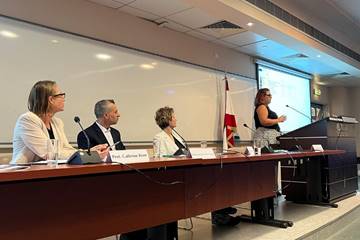 |
The workshop dissected the multifaceted relationship between climate change and displacement, tackling topics on migratory patterns and the long-term effects climate-driven displacement has on the globe and its population. |
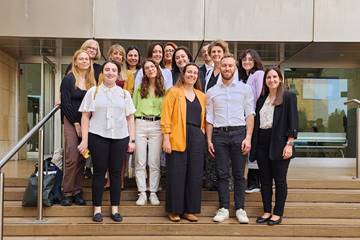 |
In an effort to address one of the gravest challenges of our time, the Institute for Migration Studies (IMS) at LAU partnered with Rice University’s Baker Institute to host the two-day workshop on climate-induced displacement. |
Bridging Divides Blog
Launched in January 2024, the Institute for Social Justice and Conflict Resolution’s “Bridging Divides” blog is a dynamic platform for amplifying voices within the realms of conflict resolution and social justice. The Institute fosters a space for scholars, practitioners, policymakers, researchers and students to engage with pressing issues at the intersections of conflict and social justice.
The “Bridging Divides” blog, founded by the Institute’s Director, Dr. Fadi Nicholas Nassar, invites submissions that delve into various aspects of conflict resolution and social justice. We welcome contributions ranging from 800 to 1,200 words and utilize direct hyperlinks for referencing.
Key areas of focus for the blog include (but are not limited to):
- Diaspora-Homeland Relations
- International Law and Conflict Resolution
- Refugee and Displacement Studies
- Labor Rights and Conflict Resolution
- Gender Equity in Conflict Resolution
- Health Equity in Conflict Zones
- Humanitarian Responses to Conflict
- Conflict Resolution Policy and Practice
- Statelessness, Identity, and Citizenship
- Environmental Justice and Conflict Mitigation
- Inclusive Governance and Conflict Resolution
- Humanitarian Responses in Crisis Settings
- Anti-Corruption Measures in Conflict Zones
Strengthened by its strategic position in Lebanon, a country impacted by concurrent crises and in a region where social justice and conflict resolution shape lived realities, the “Bridging Divides” blog actively engages with global discussions on the rising prominence of global governance, international cooperation, conflict resolution, and social justice on the world stage.
LAU and the Lebanese Armed Forces Strive for National Welfare
By Editorial Staff May 17, 2024
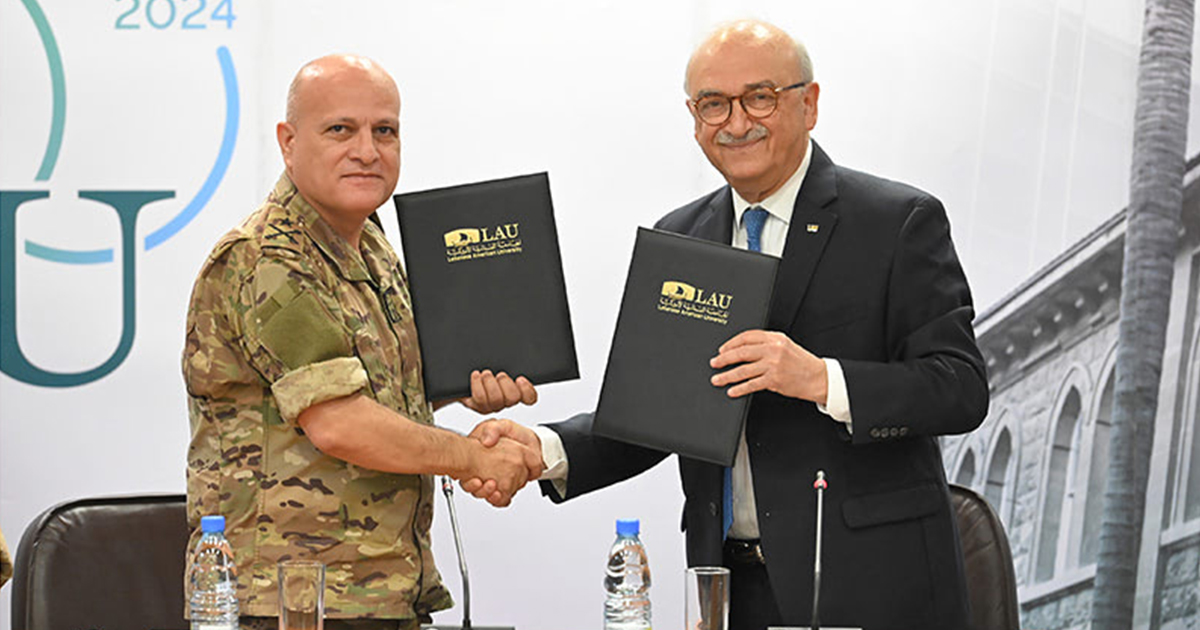
Building on their existing partnerships, a new agreement between LAU and the Lebanese Armed Forces—under the auspices of the Civil-Military Cooperation (CIMIC)—paves the way for consolidating efforts to serve the Lebanese community. This strategic collaboration leverages LAU’s academic knowledge, research, expertise and resources across various fields to initiate impactful and sustainable community development projects and uplift the quality of life for all Lebanese citizens.
“We Are Lebanon:” A Day of Unity and Hope
By Raissa BatakjiDecember 3, 2024

Marking Lebanon’s 81st Independence Day, LAU student clubs organized several activities that helped raise funds to benefit the displaced communities, including selling baked goods, flowers and candles. The Music Club partnered with the Ecole d’Art et de Musique and Layalina, who performed well-known patriotic songs. Their peers in the Public Speaking Club organized a public speaking competition themed around delivering messages of unity and hope for Lebanon.
Partnerships with government institutions:
Fiscal Policy in Lebanon
By Dana K. HaffarJuly 2, 2024
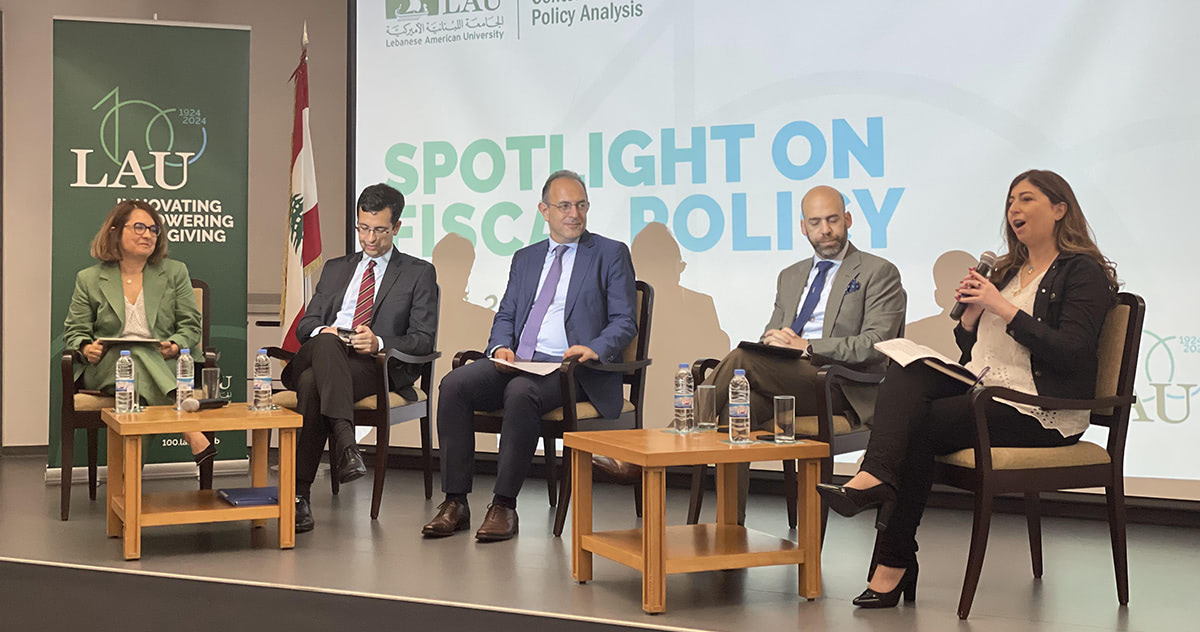 The Center for Policy Analysis and the IMF co-organized a panel discussion titled Spotlight on Fiscal Policy to address Lebanon’s fiscal challenges and propose sustainable economic recovery strategies. Notable experts examined current fiscal policies and proposed reforms to adopt a medium-term fiscal strategy consistent with debt sustainability, enhance revenue generation, and improve public financial management. Dr. Leila Dagher, assistant to the president for Public Policy, stressed the importance of continued dialogue and collaboration among all stakeholders to achieve sustainable economic recovery.
Peace and Justice Education Courses
PJE201 Cross-Cultural Communication and Conflict
[3–0, 3 cr.]
This course examines the basic concepts, theories and issues of intercultural communication and cross-cultural human relations. The course explores how these relate to interpersonal and group conflict and conflict transformation. (Required core course)
PJE201H Cross-Cultural Communication and Conflict
[3–0, 3 cr.]
This course examines the basic concepts, theories and issues of intercultural communication and cross-cultural human relations. The course explores how these relate to interpersonal and group conflict and conflict transformation. (Required core course)
PJE315 Community Conflict and Conflict Resolution
[3–0, 3 cr.]
This course focuses on the social dimension of conflict by looking at group dynamics and social interactions. The course reviews concepts such as group formation, inter- and intra-group communication, group dynamics, cultural, religious and other influences as well as ways communal conflict manifest themselves and how conflicts tend to be resolved in communities. Students would review group conflicts and analyze community conflicts that they are familiar with. This course will be of significant relevance to Political Science, International Relations and Social Studies students. The course will review the role of nongovernmental and governmental organizations in contributing to community conflict resolution. (Required core course)
RESPONSIBLE CONDUCT OF RESEARCH AND RESPONDING TO ALLEGATIONS
1.PURPOSE
The Lebanese American University (LAU) recognizes its commitment to its researchers and the community it serves to ensure the highest ethical standards based on integrity and professionalism in the conduct of research. By fulfilling its mission, the LAU encourages its researchers and faculty to partake in research and professional activities while protecting the concerned community from any form of research misconduct and false allegations.
This Policy provides the guiding ethical and legal principles for the responsible conduct of research and this applies to all those undertaking research at the University and its affiliated facilities (healthcare or otherwise) or on its behalf.
LAU follows this Policy, and relevant procedures, for
- The resolution of allegations of research misconduct,
- Determining threat or harm to the concerned community, sponsored funding and/or integrity of research, and
- Determining the appropriate course of action.
This Policy is intended to carry out LAU’s responsibilities in compliance with, but not limited to, the LAU’s Code of Ethics, LAU’s policies and procedures pertaining to research, and relevant national and international regulations pertaining to the responsible conduct of research, including those applicable to sponsored awards received by LAU.
2. DEFINITIONS
2.1.Deciding Official (DO) means the institutional official who makes final determinations on allegations of research misconduct and any institutional administrative actions. The Deciding Official will not be the same individual as the Research Integrity Officer and should have no direct prior involvement in the institution’s inquiry, investigation, or allegation assessment. A DO’s appointment of an individual to assess allegations of research misconduct, or to serve on an inquiry or investigation committee, is not considered to be direct prior involvement. For the purpose of this Policy, the DO is the LAU President.
2.2. Fabrication is making up data or results and recording or reporting them.
2.3.Falsification is manipulating research findings, materials, equipment, or processes, or changing or omitting data or results such that the research is not accurately represented in the research record.
2.4.Plagiarism is the use of another person’s ideas, processes, results, or words without giving appropriate credit or acknowledging the author, or obtaining their consent.
2.5.Research is defined as a systemic investigation, including research development, testing and evaluation, designed to develop or contribute to generalizable knowledge.
2.6.Research Integrity Officer (RIO) means the institutional official responsible for: (1) assessing allegations of research misconduct to determine if they fall within the definition of research misconduct, and warrant an inquiry on the basis that the allegation is sufficiently credible and specific so that potential evidence of research misconduct may be identified; (2) overseeing inquires and investigations; and (3) the other responsibilities described in this document. For the purpose of this document, the RIO is the Provost.
2.7.Research Misconduct is defined as fabrication, falsification, or plagiarism in proposing, performing, or reviewing research, or in reporting research results.
2.8. Responsible Conduct of Research is defined as “the practice of scientific investigation with integrity.”
3. RESPONSIBILITY
3.1. All Faculty, Staff, Students of the University and its affiliated health care facilities, as well as visitor researchers (if applicable) should adhere to the principles highlighted in this document and report any form of research misconduct as stated in the LAU Procedures for Responsible Conduct of Research and Responding to Allegations.
3.2. The Office of Graduate Studies and Research is responsible for informing, providing awareness and educational seminars, online training and support to faculty, staff and students to ensure responsible conduct of research.
3.3. The Office of Graduate Studies and Research is responsible for implementing, updating this Policy and relevant procedures and ensuring compliance with its terms.
3.4. The DO will make a final determination of the alleged research misconduct following the procedures set forth in the LAU Procedures for Responsible Conduct of Research and Responding to Allegations.
3.5. The RIO, in coordination with the Office of Graduate Studies and Research, the General Counsel’s Office and in line with sponsored award requirements, shall coordinate any required reporting or submissions to the concerned awarding agencies.
4.SCOPE AND APPLICABILITY
4.1.This Policy applies to all researchers conducting research under its auspices including faculty, staff and students as well as visitor researchers (if applicable).
For the purpose of this document, a finding of research misconduct requires that:
4.1.1. There is a significant departure from accepted practices of the relevant research community
4.1.2. The misconduct is committed intentionally, knowingly, or recklessly,
4.1.3. The allegations to be proven by a preponderance of the evidence
For the purpose of this document, research misconduct does not include differences of opinion.
Furthermore, this Policy does not apply to authorship or collaboration disputes and applies only to allegations of research misconduct that occurred within six years of the date the institution or sponsored awards agency received the allegation.
4.2. This document applies to allegations of research misconduct as defined above for the fabrication, falsification, or plagiarism in proposing, performing, or reviewing research, or in reporting research results involving:
4.2.1. Any person, including a faculty member, staff member and/or student who, at the time of the alleged research misconduct, was employed by, as faculty or staff, or was affiliated by contract or agreement with the institution (research collaborators must be made aware of this document) as well as graduate or undergraduate student working under the supervision of a faculty or staff. This also includes members of the faculty research councils /committees within the schools, University Research Council, Institutional Review Board, or any other related Advisory Board or committee).
4.2.2. Any form of research proposed, performed, reviewed or reported, regardless of whether an application or proposal for funds resulted in a grant, contact, cooperative agreement, or other form of funding support related to Sponsored Awards.
This document does not apply to authorship or collaboration disputes or non-compliance related matters pertaining to human or animal research. Concerns regarding non-compliance and violations pertaining to ethical conduct of research involving humans / animals must be reported to the LAU Institutional Review Board for Human participant research.
5. STATEMENT OF POLICY
5.1. LAU will encourage a strong research culture that will demonstrate strong commitment to responsible conduct as per below principles, by actively promoting awareness/training and maintaining an environment of ethical behavior of research.
5.1.1. Integrity
- Oversee and comply with all relevant regulatory and ethical requirements for the conduct of research within LAU and any collaborative organization/institution
- Ensure securing necessary approvals, as it is required, to conduct the research
- Demonstrate accountability of awarded research funds and comply with the specific terms and conditions related to research contracts and grants
- Foster and support honesty in research, in relation to your own research and that of others
5.1.2. Ethical Conduct
- Comply with all relevant regulations, local and international laws or legislations as well as the University’s Policies and Procedures for the conduct of research and the protection of human participants, when applicable
- Secure Institutional Review Board (IRB) approval for all research involving human participants or participants’ information
- Ensure the highest standards of honesty, integrity, accuracy and objectivity
5.1.3. Individual responsibility, Training and Skills
- Conduct the research in accordance with this code and all applicable laws, policies and procedures
- Exercise sound judgement and serve in the best interests of the institution and the community
- Identify and undertake the necessary training and development to carry out the proposed research.
5.1.4. Conflict of Interest
- Recognize and disclose any potential or perceived professional or non-financial conflict of interest relating to any aspect of the research conducted
- Recognize and disclose any form of actual or perceived financial conflict of interest, and or receipt of any form of financial or benefit from a third party relating to any aspect of the research conducted
5.1.5. Compliance
- Ensure that any research undertaken complies with an approved research project, agreements, terms and conditions relating to the project while maintaining proper governance and transparency
- Comply with multi-institutional agreements when researchers are involved in joint research projects, particularly those relating to dissemination of research findings and management of the research data and materials
- Ensure the accuracy, security and accessibility of all research data
- Avoid plagiarism and use of other researchers’ intellectual property, ideas, or data without their proper consent
- Ensure that the data and results are retained or deleted/destroyed in accordance with all legal, ethical, funding organization and University’s requirements.
- Comply with all conditions specified by awarding agencies with respect to the research
5.1.6. Publication and Dissemination of Research Findings
- Disseminate a complete description and related findings of the research project as broadly as possible, including negative findings, results contrary to the hypothesis, and any changes or corrective actions
- Take into account any restrictions to intellectual property or culturally sensitive data
- Cite and acknowledge other relevant work appropriately and accurately when disseminating research findings
- Include information on all funding resources for the specific research and any potential conflict of interest
5.2. LAU will commit to a timely review of up to 90 days and resolution of allegations related to research misconduct that leads, as appropriate, to an inquiry or an investigation, as per the LAU Procedures for Responsible Conduct of Research and Responding to Allegations.
6. EFFECTIVE DATE
The foregoing Responsible Conduct of Research and Responding to Allegations Policy was adopted by the Board of Trustees on March 21 & 22, 2019 and is effective as of March 22, 2019.