Supporting the Start-up of Financially and Socially Sustainable Businesses
LAU provides significant assistance to the local community in supporting the start-up of financially and socially sustainable businesses through relevant education, mentorship programs, training workshops, and access to university facilities.
The Fouad Makhzoumi Innovation Center (FMIC) is an all-inclusive incubation hub that empowers stakeholders to transform ideas into sustainable ventures. FMIC supports entrepreneurs at every stage of development, from raising awareness and defining target markets to securing investor meetings and scaling businesses. Its dynamic programs connect participants with cross-industry expertise to address evolving market demands effectively.
The SPARK Program, a university-based startup accelerator, extends tailored support to students, faculty, researchers, staff, and alumni. It offers mentorship, training workshops, investment opportunities up to $10,000, and access to a robust community of mentors and clients. This comprehensive support helps entrepreneurs validate solutions, adopt customer-centric approaches, and create scalable, impactful businesses.
The university also demonstrates its commitment to social innovation through initiatives like the MEPI-TLP-funded “Towards the End of Period Poverty” project. In collaboration with the Industrial Hub at LAU, a multidisciplinary student team developed a machine to produce affordable sanitary pads. The Arab Institute for Women (AiW) contributed to this effort by hosting awareness sessions, aiding material production, and organizing a panel discussion, showcasing how innovation can address critical social issues.
Further, the Academy of Continuing Education (ACE) provides specialized certifications and diplomas, such as the Professional Real Estate Brokerage program in partnership with the Real Estate Syndicate of Lebanon (REAL). This program equips participants with skills in real estate laws, marketing, property management, and advanced technologies like AI and AR/VR, enabling them to create sustainable businesses in challenging economic conditions.
Additionally, the university’s Outreach & Civic Engagement (OCE) department fosters entrepreneurial and leadership skills through programs like the Tomorrow’s Leaders Scholarship Program and the University Scholarship Program (USP). These initiatives incorporate Individual Development Plans (IDPs) and Community Service Projects (CSPs) that teach essential skills such as project management, budgeting, and team-building, often leading to impactful community ventures.
The Outreach, Leadership & Empowerment (OLE) program further supports entrepreneurship by offering workshops, mentorship, and skills training. Participants gain access to local and international networks, enhancing their personal and professional growth while contributing to sustainable business objectives.
Through these initiatives, the university actively empowers individuals and communities, creating businesses that are both financially viable and socially impactful.
LAU Startups Gain a Head Start
The LAU Innovation Center transforms twelve entrepreneurial ideas into market-ready businesses through hands-on mentorship and seed capital.
In line with the university’s dedication to innovation and giving back to the community, the Fouad Makhzoumi Innovation Center (FMIC), the entrepreneurial arm of LAU, continued for the fourth year to support Lebanese startups in their journey to build sustainable, profitable and impactful businesses.
As part of the centennial edition of its SPARK program, FMIC hosted iDay, the final pitching event for this year’s cohort of entrepreneurs, at the Beirut campus on August 12, 2024, where 16 startups presented their businesses to the LAU investment committee, competing for a $10,000 prize to help them turn their products and services into thriving enterprises.
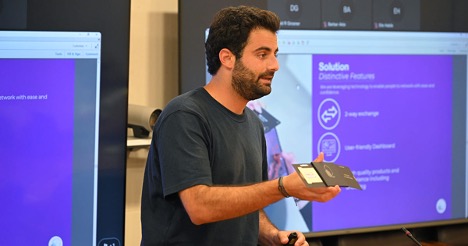 iDay marked the end of a five-month incubation program that began with a record of 107 startup applications. After multiple screenings, 31 teams advanced to a rigorous program featuring 14 expert training modules, including legal, marketing, finance and purpose-driven sales. From there, 20 startups reached Demo Day, and 16 finalists were selected to pitch to the investment committee.
 “It is obvious that the selection process was driven by passion, intense competition and meticulous scrutiny,” said LAU President Michel E. Mawad, who headed the committee alongside institutional and industry veterans.
Committee members included Vice President for Business Development and Global Affairs Elie Badr, Chief Investment Officer of LAU David Grosner, Associate Provost for International Education and Programs Barbar Akle, Director of the Industrial Hub and Assistant Professor of Practice Ali Ammouri, Vice President of Finance Charles Abou Rjeily, Chief Operating Officer at Berytech Ramy Boujawdeh and Anghami Co-Founder Elie Habib.
“The SPARK program not only empowers entrepreneurs by addressing gaps in their expertise and opening networking opportunities with business leaders and LAU partners,” said FMIC Director Annie Seferian, “but it also helps them launch businesses that ultimately contribute to their communities.”
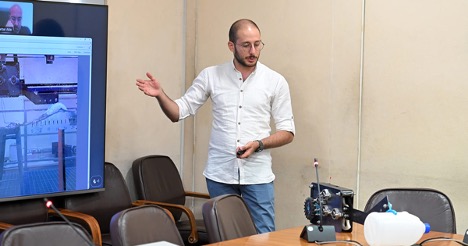
Among the pitching teams were students, alumni, staff and faculty who received tailored mentorship on how to gear their startups toward success. Using a new startup-targeted assessment tool, the jury evaluated the diverse projects, scaling them on innovation, sustainability and business model, among other key elements essential for startup success.
Exceptionally this year, on the occasion of the university’s 100th anniversary, 11 teams were declared winners instead of the customary five, each receiving $10,000. This investment mandates quarterly presentations of their growth and profitability, after which external auditors re-evaluate them for a potentially larger investment.
Winners of the Centennial Cohort Incubation are:
- Coducators SARL: A gamified learning method of skills, such as robotics and coding, to prepare the youth for the new tech-heavy job market.
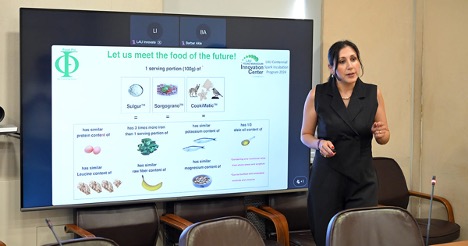
- Food Phi: A range of food products that combines the benefits of sorghum and wheat, offering superior nutrition while using fewer resources.
- Honeylicious Treats: A natural honey powder serving as a healthier sugar alternative.
- Jibly World: An e-commerce platform that provides exclusive Lebanese products to global consumers.
- Muscle Engineer: Nutritious protein snacks that curb cravings and enhance metabolic and energetic performance.
- Netify: A networking application that uses Near Field Communication (NFC) technology and digital business cards to build a dynamic community and turn interactions into meaningful results.
- Parapharma: A digital platform that aggregates premium, expert-approved parapharmaceuticals, cosmetics and fitness essentials, providing personalized recommendations and health content.
- Rukun: A digital platform that connects clients with vetted freelance interior designers, offering customized and affordable design solutions tailored to individual tastes and lifestyles.
- Sourcing & Beyond: A tech integrated supply chain marketplace to allow collaboration between companies and reliable suppliers.
- Stir: Versatile drink capsules for coffee and cocktails that can be added to any base, without a machine.
- WaveTech: A compact and versatile machine that produces usable energy from sea and ocean waves.
Celebrating Excellence in Innovation & Entrepreneurship at LAU
Apr 29, 2024
LAU continues to foster a culture of innovation and entrepreneurship within its academic community. On April 29, 2024, the second round of the Innovation and Entrepreneurship Competition took place at the Adnan Kassar School of Business (AKSOB). The event featured students from both Beirut and Byblos campuses and involved the School of Pharmacy as well as the School of Business. This exemplified the spirit of innovation and provided participants with invaluable experience in conceptualizing business solutions.
Participants presented their interdisciplinary projects to a distinguished panel of judges, including seasoned board members, industry professionals, and LAU faculty and staff. Dr. Michel Majdalani, who designed the course with an emphasis on experiential learning, praised the students’ journey: “This semester has been one of exploration, creativity, and unwavering dedication. Our students have demonstrated exceptional vision and resilience, transforming concepts into impactful ventures.”
The judging panel comprised prominent figures such as Mr. Michel Bayoud, founder and CEO emeritus of Boecker World Holding; Ms. Catherine Moukheiber, CEO of MedDay Pharmaceuticals and Mr. Bassam Tabshouri, founder and chair of the Healthcare Technology Management and Advancement Society. From LAU, the panel included Dr. Mohammad Mroueh, professor and chair of the Department of Pharmaceutical Sciences; Ms. Annie Seferian, director of the Fouad Makhzoumi Innovation Center; Dr. Grace Dagher, associate chair of the Marketing and Management Departments; and Dr. Michel Majdalani.
Projects were evaluated based on their originality, innovation, feasibility, market potential, business model, social impact, and presentation delivery. The students addressed various sectors, including pharmaceuticals, and competed for cash prizes after receiving tailored coaching sessions.
The competition’s sponsor, Mr. Michel Bayoud, was acknowledged for his pivotal role in encouraging an environment where creativity and entrepreneurship thrive. He, along with Ms. Moukheiber, Ms. Seferian and Mr. Tabshouri volunteered their time and efforts to provide mentoring sessions to students throughout the semester.
The competition winners were as follows:
- First Prize ($2,000 and 10 days of coaching): Vanessa Tarraf and Siham Bazzi for “SIVALume: Skincare Serum,” a nano-based serum derived from yeast.
- Second Prize ($1,500 and one week of coaching): Tala Machmouchi, Ghazal El Beb, Nasser Al Allaq, and Rami Youness for “ParaHerba,” a mobile application enhancing integrative wellness in Lebanon.
- Third Prize ($1,000 and five days of coaching), a tie between:
“Connect,” an application simplifying the purchase and exchange of concert tickets, by Raymond Bedran and Mohammad Hajj Ali; and
“Oli Pharm,” an online pharmacy service, by Afifeh Massoud, Celine Abboud, and Antoine Khalifeh.
Ms. Seferian, reflecting on the commitment to nurture the next generation of innovators, invited all group winners to the LAU Innovation Center and offered all participants the opportunity for incubation in the next cohort, along with a chance to win a $10,000 prize through the center.
Dr. Majdalani acknowledged the management department’s leadership role in facilitating the event. “We are grateful for the partnerships we forge with our stakeholders. This joint collaborative effort prepared our students to address real-life challenges through innovation and entrepreneurship. The event highlighted LAU’s dedication to excellence, passion for innovation, and commitment to shaping the future through transformative learning, ” he said.
An Industrial Hub Endeavor Aims to End Period Poverty
A faculty-and-student team delivers solutions to a prevailing socio-economic problem, in collaboration with UN Women and ACTED.
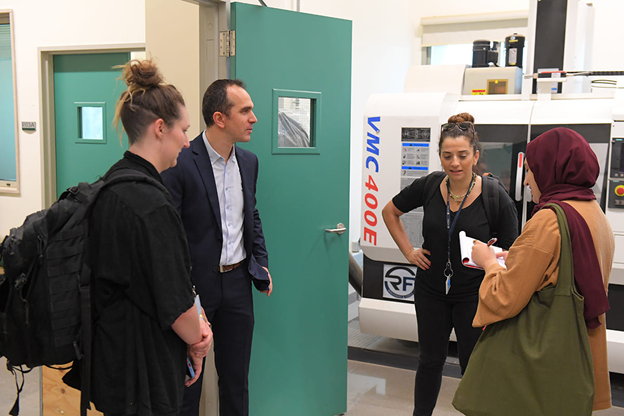
Dr. Ammouri led the tour of the Engineering Labs and Research Center on the Byblos campus.
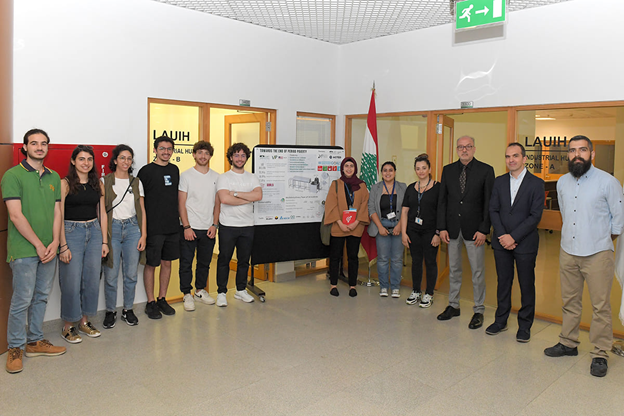
The teams from UN Women and ACTED identified an opportunity to manufacture the unit locally, thanks to a connection with LAU’s Arab Institute for Women that directed them to the newly established LAU Industrial Hub (LAUIH).The students shared progress on the fabrication of the machine and fielded questions from the visitors. Dr. Ammouri led the tour of the Engineering Labs and Research Center on the Byblos campus.
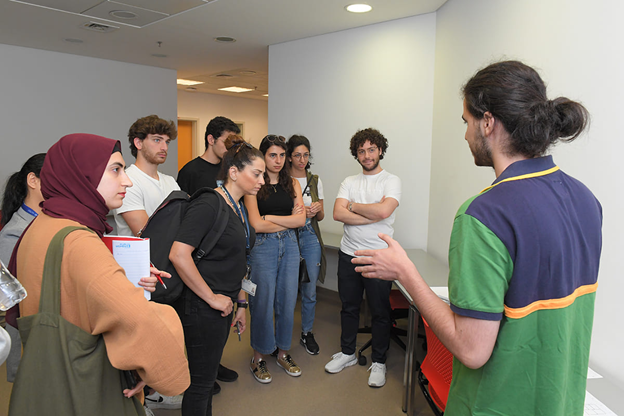
The teams from UN Women and ACTED identified an opportunity to manufacture the unit locally, thanks to a connection with LAU’s Arab Institute for Women that directed them to the newly established LAU Industrial Hub (LAUIH).The students shared progress on the fabrication of the machine and fielded questions from the visitors.Dr. Ammouri led the tour of the Engineering Labs and Research Center on the Byblos campus.
In 2020, a study by Plan International estimated that around 66 percent of adolescent girls and women in Lebanon were no longer able to afford safe and hygienic menstrual care products. Since then, what become known as “period poverty” – the struggle that women face in trying to afford the products that help them manage their menstrual cycles – is still on the rise.
To make these products more accessible to women, a group of 15 LAU students – “the Padvocates” – is working on designing and assembling a machine that manufactures them, which, once launched, will be the first such unit to be designed and fabricated in the region.
The idea took root in an ongoing partnership with UN Women and ACTED, an international Non-Governmental Organization. The two joined forces shortly after the onset of the economic crisis to alleviate the impact of period poverty on vulnerable communities in Lebanon. With the help of several donors, they imported and delivered three manufacturing units of sanitary products to Tripoli, Beirut and Sidon, providing a cost-effective solution to underprivileged women.
The teams from UN Women and ACTED identified an opportunity to manufacture the unit locally, thanks to a connection with LAU’s Arab Institute for Women that directed them to the newly established LAU Industrial Hub (LAUIH).
“Our aim is to bridge the gap between the industry and academia by collaborating with industry partners to outsource their products and services to the LAUIH which aims at delivering these products through our faculty expertise, research capacity, student talent, and our state-of-the-art facilities,” said Assistant Professor of Practice at the School of Engineering Ali Ammouri, who is the director of the LAU Industrial Hub.
He also pointed to the USAID-funded Vertically Integrated Projects (VIP+) Program at LAU, which provides a framework for students from different disciplines to work together while collaborating on LAUIH industry challenges to provide cost-effective products and solutions. Last March, this design won at the Industry-Academia Day and the students presented their work at the Annual VIP Consortium in the US.
Shortly after Menstrual Hygiene Day on May 28, LAU hosted visiting teams from UN Women and ACTED on the Byblos campus, for the students to share progress on the fabrication of the machine. The visitors toured the Engineering Labs and Research Center and engaged in discussions with the team on their experience so far.
Fifth-year mechatronics engineering student Ralph Sakhat reflected on his journey of discovery, research and development throughout the project. “Learning from what the women and girls had to say during our research has been eye-opening for me, especially as we have come across some shocking numbers,” he said, adding that “our job as engineers is to solve problems, and this project has been very inspirational in that sense.”
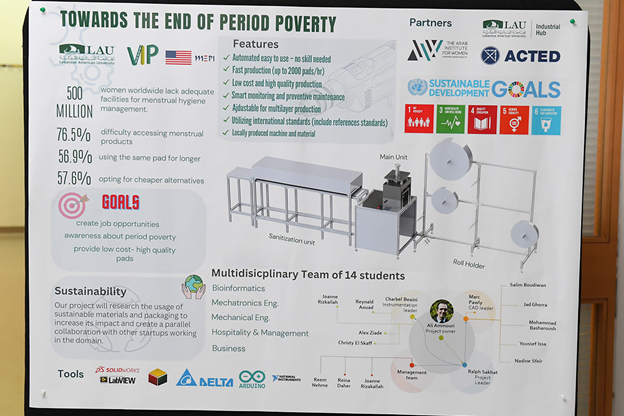
“As a woman, I struggled first-hand from the continued rise of period-care products, and it has been very fulfilling for me to put my engineering skills to use for a cause that is very important to us,” said fourth-year mechatronics engineering major Joanne Rizkallah.
For Program Assistant at UN Women Nour Abdul Reda, localizing the manufacturing of the machine is intuitive: “In Lebanon, we have brilliant minds who shine across different sectors – why not work with the local talents to produce something we so desperately need?”
Sakhat explained how a locally manufactured machine is more cost-effective in the long term, since its maintenance and procurement of spare parts can be sourced locally, and saves the time and resources spent in communicating with international suppliers and waiting for shipments to arrive. “Since we are the ones who created the machine, we would be able to fix it,” he noted.
This collaboration opens many doors for the students on one hand and for the industry partners on the other, said Dr. Ammouri. He gave the example of a final year student project, a wash station, that was adopted by the Red Cross to help maintain hygienic practices at refugee camps. “The sky is the limit to the solutions that we can offer together with our students through the LAUIH,” he said.
Echoing this thought, Vice President for Business Development and Global Affairs Elie Badr hoped that this project will be “a landmark launch for the LAUIH, with many more to follow.”
LAU Innovation Center
What is your objective?
I am an Entrepreneur, I have a Startup Idea, But…
- I don’t know if my idea will work
- I don’t know if the market is ready or interested in my idea
- I don’t know some topics, like Legal, Marketing, budgeting…
- I need help to pitch it to investors & get funds
- I don’t know how to scale it, grow internationally
The LAU Spark Program is right for you!! From Passion, to idea, to product!
All students, Staff, Faculty and Alumni are eligible to apply.
Gain access to the most influential connections in your industry
LAU Fouad Makhzoumi Innovation Center (LAU FMIC) is an innovation center that provides all LAU stakeholders with an all-inclusive incubation hub. We aim at fostering entrepreneurship endeavors and transforming ideas into sustainable businesses.
Throughout our programs, we work closely with our startups on raising basic entrepreneurship awareness, defining a target market, finding product-market fit, to getting first validation for the startups. We are also instrumental in helping entrepreneurs prepare for investor meetings, thereby guiding them throughout the whole product development process.
The rigorous and dynamic programs prepare entrepreneurs and matchmake them with cross-industry expertise and diverse perspectives to innovate and meet the new and evolving demands of the market.
Apply to Our Program.
Take a step forward in your career! Apply to start your new journey.
LAU SPARK Program
A full suite university-based Startup Accelerator for students, faculty, researchers, staff, and LAU alumni.
SPARK helps entrepreneurs:
- Develop their ideas into viable solutions
- Validate their solutions with a customer-centric and international focus
- Turn their solutions into scalable business
- SPARK offers:
- Investment up to $10,000
- Supportive community of mentors and dealmakers
- Clients to validate the business and help build needed solutions
Your Journey in LAU FMIC
The world is enormous—yet everything is within reach. Once you get accepted into our programs, you will develop connections, skills, products, and services. You will also gain access to companies and potential early adopters that are prepared to drive innovation in Lebanon and the regional economy.
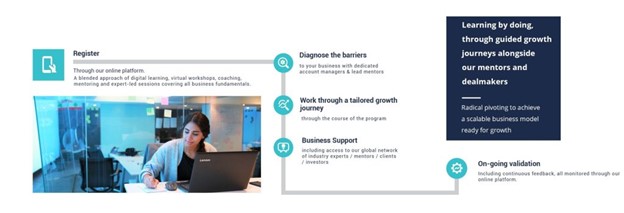
Unlike traditional innovation centers, LAU FM Innovation Center offers programs that constantly evolve to keep pace with the dynamics of the modern 21st-century technological advancements.
Outreach and Civic Engagement - USP
OCE manages LAU’s USAID University Scholarship Program (USP), which allows academically qualified but financially underprivileged Lebanese students from public high schools to attend the university. The program aims to provide quality education in various majors and develop the leadership potential of the students, providing them with the skills necessary to build their communities.- Under the leadership component of USP, every student is required to implement a community service project (CSP).
- The CSP aims towards:
- Developing and testing the leadership skills gained through training in the field;
- Personal development of scholars.
- CSPs help students gain:
- Team-building skills;
- Networking and communication skills;
- Project conceptualization and budgeting skills;
- Self-confidence and leadership skills;
- Better appreciation of diversity.
- Students must follow a certain process during the conceptualization, implementation, and evaluation post implementation
Volunteering Program (OCEVP)
OCE launched in Fall 2019 a volunteering program “Outreach & Civic Engagement Volunteering Program” (OCEVP), specifically for LAU students under the Higher Education Scholarship (HES) program.
Those allocating LAU HES volunteers should complete 4 hours of volunteer activities per month. Accordingly we will be sharing with you the list of assigned LAU HES volunteers on a monthly basis.
Individual Development Plans (IDPs)
Geared for scholars of the University Scholarship Program, the IDP is a live document that guides students throughout their years at LAU, and brings OCE up to speed on their interests and needs. It allows the scholars to explore their holistic potential and advance their soft skills, character development and career-readiness.
- During their first semester at LAU, the scholars set the general objectives pertaining to their personal development, including opportunities for leadership and civic engagement.
- Every semester, the scholars update the IDPs to identify internships, community development projects, and NGOs they wish to work with.
Outreach, Leadership & Empowerment (OLE)
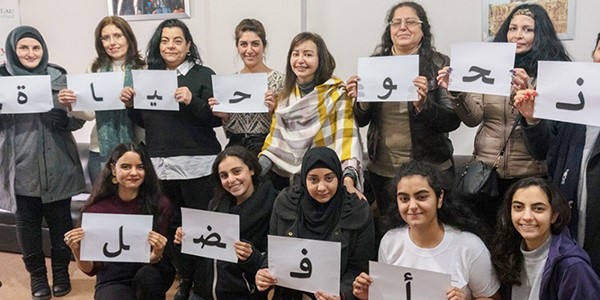
The Outreach, Leadership & Empowerment (OLE) at LAU aims at fostering holistic student empowerment. Through specific leadership and outreach programs, OLE aims to equip students with essential skills, promoting resilience and inclusive leadership. It fosters a diverse and inclusive campus environment and provides opportunities for personal and professional growth. It encourages students to broaden their horizons both within and outside Lebanon through leadership training, skills development, and volunteering opportunities.
OLE prepares students for their future roles as global citizens and ethical leaders. Its main objective is to have students equipped with needed skills and tools to thrive both personally and professionally.
How will OLE transform my experience?
- You will be exposed to like-minded people in Lebanon and beyond.
- You will develop essential soft skills such as leadership, communication, conflict-resolution, team-work and resilience.
- You will grow your life-knowledge beyond academics, through volunteerism, local and international conferences, as well as seminars and training.
- You will benefit from OLE’s 10+ years of experience in offering unique programs and opportunities that will match your interests and challenge your givens
Community Service & Engagement (CSE)
The Community Service & Engagement (CSE) at LAU aims to provide LAU students and student recipients of USAID scholarship grants with the tools, opportunities, and guidance needed to not only excel academically but also become active, compassionate, and socially responsible leaders within their communities and the world at large.
CSE serves as the driving force behind fostering a culture of community engagement throughout the LAU community. We provide innovative and immersive programming that encourages LAU students to explore the diverse landscapes of their nation while contributing to meaningful causes. This experiential learning is not just an addendum; it’s a vital facet of the LAU academic journey.
Join us in shaping compassionate pioneers dedicated to making a profound impact in their communities. Discover how CSE at LAU transforms students into engaged citizens, equipping them with the skills and empathy needed to build a better tomorrow.
How will CSE transform my experience?
- Aptitude Development: Participating in CSE programs allows you to hone your core competencies through practical experiences, workshops, and interactions with mentors, empowering you to become a more effective and influential changemaker.
- Community Impact: CSE offers chances to engage in community service and public service initiatives, enabling you to make a positive impact on society and develop a sense of social responsibility that goes beyond the classroom.
- Personal Growth: Beyond academic excellence, CSE promotes personal growth by encouraging self-discovery, resilience, and adaptability, preparing you to face challenges and seize opportunities with confidence.
ACE Graduates a New Batch of Real Estate Professionals
Life-long learners from various age groups, education, and professional backgrounds advanced their legal, business, and marketing skills in real estate brokerage.
In the midst of the country’s economic crisis, the real estate sector stands as a reliable refuge for depositors seeking to protect their savings. This sector’s enduring strength is attributed not solely to the collaborative dedication of its professionals but also to the high-caliber skills and expertise they employ to facilitate transactions and preserve investments.
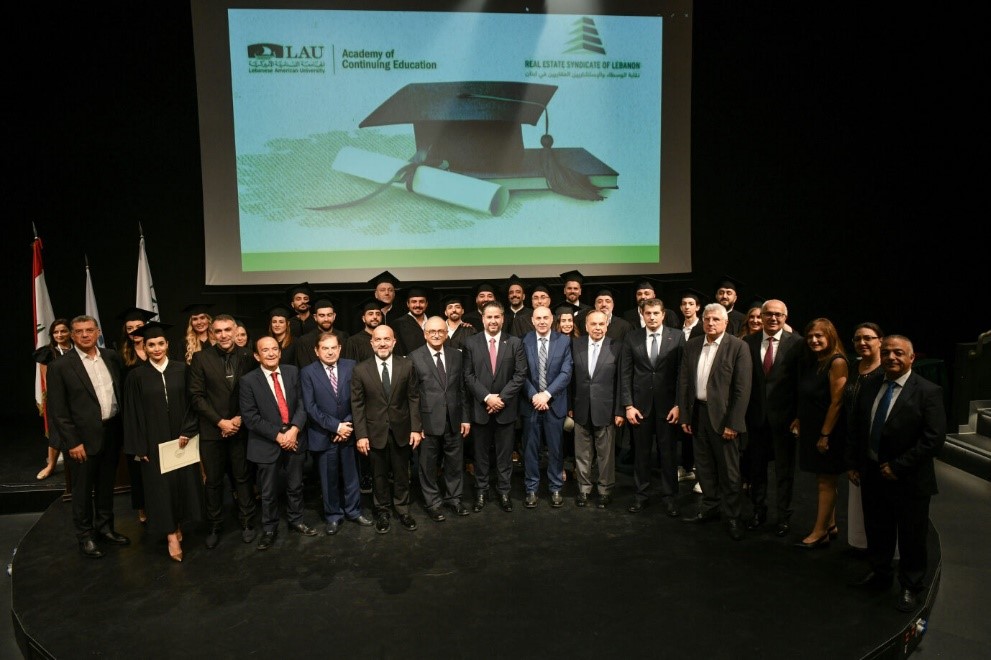
In line with imparting relevant and up-to-date knowledge and skills to the community, the Academy of Continuing Education (ACE) at LAU, in partnership with the Real Estate Syndicate of Lebanon (REAL), celebrated the graduation of its fourth cohort from the Professional Real Estate Brokerage program in a ceremony at Gulbenkian Theater, Beirut campus, on October 17.
Choosing LAU as their destination for personal and professional growth, 35 life-long learners from various age groups, education, and professional backgrounds advanced their legal, business, and marketing skills in real estate brokerage.
LAU President Michel E. Mawad commended the graduates’ decision to acquire a specialized certificate instead of plunging into the job market. “Your joining this sector at such a critical juncture will undoubtedly have its positive effect and contribute to its regaining its known level of vitality,” he said.
During the event, ACE Director George Obeid seized the opportunity to unveil an extensive real estate brokerage diploma program as an extension of the existing certificate, developed in partnership with REAL and under the sponsorship of the Minister of Economy and Trade Amin Salam.
The diploma will cover 135 effective teaching hours and will encompass the latest marketing techniques, including artificial intelligence (AI) and artificial and virtual reality (AR and VR), in addition to a comprehensive coverage of real estate building and construction laws, economics, valuation, and property management.
Students and brokers have the flexibility to choose between the certificate or diploma programs to match their individual needs and scheduling preferences, noting that membership in REAL is exclusively available to brokers who successfully complete the certificate program.
As a fundamental mission of ACE, Obeid emphasized the significance of ongoing education and “investment in education as key to the sustainable development of the economy.”
The program will be the first of its kind in the Middle East, and its importance, according to Walid Moussa, president of the International Real Estate Federation and of REAL, lies in the “need to improve real estate laws, regulate real estate professions, and protect consumers.” The certificate is intended for all people who want to work in the real estate sector in Lebanon and abroad and for employees of the private and public sectors.
Minister Salam praised the joint efforts of the syndicate and LAU in regulating frameworks of the real estate industry and highlighted the pivotal role they play “in unlocking the sector’s full potential and ensuring substantial investments.”
Commenting on his experience at LAU, Charbel Kallas, a fourth cohort graduate, member of REAL, and an owner of a real estate company, said: “This program has offered me the professional development and skill enhancement I have consistently pursued.”
Graduate Seroj Serop, a NIIAR Real Estate employee with eight years of experience expressed his profound appreciation for the program.
“While I had practical experience in the field, this program provided me with valuable knowledge needed to complement my hands-on expertise,” he said.