Mental Health Support For Students
LAU is deeply committed to fostering a supportive and inclusive environment by providing comprehensive access to mental health support for both students and staff. Through dedicated counseling services, employee assistance programs, and a robust network of mental health professionals, we ensure that our community has access to confidential support services. Additionally, the university organizes workshops, training sessions, and wellness programs aimed at promoting mental well-being and reducing stigma around mental health. By integrating these resources into campus life, we prioritize the mental health and resilience of our community, recognizing its critical role in academic and professional success.
LAU Promoted Mental Health Awareness Through Support Events and Counseling Initiatives
Byblos, December 11, 2024 — The Department of Liberal Studies at the School of Arts and Sciences held a campus-wide well-being campaign titled “It Is Okay Not to Be Okay: The Importance of Mental Health Awareness” at the LAU Byblos Campus Fountain Area. The initiative aimed to normalize conversations around mental health, reduce stigma, and encourage students to seek help when facing emotional or psychological challenges.
Through targeted activities and interactive sessions, the event highlighted the importance of acknowledging mental health struggles as common and manageable, while promoting early intervention and peer support. The campaign reinforced the message that students should not have to suffer in silence and that help is always available through LAU’s counseling and wellness services. The initiative also sought to foster a compassionate and inclusive campus culture, empowering students to prioritize their mental well-being and that of their peers.
In parallel, the university continued to provide ongoing mental health support through various programs and partnerships.
On October 7, 2024, Counseling Services launched the first in a series of psychological support groups titled “Talk It Out,” led by Dr. Joumana Haddad and Ms. Tala AlNoweisser. The session offered students a safe and confidential space to share their experiences and emotions, particularly in light of recent hardships. Participants engaged in open discussions, while facilitators introduced coping strategies and emotional regulation techniques to help manage stress and anxiety.
Expanding these efforts to the broader community, the LAU Gilbert and Rose-Marie Chagoury School of Medicine’s Office for Continuing Medical Education (CME), in collaboration with the School of Arts and Sciences, launched a weekly online psychological counseling series beginning in late September 2024. The initiative aimed to support LAU students, faculty, and staff during times of crisis by providing expert-led discussions and practical mental health advice.
The first webinar, “Supporting Children and Families in Times of Crisis: Managing Panic and Anxiety,” held on September 26, featured Associate Professor of Clinical Psychology Pia Tohme and Clinical Assistant Professor of Psychiatry Wael Salame. The speakers addressed how parents can communicate with their children about traumatic events, manage fear, and provide reassurance during uncertainty. A second session, “Dealing with Uncertainty,” held on October 2, explored coping mechanisms for prolonged stress, survivor’s guilt, and emotional fatigue, providing tools for self-awareness and emotional regulation.
Associate Dean for Faculty Affairs and Development Dr. Vanda Abi Raad, who moderated the webinars, emphasized the importance of collective support. “As a community, we need to support each other by sharing resources and expertise, which is exactly what this series aimed to achieve,” she said.
The sessions, held every Wednesday from 12:00 to 1:00 p.m., drew significant participation and engagement, reflecting LAU’s commitment to fostering mental health awareness and providing accessible psychological support for its community.
The LAU Mobile Clinics Deliver Healthcare and Renewed Hope to Lebanon’s Displaced
In collaboration with the Ministry of Public Health’s assigned primary healthcare provider, the Beirut Association for Social Development–Health Sector, LAU embarks on the first of a series of missions to bring vital relief to the displaced.
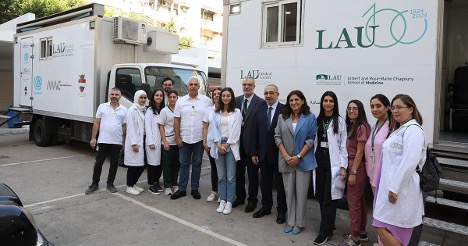
On October 9, 2024, in coordination with the Ministry of Public Health’s assigned primary healthcare provider—the Beirut Association for Social Development (BASD)–Health Sector— and as part of the university’s Emergency Relief for Lebanon, teams from the LAU Medical Center–Rizk Hospital, the LAU Medical Center–Saint John’s Hospital, LAU Gilbert and Rose-Marie Chagoury School of Medicine, LAU Alice Ramez Chagoury School of Nursing, and LAU School of Pharmacy deployed two mobile clinics to Amlieh High School in Ras El Nabaa in the first of several missions to provide essential primary care services, screenings, and dispense medications to those in need.
Upon leaving their homes, most of those displaced had either lost or had to leave behind their belongings, medicines and medical records, while newborns, lactating mothers and chronically ill patients lacked access to vital treatments. True to their raison d’être of helping Lebanon’s underserved populations, the LAU Mobile Clinics rose to the challenge. The missions were further strengthened through the skilled logistics and nursing teams at BASD, which ensured the smooth coordination and delivery of services, complementing LAU’s medical expertise with vital operational support.
At Amlieh High School, which currently shelters around 800 displaced people, the LAU medical centers’ teams—comprising one internal medicine physician with two residents, one pediatric physician with two residents, as well as four nurses and four staff members—provided primary care services, consultations, and counseling to more than 100 patients, including 44 children averaging 7.5 years of age.
At the end of the visit, the LAU team distributed 150 family care hygiene kits and 150 first aid kits and raised awareness on health and hygiene best practices.
Moving forward, the LAU Mobile Clinics Emergency Relief missions will pick up pace in the coming weeks to address the needs of as many displaced people as possible. As part of a comprehensive integrated care approach, the missions will involve the LAU schools of medicine, pharmacy, nursing, and the psychology program to ensure an integrated, comprehensive support. This initiative will provide not only primary care and mental health support but also essential pharmaceutical services and health education to improve outcomes for displaced families.
In its commitment to making a lasting difference, LAU will work tirelessly and collaboratively to provide care, compassion, and hope to every community we serve.
Click here to support the mobile clinic’s mission.
Lebanon is facing a humanitarian catastrophe, and the need for urgent support has never been greater. Your help can enable LAU to deliver critical healthcare for patients, provide primary care and mental health support to displaced individuals, and safeguard the future of students facing hardship. You can learn more by visiting the LAU Emergency Relief for Lebanon.
Counseling Services
Counseling at LAU helps you power through your university years. Starting with the school-to-college transition and all its emotional baggage, to dealing with anxiety such as that associated with remote learning, university counselors equip you with essential tools to effectively manage current and future problems.
Sessions are strictly confidential and free of charge for all students. They are typically scheduled once a week and may expand over several weeks depending on the objectives identified by the counselor.
When Should I Seek Help from a Counselor?
If you are experiencing one or more of the following concerns:
- Test anxiety
- Sleeping problems
- Low self-esteem
- Alcohol or drug abuse
- Concentration problems
- Decision making problems
- Dramatic mood swings
- Hopelessness or helplessness
- Exposure to sexual, physical, or emotional abuse
- Anxiety, fear, or anger that affects everyday life
- Eating disorders
- Suicidal thoughts
- Loneliness and/or homesickness
- Procrastination
- Relationship issues (family, friends, romantic)
- Loss of a family member or loved one
- Poor academic performance.
What Types of Counseling Services Are Offered at LAU?
- Short-term individual counseling
- General consultation
- Group counseling
- Academic skills guidance
- Career/vocational counseling
- Crisis interventions
- On/Off campus referrals
If the counselors believe that the student’s concerns are beyond the scope of the services provided at LAU, they will provide the student with a list of off-campus professionals (i.e., psychotherapists and/or psychiatrists) from which to choose.
How will a Counselor at LAU Help Me?
Counseling at LAU offers you the chance to:
- Disclose and discuss sensitive issues in a safe environment
- Confide in someone who can be trusted for their open-mindedness and professional help
- Receive support and aid in overcoming distress
While knowing that all the information discussed during counseling sessions:
- Will not go on your official record, nor on your transcripts
- Are strictly confidential – unless the counselor identifies that there is potential for self-harm, or harm to others.
Tips During these Challenging Time
Guidelines and Tips
 |
 |
 |
 |
 |
 |
Managing Anxiety Through a Holistic Balance of Mind and Body
LAU Medical Center-Rizk Hospital hosts a cross-departmental initiative to increase awareness of the relationship between the physical and mental impacts of anxiety.
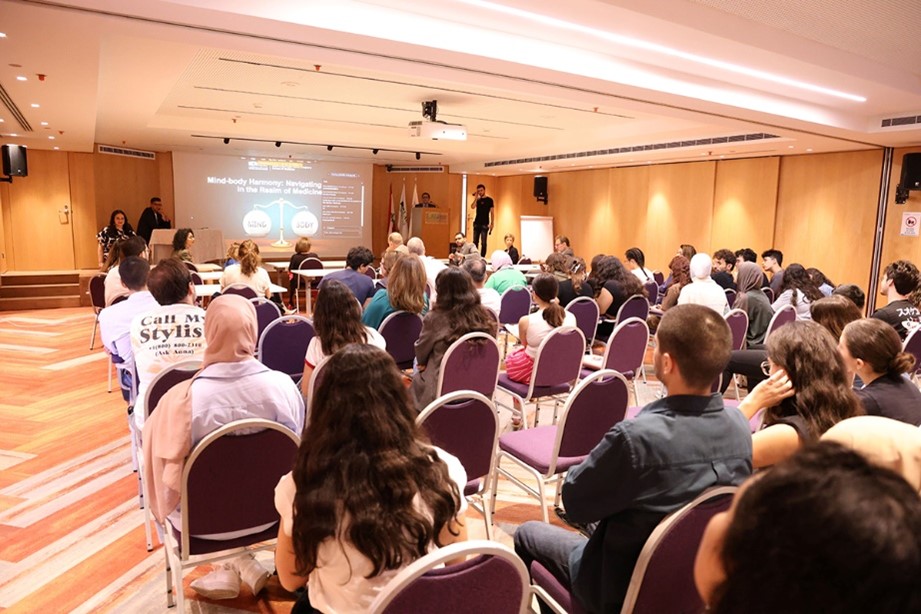
The event was attended by students and staff, in addition to residents and physicians as part of their continuing medical education.
With 14 types of anxiety disorders affecting more than 300 million people globally, the condition can have a profound impact on the mental, physical, and overall wellbeing of individuals across age groups. However, due to the prevalent siloed approach toward patient care, the medical community faces challenges in early screening, diagnosis, and treatment of one of the most common psychological disorders.
To tackle this significant issue, the Gilbert and Rose-Marie Chagoury School of Medicine, in collaboration with the Psychology Program at the School of Arts and Sciences, organized a symposium titled Mind-Body Harmony: Navigating Anxiety in Medicine at the LAU Medical Center-Rizk Hospital on November 4, 2023.
Managing Anger During Uncertainty
LAU Clinical Psychologist Wissam Kheir addresses common concerns on anger management and psychological uncertainty.
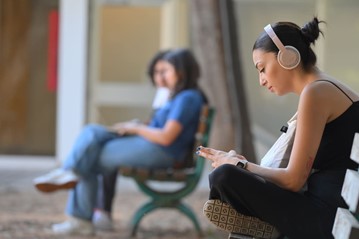
In light of distressing events, LAU clinical psychologists took the initiative to organize four sessions in October 2023, that addressed timely common concerns that faculty, staff and students across the LAU community are facing, and dedicated two in-person sessions for LAU students to learn directly from the experts.
Across the sessions, the clinical psychologists underscored that there is no “right” or “wrong” when facing emotional stress amid uncertainty. Typically, people initially react with a “fight, flight or freeze” response, which is not unhealthy initially, but which could lead to burnout if left unchecked.
Check In With Your Children
LAU Child and Adolescent Clinical Psychologist Pia Tohme answers parents’ questions on handling their children’s concerns in uncertain times.

A Students’ Guide for Maintaining Mental Health During Uncertainty
LAU Clinical Psychologists Rudy Abi Habib and Tony Sawma answer students’ pressing questions on striking a balance in their day-to-day life.
Spilled Ink and Tears: Healing Through Writing
LAU’s 11th Creative Writing Competition helps students find catharsis in relaying health-related memoirs through poetry and prose.
Ms. Paula Habre and Dr. Sleiman El-Hajj organized, hosted and juried the event.
When American essayist, philosopher and transcendentalist Henry David Thoreau withdrew into the woods around the shores of Walden Pond for two years, he went on a voyage of spiritual discovery which he documented in a book.
Years later, as the world shakes off the shackles of the pandemic, the need for a medium to channel one’s stories of hardship and endurance has never been greater. Similar to Thoreau’s retreat from civil society, the solitude and contemplation imposed by the lockdown, albeit unintended, fueled a need to share narratives and find solace in collective understanding. This need has been all the more acute in Lebanon in the aftermath of the August 4 Beirut Explosion.
To that end, the Department of Communication, Arts and Languages at the School of Arts and Sciences dedicated its 11th Annual Creative Writing Competition (CWC) to Illness Writing and Health Memoirs, providing participants with the opportunity to present a candid narrative on a physical or mental illness. The event, as in the past four years, was organized, hosted and juried by Senior Instructor of English and former Director of the LAU Writing Center Paula Abboud Habre and Assistant Professor of Creative and Journalistic Writing Sleiman El Hajj.
Nursing Students Tell their Stories with Drama Therapy
The Alice Ramez Chagoury School of Nursing organized a drama therapy workshop in collaboration with renowned actress Zeina Daccache for nursing students. They used drama therapy as a tool to express their feelings and bolster their social and team skills. The workshop is another example of the university’s commitment to the UN Sustainable Development Goals (SDGs), specifically SDG 3: Ensure Healthy Lives and Promote Wellbeing.
Write to Remember Project Commemorates August 4 Explosion
LAU faculty launch creative writing initiative to help students impacted by the blast and document oral history.
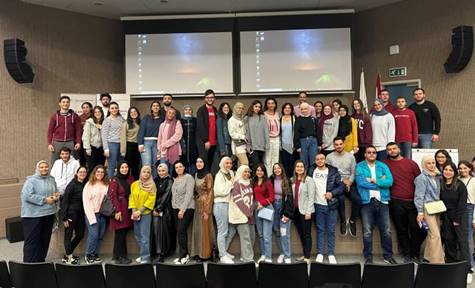
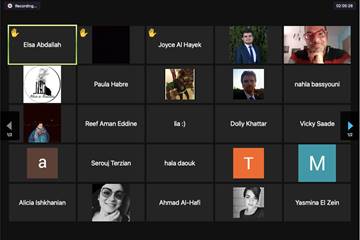 Participants in the workshop explored the use of sensory perceptions to navigate through and reimagine/(re)write trauma. |
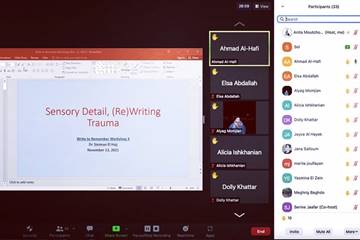 The workshop run by Dr. Sleiman El Hajj focused on sensory detail. |
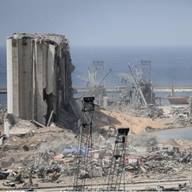
The aftershocks of the massive August 4 explosion at the Port of Beirut were of such magnitude that they could not be swept under the rubble. Fear, disbelief and grief are only a few of the tangled emotions that will continue to fester if suppressed.
And what better way to release them than through self-expression? Believers in the cathartic power of words, faculty at LAU’s School of Arts and Sciences (SoAS) took the initiative to help the youth come to terms with the after-effects of the blast through a web-memoir where they could voice and preserve their memories.
The Write to Remember project was launched on the first anniversary of the blast, after Senior Instructor of English Paula Habre and Instructor of English Hala Daouk secured a $10,000 grant from the US Embassy, based on a proposal submitted with Haigazian University colleagues – former LAU faculty and Writing Center tutors – Anita Moutchoyan and Serine Jaafar.
The outreach project targets youth who had been directly or indirectly affected by the blast with the grant specifying an age range between 16-22.
“We felt this would be a good coverage of high school/secondary level and university students who can write about their trauma,” Habre said. “The project creates a safe platform and a safe space for them to share their feelings and deal with it collectively.”
The one-year initiative serves as an archive of stories, reflections, photos, and oral history related to the explosion and its aftermath through six virtual workshops.
The most recent workshop in November was presented by LAU Assistant Professor of Creative and Journalistic Writing Sleiman El Hajj, who had written about the blast in his widely-cited collective memoir “Writing (from) the Rubble: Reflections on the August 4, 2020 Explosion in Beirut, Lebanon.”
Dr. El Hajj focused on having participants in the workshop explore the use of sensory perceptions to navigate through and reimagine/(re)write trauma.
“Food and trauma have become interrelated for many survivors of August 4 since the sights, smells, sounds, texture, even taste of food, and food in preparation, are ones that now trigger PTSD recollections of the calamity,” Dr. El Hajj explained about the use of sensory details as an embodiment of trauma. “They are therefore no longer the comforting or pleasurable activities they once were.”
“If a concrete object can so easily, and so painfully swiftly, become an embodiment of trauma,” he added, “then thinking of ways of revoking – or at least helping to process – this reality is essential, especially in climates of perpetual tension, such as Lebanon.”
The participants shared short pieces they wrote during the workshop and gave each other support and feedback.
“I was impressed by their eagerness to share their lived narratives, however painful, and also by their alacrity in embracing the reimagined narrative approach, which I suggested as a way of reclaiming a semblance of agency over an otherwise slippery slope into inchoate trauma,” said Dr. El Hajj.
“By concentrating their experiences and/or perceptions of trauma into concrete objects, they managed, in part, to rethink and make sense of at least one aspect of all that we lost on that day,” he added.
The first workshop was led by the Regional English Language Officer at the US Embassy Eran Williams, and the second was presented by Zeina Daccache, the founder of Catharsis. Three open mic sessions will be held in venues that were damaged by the blast to allow the participants to share their pieces with a wider audience.
“We have officially completed half the workshops for this project and have three to go,” Habre said. “We look forward to the upcoming open mic event on December 11, which the participants are very excited to attend.”
“The team plans to recruit more local and foreign specialists for future workshops to help the youth come to terms with their trauma through writing,” she added.
Browse the Write to Remember website to learn about upcoming workshops and open mics, participants, oral narratives, and more.
Someone to Talk To
LAU counselors help students overcome – and even better, preempt – all sorts of challenges.
The counselors aim to empower students by giving them the tools they would need to overcome immediate as well as future difficulties.
Every day, LAU’s counselors help students make the most of university life by empowering them to manage their workload, extracurricular activities and personal concerns.
For second-year communications major Carly Aziz, the service “is not only important, but a must, especially during these hard times.”
Counseling is helpful for resolving a full range of challenges, no matter how “small” or serious they may seem (see the list below for examples).
“We have assisted students in getting to know their campus, getting involved, staying active on campus, and taking advantage of new opportunities,” said Joumana Haddad, principal counselor on Byblos campus.
“This has helped them meet new people with similar interests and alleviated their feelings of homesickness and loneliness,” she added.
The past three years have been particularly taxing on students, who have borne their fair share of financial hardship, a pandemic and disruptions to their campus life.
According to Nathalie Medlege, lead counselor on Beirut campus, “a lot of students are noticing that they are having difficulties and are aware of the importance of their mental health. Even if they have enough support from their surroundings, they know they need to supplement it, so they come to us and talk about it.”
Faculty, too, have become increasingly aware of students’ need for support, adds Medlege, and take it into consideration.
Free and Confidential
Counseling services are free of charge and strictly confidential. They provide a safe environment for students experiencing difficulties, whether on the personal or academic level. The counselors’ offices are easily accessible and conveniently located close to the student lounge.
“I think all institutions should consider adding this to their offering, as it normalizes seeking help and goes to show that the university is invested in students’ wellbeing, and not just their academic achievements,” said Aziz.
Mission: Empowerment
The counselors aim to empower students by giving them the tools they would need to overcome immediate as well as future difficulties.
Second-year multimedia journalism student Lyne Samury finds counseling very helpful. “My counselor provides tactics and tools to help me solve problems on my own,” she noted.
Both counselors agreed that “it is important to seek help when needed, especially when it is available,” for there is no health without mental health.
Get some tips and more information on LAU’s counseling services here.
15 Things You Can Discuss with a Counselor:
- Test anxiety
- Depression
- Suicidal ideation
- Eating disorders
- Sleeping disorders
- Study skills
- Sexual health
- Attention deficit disorder
- Family conflicts
- Relational concerns
- Stress
- Major confusion
- Self-confidence
- Learning difficulties
Salaam Halila Launches Her First Campaign in Campus to Raise Awareness on Mental Health
Salaam Halila, an LAU MEPI TL Student in Communication Arts, started implementing acquired communication and message conveying skills along with her colleagues within the campus by launching: “Bil Hawa Sawa” (we are all in the same boat), an awareness campaign with the objective to raise awareness about mental health among LAU students and to remind them about the counseling services that LAU offers.
Before starting crafting the campaign tactics, Halila along with the team members conducted a qualitative survey across students in campus to help them identify the key messages that they need to tackle in their campaign.
“Bil Hawa Sawa” Campaign lasted for two consecutive days (March 20 and 21, 2019) during the LAU yearly festival “NEXT” at LAU Beirut Campus.
Halila together with her colleagues planned, organized and executed the campaign that covered online, offline and in-campus activation media to ensure conveying the message to a wider audience. Planning the campaign on a low budget was not an obstacle, on the contrary, it has triggered Halila’s creativity to deliver the campaign’s messages at minimal cost; one of the ideas was to use “chalk advertising” were they wrote teasing messages about mental health on the campus’ floor and stairs as a way to attract the students’ attention. During the campaign, students were encouraged to share their suggestions about the counseling services at LAU by writing their ideas on a big black board, in addition to distributing stickers to passerby and hanging posters for bigger exposure.
The campaign gained wide acceptance and brought expected results: 158 followers on the Instagram page with 626 profile visits and 344 accounts reached, during the campaign ; 107 students responded to the online survey ; Almost 100 students visited the awareness booth and projected their input about mental health in general and LAU counseling services in particular.
At the end of the campaign, Halila and the team members gathered all students’ feedback and suggestions and submitted a detailed report to the counseling panel at LAU for their reference and consideration
The LAU MEPI TL Program enabled Halila pursue her education in Communication Arts and to be life-long learner, critical thinker and gain persuading and influencing skills.
“Shabaket el Meem”: LGBTQ Youth Support Platform
In 2018, The AiW began working on a new project with a funding from the Embassy of Netherlands in Lebanon that aims to promote issues related to the LGBTQ community in Lebanon. The project focuses on the dearth of reliable information and support available to the LGBTQ community, and strives to promote a strong civil society network of organizations and actors that can fill this gap. The AiW, together with a number of local subject-matter experts, produced an online platform “Shabaket el Meem” for LGBTQ youth in Lebanon that features short animations, a podcast series, a Q&A section, and a glossary with LGBTQ terms in English and Arabic. The platform also includes a map where visitors can share their own experiences.
Visit www.shabaketelmeem.com for more information and follow them on Instagram (@shabaketelmeem) and on Facebook (Shabaket el Meem).