Meaningful Education Around the SDGs
LAU is dedicated to integrating the Sustainable Development Goals (SDGs) into its curriculum and across the university’s various academic programs. Curriculum Z for instance, is mandatory for all new LAU students and almost all schools have mapped their courses to SDGs.
Below are details about Curriculum Z and examples of how different schools within LAU incorporate SDGs into their educational framework:
Curriculum Z
https://catalog.lau.edu.lb/2024-2025/undergraduate/lac.php
All students who joined LAU or changed their major in AY 2022-2023 and beyond should follow curriculum Z. This new curriculum caters for the multidisciplinary education of generation Z. The courses offered are linked to the United Nations’ 17 Sustainable Development Goals (SDGs) and capture the spirit of the major problems that our world is facing.
Mission
The mission of the Liberal Arts and Science Curriculum is to foster the education of the cultured and civically engaged person, and the formation of students as future leaders in an increasingly complex world.
Program Educational Objectives (POs)
- Demonstrate knowledge, abilities and dispositions needed for addressing current issues and problems of our increasingly complex world
- Demonstrate critical thinking and inquiry competence needed for engaging in the exploration of local and global challenges
- Make informed and ethical decisions about individual and social issue
Program Requirements
- Required Core Courses (6 credits)
- Digital Cultures Courses (min. of 3 credits):
- Change Makers Courses (min. of 6 credits):
- Debate: LAS301 Debating Sustainability (also LAS301H)
- Energy:
- LAS203 Sustainable Energy
- LAS304 Energy & Environmental Policy
- Food: LAS202 Sustainable Food Systems (also LAS202H)
- Gender Studies:
- LAS209 Doing Gender: Contextual Approaches (also LAS209H)
- SOC488E Gender Equality in the Workplace
- POL437O Gender Negotiations Mediation and Conflict Resolution
- SOC488D Fundamentals of Gender Discrimination
- COM312 Media and Gender
- Health: LAS208 Wellbeing Matters (also LAS208H)
- Inclusive Societies: LAS217 Voices of Change
- Innovation and Entrepreneurship: LAS302 Inquiry for Innovation (also LAS302H)
- Interdisciplinary courses:
- LAS498H Professional Portfolio
- LAS499H Honors Interdisciplinary Capstone
- Migration: LAS207 Intro to Migration Studies
- Poverty: LAS210 Poverty and Human Development
- Water: LAS201 Water Security (also LAS201H)
- LAS Free Elective Courses (remainder credits according to program-specific requirements)
Integrating the SDGs in a Unique Structured MD Program:
https://medicine.lau.edu.lb/education/md/integrating-the-sdgs-in-a-unique-structured-md-program.php
The United Nations 2030 Sustainable Development Goals (SDGs) represent a global initiative to address pressing challenges and achieve a sustainable future by the end of the decade. In alignment with these goals, the School of Medicine recognizes the pivotal role it plays in contributing to a healthier and more equitable world.
However, the challenge in mapping the SDGs within the MD program arises from its unique structure, which is organized into modules rather than traditional courses. In a conventional curriculum, specific courses may align with distinct topics or objectives, allowing for a more straightforward integration of SDGs. However, the modular framework of the MD program means that various disciplines, including anatomy, biochemistry, physiology, pathology, social sciences, behavioral sciences, population health, nutrition, medical ethics, clinical skills, and clinical sciences, are interlaced throughout the learning journey.
This interdisciplinary nature makes it challenging to assign specific SDGs to isolated disciplines or modules, as the content of each discipline often spans multiple modules. The intricate connections between different disciplines and the fluidity of topics within modules make it difficult to apply a direct, one-to-one mapping of SDGs to each module. The challenge lies in ensuring that the principles of sustainable development are adequately addressed across the entire curriculum, considering the integrative and interconnected nature of medical education.
To overcome this challenge, a meticulous mapping process was undertaken, breaking down the curriculum to modules (in Med I and Med II) and clerkships (Med III and Med IV) and further by disciplines and then further delineating certain topics or curricular activities within each module. This approach allows for a more nuanced evaluation of the extent to which SDGs are covered in various aspects of the MD program, acknowledging the complexity introduced by the modular structure. Moreover, we developed an interactive “SDG mapping tool” that measures the extent to which every SDG is covered in every discipline and every module/clerkship. Subsequently a score that ranges from 0 to 5 is entered based on the following definition:
- 0 = No coverage of SDGs
- 1 = Minimal coverage or incidental inclusion of SDG-related topics,
- 2 = Limited integration of SDG principles into the curriculum, within the context of one’s own discipline
- 3 = Moderate incorporation of SDGs, with specific learning objectives related to SDG targets
- 4 = Substantial integration of SDGs, with active discussions and assignments addressing SDG-related issues
- 5 = Comprehensive coverage of SDGs, with extensive exploration of SDG principles, engagement in action-oriented pedagogies, community outreach activities and assessments related to SDGs
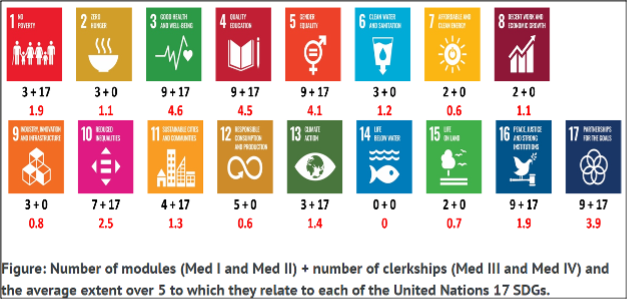
Below is a summary of the mapping, expressing the number of Modules + the number of Clerkships in the 4-year MD program, addressing each SDG and the overall average of the extent to which each SDG is covered on a scale from 0 to 5. There are 9 modules across Med I and Med II and 17 clerkships throughout Med III and Med IV.
SDGs in AKSOB Courses
https://sb.lau.edu.lb/about/sdgs-aksob-courses.php
The Adnan Kassar School of Business (AKSOB) mission statement includes the aim of “contributing knowledge to industry and society.” In addition, as a member of AACSB-accredited schools, AKSOB is committed to having a societal impact by strategically choosing to address significant local, national, and international issues. In this respect, the United Nations Sustainable Development Goals (SDGs) can form guideposts for AKSOB in its path to achieving its mission goals and social impact. A preliminary mapping shows a significant number of courses with contents commensurate with SDGs. AKSOB faculty will work in the near future to improve on this assessment and to align pertinent and specifically targeted courses with SDGs especially those related to industry and innovation, decent work and economic growth, inequalities, gender equality, poverty, hunger, and environmental sustainability.
Aligning Nursing Courses with Global Sustainability Goals
https://nursing.lau.edu.lb/education/bs-nursing/teaching-the-sustainable-develop.php
The LAU Alice Ramez Chagoury School of Nursing – ARCSON is committed to continuously improving the integration of the SDGs into its nursing curriculum. This commitment is aimed at supporting the worldwide endeavor to achieve the SDGs by the end of the current decade.
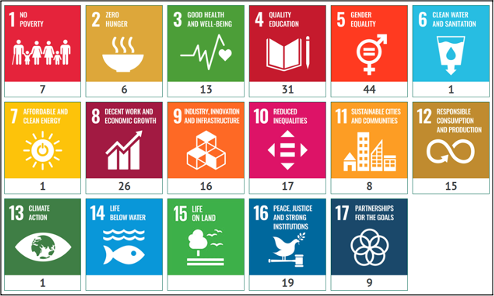
Here is an overview of the nursing (NUR) courses at ARCSON and how they relate to each of the SDGs. For more detailed information, please refer to the additional resources provided here.
School of Pharmacy Curriculum
The curriculum covers the pre-pharmacy and professional pharmacy years. The B.S. in Pharmacy and Pharm.D. programs require students to complete coursework in the classroom, laboratory work, and pharmacy practice experiences. Students’ practice experiences at the introductory and advanced levels are planned and coordinated by the Experiential Education program, and are supervised by clinical faculty and selected professional practitioners known as preceptors.
Curricular cores cover the biomedical, pharmaceutical, social, behavioral, administrative and clinical sciences. Courses are designed with the appropriate depth, breadth, sequence and timeline in order to ensure proper student progression and synthesis of learning. The curriculum provides a balance of required and elective courses that meet the program educational goals and outcomes. Electives are designed to provide students with the opportunity to develop and expand their knowledge in areas of professional and educational interest.
Get acquainted with the school’s educational goals and outcomes as well as our assessment methods.
Aligned with the United Nations Sustainable Development Goals (SDGs), our courses empower students to make a positive impact. Click the below link to view our curriculum alignment with the SDGs:
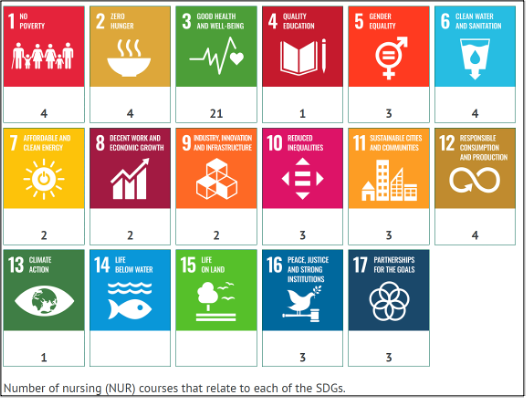
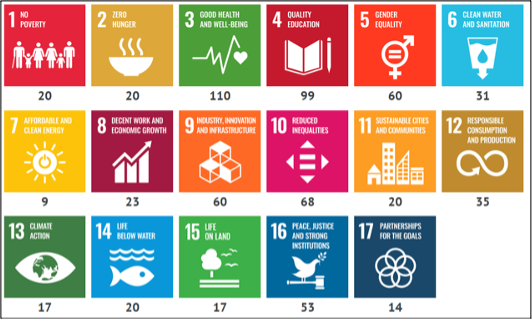
Number of Pharmacy Courses Matched to each SDG:
School of Engineering:
https://soe.lau.edu.lb/about/strategic-plan.php
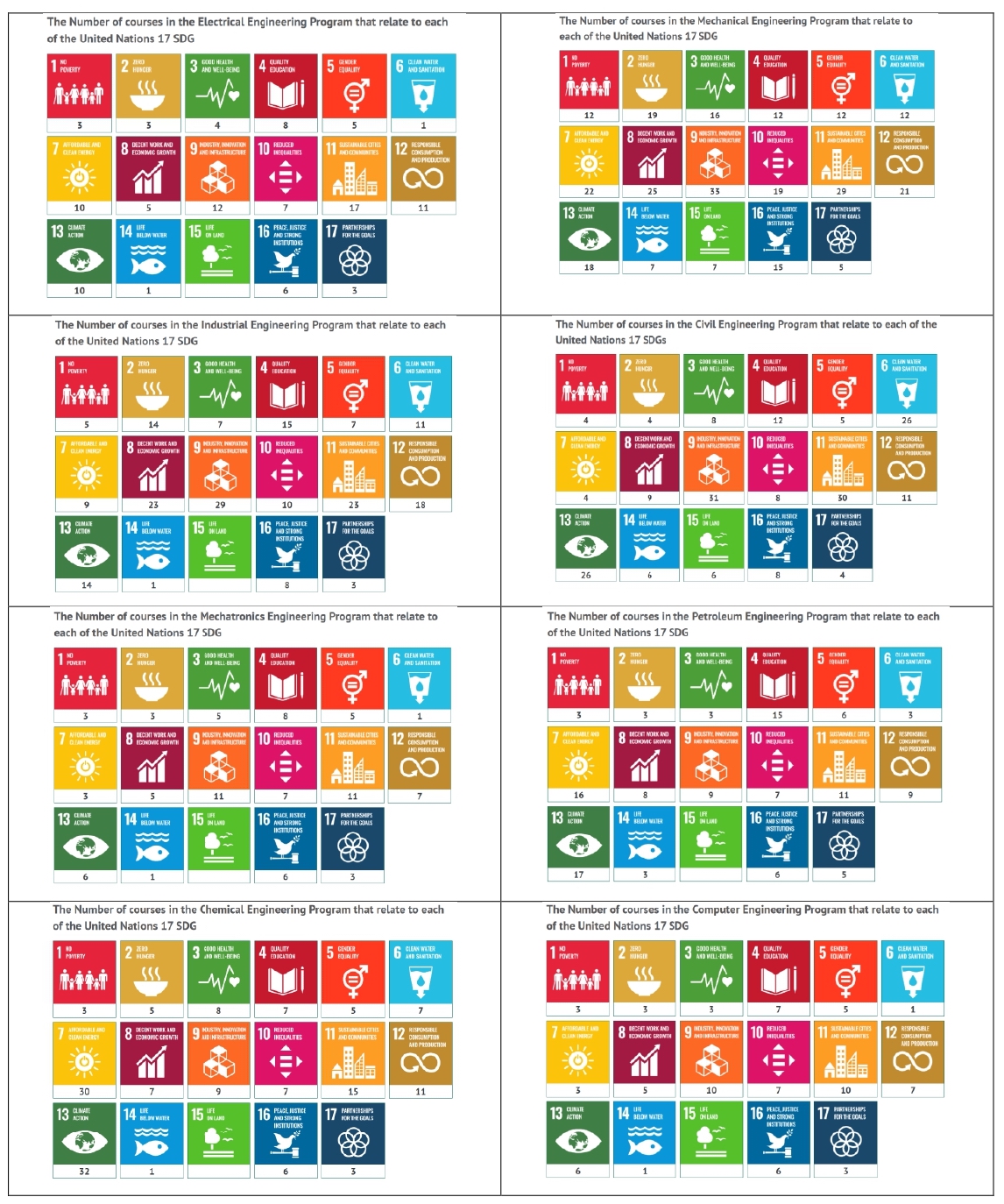
SDGs importance are highlighted in the Strategic Plan as part of SOE Strategic Goals:
The world faces challenges related to the environment, energy sustainability and security as outlined in the United Nations Sustainable Development Goals (SDG’s). By incorporating these topics in SOE’s engineering curricula, SOE students will gain expertise in engineering practical solutions to current world and society problems, thus making them more adaptable to current and future changes and increasing their employability and success as future engineers.
While a course is directed towards sustainability: [GNE335] Introduction to Sustainable Engineering [3-0, 3 cr.] Sustainable design and related topics such as environmental impact assessment methods, climate science, green building, life cycle analysis, and energy considerations. Principles of sustainability and their application to real world design and problem analysis within various fields of engineering. Prerequisites: GNE331 Probability and Statistics and INE320 Engineering Economy I.
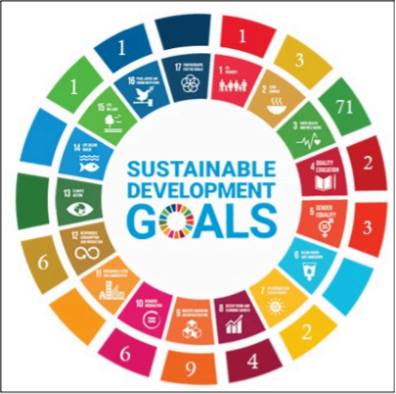
All departments within the SOE have mapped their courses to SDGs as shown below (for more information, visit the departments webpages
School of Arts and Sciences
Teaching the SDGs
Number of Courses in the School of Arts and Sciences Curricula Related to Each Global Goal:
https://soas.lau.edu.lb/about/people/teaching-the-sdgs-the-number-of-liberal-arts-and-sciences-course.php
The global south faces a challenge in closing the sustainable development gap due to historical marginalization, which has resulted in deep-rooted economic and social inequalities. Many countries in the global south are still grappling with the legacies of colonialism, including unequal access to resources and markets and institutional weaknesses.
Closing the sustainable development gap requires concerted efforts from universities, governments, civil society, and the private sector. This entails addressing systemic inequalities, promoting inclusive and equitable development strategies and addressing various forms of deprivation.
The Lebanese American University embraced the 17 Sustainable Development Goals (SDGs) that were collectively adopted in 2015 by the Member States of the United Nations. As such, it was among the first universities in the world to mainstream the SDGs into the Liberal Arts and Sciences Curriculum (LASC). Furthermore, special care was taken to address the SDGs across most of the School’s curricula and research. This includes the following key components:
- Introduce all students to the United Nations Sustainable Development Goals (SDGs) and enable them to explore how science contributes to achieving these goals through a mandatory core, the Change Makers series.
- Enhance students’ scientific literacy through a series of Digital Cultures courses.
- Address healthcare and education, mitigate inequality and promote economic advancement, all while confronting the challenges of climate change and preserving our precious oceans and forests.
We believe that all the School’s curricula engage the students and enable them to establish a sustainable connection between humanity and the planet. The approach is grounded in the fundamental premise that every student should possess a foundational understanding of SDGs and their fundamental principles, which can be applied in their future careers and personal lives.
Liberal Arts and Sciences Curriculum
Our Promise: We empower the change makers of tomorrow.
The Liberal Arts and Sciences Curriculum (LASC) will provide you with a number of diverse courses. It is a multi-disciplinary LASC that tells a story and educates the whole person.
- The courses offered are linked to the United Nations’ 17 Sustainable Development Goals (SDGs) and capture the spirit of the major problems that our world is facing.
- The LASC will help you think about the SDGs and digitization as they relate to our nation, but also to the region and the world.
- The LASC will also help you think about yourself by promoting physical and psychological well-being and cultivating ethical development and social engagement.
In other words, the LASC will help you study and think differently, making you more intellectual, more confident and more employable.
Ready to know more? Here’s a first look at the program in detail and the courses offered.
Check the Academic Catalog for specific program requirements.
Liberal Education Courses Map to the UN SDGs
In 2015, the Member States of the United Nations collectively embraced the 2030 Agenda for Sustainable Development, which comprises 17 Sustainable Development Goals (SDGs). The SDG goals acknowledge that eradicating poverty and addressing various forms of deprivation must be pursued in conjunction with efforts to enhance healthcare and education, mitigate inequality, and promote economic advancement, all while confronting the challenges of climate change and preserving our precious oceans and forests.
LAU was among the first universities in the world to mainstream the SDGs into the liberal arts and sciences curriculum (LASC). The LASC includes several key components:
- Introduces all students to the United Nations Sustainable Development Goals (SDGs) and enables them to explore how science contributes to achieving these goals through a mandatory core, the Change Makers series;
- Enhances students’ scientific literacy through a series of Digital Cultures courses.
The LASC engages the students and helps them to establish a sustainable connection between humanity and the planet. The approach is grounded on the premise that every student should possess a foundational understanding of the SDGs and their fundamental principles, which can be applied in their careers and personal lives.
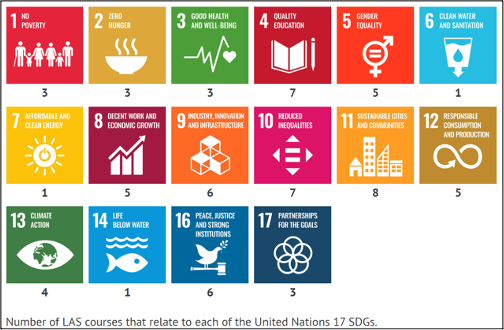
Number of LAS courses that relate to each of the United Nations 17 SDGs
Camping Around the Sustainable Development Goals
Participants in this year’s School of Arts and Sciences Summer Camps got a taste of university-level education in line with LAU’s SDG-based Liberal Arts and Sciences Curriculum.
This year, 79 high-school students congregated to participate in the School of Arts and Sciences Summer Camps, which were spread out across three individual camps focusing on essential SDG-focused majors: physics, chemistry and nutrition.
Following the immersive summer camps of 2022, the Liberal Arts and Sciences Department designed lectures and activities over five days of learning, from July 3 to July 7.
Campers had the opportunity to experience a university environment and explore multiple programs they might wish to study at LAU. This was facilitated not only by the number of seminars that were given at each camp but also by the chance to earn a 10-to-30-percent scholarship to study at the university upon completing the camp.
Introductory sessions for all the participants were held at the Adnan Kassar School of Business (AKSOB) on the Beirut campus before they dispersed among different schools. AKSOB hosted most of the physics and nutrition sessions, whereas the chemistry sessions took place at the chemistry facility in Sage Hall.
At the physics camp, students participated in interactive lectures on Einstein’s theory of relativity, electromagnetism and the realm of quantum mechanics by discussing their understanding of the theories with the instructors. Associate Professor of Physics Jimmy Romanos and Assistant Professors of Physics Rana Nicolas and Walid Malaeb organized lectures, experiments and documentaries to allow for an engaging learning experience.
“We tried to give the students an overall idea of the different interesting topics in physics,” said Dr. Nicolas, “especially since the subject itself can be intimidating. In all, I think the students were very interested and motivated and posed a lot of questions that were surprisingly good for their age.”
Grade 11 student Jana Abou Hijeily said that “the camp was a great opportunity to discover new aspects of physics that we don’t thoroughly learn at school. The practical experiences, like performing a residential energy audit, enabled us to visualize the pragmatic side of most of the theoretical knowledge we’ve acquired over the years.”
Over at the nutrition camp, discourses were designed by Associate Professor of Nutrition Nadine Zeeni, Associate Professor of Food Science and Technology Hussein F. Hassan, Assistant Professor of Nutrition Rana Rizk as well as Instructors of Nutrition Marwa Fadlallah and Marie Stephan to address emerging issues in nutrition and food science with a focus on the impact of food insecurity and malnutrition on communities worldwide.
Additionally, students got to explore sustainable food practices and how they contribute to both human health and the environment. “Throughout the camp, the intricate connections between nutrition and overall health were investigated,” said Dr. Rizk. “Lectures provided a comprehensive overview of this link, explaining how proper nutrition directly impacts physical and mental wellbeing.”
Youssef Itani, Grade 11, said that having this opportunity was beneficial for him and his peers as they made “new acquaintances in the field on top of learning about the role of nutrition in addressing the sustainable development goals.”
Inspired by videos featuring testimonials from practicing dietitians in diverse nutrition fields, the participants gained insight into real-life experiences and perspectives on the day-to-day responsibilities of a career in nutrition.
Meanwhile, the chemistry camp addressed the challenges related to soil quality deterioration in Mediterranean countries and introduced experimental procedures to the participants to sharpen their understanding of soil parameters and environmental contaminants.
Assistant Professor of Chemistry Elias Akoury, who was responsible for delivering all the lectures, was determined to ensure a learning experience for the students different from the methodology used in schools. And in fact, the campers felt enlightened as they discovered the multidisciplinary approaches used to address environmental issues.
All of this was made possible by the experiments they got to conduct in the chemistry labs, such as spectroscopic techniques, thermogravimetric analysis (observing the mass variation of materials with temperature changes) and X-ray fluorescence.
“I am glad I took part in the program because we were introduced to the different disciplines and experiments of science,” stated 11-grader Karim Kassem. “Tackling soil chemistry, its chemical composition and properties with Dr. Akoury was very enriching. I was able to form solid bonds with chemistry enthusiasts and obtain a rigid chemistry background knowledge.”
On the final day, in an awards ceremony held on the Beirut campus, scholarships covering up to 30 percent of the tuition were granted to the 17 participants who scored high on their final examination to kick off their university education at LAU.
Sustainable Fashion Design in the Making
https://news.lau.edu.lb/2022/sustainable-fashion-design-in-the-making.php
LAU formalizes its partnership with the UN Environment Programme (UNEP) and hosts a workshop to promote zero-waste design in collaboration with the UNEP Sustainable Fashion Academy.
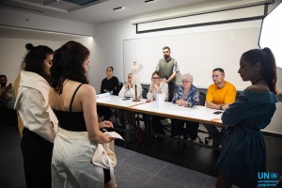
LAU fashion design students were trained on eco-innovative designs in three days of hands-on sessions given by sustainable fashion experts at the newly renovated Gezairi Building on Beirut campus last week.
They were introduced to zero-waste techniques such as subtraction cutting, kinetic cutting, reverse engineering, modular design, hyperbolic tessellation, and hybridization. The students also attended talks by designers, entrepreneurs and advocates of the eco-friendly methods.
Fashion is one of the fastest growing industries globally, estimated at $2.4 trillion. Characterized by overproduction and overconsumption, it carries grave socioeconomic and environmental impact – for example, the emission of 3.3 billion tons of greenhouse gases and the use of 215 trillion liters of water every year.
These staggering figures were presented at the opening session of the three-day marathon hosted by the School of Architecture and Design’s Fashion Design Program, in collaboration with the United Nations Environment Programme (UNEP) Regional Office for West Asia (ROWA), under the framework of West Asia Sustainable Fashion Academy.
UNEP West Asia Goodwill Ambassador and world-renowned fashion designer Rami Kadi invited students to take responsibility and think within a more sustainable approach. “It is our duty, as fashion lovers, to help carry this industry into one that brings inner peace and joy to the people around the world.”
LAU President Michel E. Mawad spoke about the responsibility that the fashion industry should shoulder in respecting the UN Sustainable Development Goals. From the production of cotton and yarn and the textile industry, to fashion design and its trade, “it is essential for us to take on this commitment and protect the environment from pollution, reserve water and manage waste,” he said.
Dr. Mawad also hailed the collaboration with UNEP, which was formalized with the signing of a Memorandum of Understanding at the event. The agreement outlines common areas of interest that LAU and UNEP aim to achieve, and highlights consultations to encourage further cooperation moving forward.
Providing background on UNEP’s approach, Regional Director for West Asia Sami Dimassi said that changing mindsets, strategies and policies is key. “UNEP has launched the Sustainable Fashion Academy to promote circularity within the textile value chain, to inspire young entrepreneurs and to educate youth,” he said.
He thanked LAU’s leadership for the collaboration, hoping that it will drive change and set an example for other institutions across West Asia to follow suit.
Similar workshops were held in parallel across the region – in Bahrain, Iraq, Jordan, Kuwait, Oman, Palestine, Qatar, Saudi Arabia, Syria, the United Arab Emirates and Yemen – to help up-and-coming fashion designers adopt a sustainable approach throughout their careers.
Teaching Sustainable Development Goals through Virtual Exchange in Design Thinking Courses
https://papers.academic-conferences.org/index.php/ecie/article/view/1696
- F. Jordan Srour Lebanese American University https://orcid.org/0000-0001-7623-723X
- Christy Suciu Boise State University
- Seth Woody Boise State University
DOI: https://doi.org/10.34190/ecie.18.2.1696
Keywords: Design thinking, virtual exchange, sustainable development goals
Abstract
The stated objective of the United Nation’s Sustainable Development Goals (SDGs) are to serve as a shared blueprint for peace and prosperity around the planet. If this blueprint is to become a reality, the inclusion of the SDGs in university curricula is essential. Yet how can we be sure that we teach a unified and shared view of these goals? This paper examines the value of using virtual exchange in teaching the UN SDGs in Business School Design Thinking courses. Specifically, the experience of a partnered course run at both the Boise State University’s College of Business and Economics and the Lebanese American University’s Adnan Kassar School of Business serves as a case-study. Results from a survey of both student groups indicate that the experience of working with students from outside their home culture did improve their cross-cultural communication skills. Furthermore, learning about the SDGs was a valued experience. However, learning about the SDGs in collaboration with “foreign” team members was eclipsed by the broader experience of engaging with students outside their home culture.
Dr. Suad Joseph Distinguished Lecture Series
As part of AiW’s continuing dedication to promoting rigorous intellectual and academic work on the issues of gender equality and women’s rights, the Institute launched its annual Dr. Suad Joseph Distinguished Lecture Series. The aim of the series is twofold, first, to bring speakers that highlight important topics or themes in the field of gender and women’s studies globally, with the aim to contextualize this to the Arab Region and second, to provide graduate students from across the Lebanese American University and specifically, from the MA in Interdisciplinary Gender Studies the opportunity to liaise directly with such high-level academics and researchers.
Dr. Suad Joseph is a Distinguished Research Professor of Anthropology and Gender, Sexuality and Women’s Studies at the University of California, Davis. She founded and is a former president of the Middle East Research Group in Anthropology precursor to the Middle East Section of the American Anthropological Association, the Association for Middle East Women’s Studies, the Arab Families Working Group, the University of California Davis Arab Region Consortium and the Middle East/South Asia Studies Program at UC Davis. She co-founded the Arab American Studies Association, the Association for Middle East Anthropology, the Women and Gender Studies Program, UC Davis and was the president of the Middle East Studies Association of North America.
She is General Editor of the Encyclopedia of Women and Islamic Cultures and has edited and co-edited 9 books, including, most recently Arab Family Studies: Critical Reviews (2018 Syracuse UP). She also published over 100 articles. Her awards include the University of California, Davis Prize for Undergraduate Teaching and Research (the largest such award in the USA) and life time achievement awards from the Association for Middle East Women’s Studies and the Middle East Section of the American Anthropological Association. Her research focuses on Arab families, gender, citizenship and the state, child socialization and cultural constructions of selfhood, and community formation in the Middle East. She has numerous research grants, including grants for training early career scholars in proposal writing and research design. Dr. Joseph completed her Ph.D. in Anthropology from Columbia University in 1975 and joined the faculty at University of California, Davis in 1976.
Food 4 Thought Series
- Webinar: “Gender and the Environment” (24/02/2023)
- Webinar: “Call to Action: Women’s Leadership in Lebanon’s Crisis and Recovery” (07/12/2022)
- Webinar: Personal Status Laws: Amending the Codes (05/07/2022)
- Webinar: Stand Up Against Street Harassment (05/07/2022)
- Why Gender Justice Matters (09/11/2021)
- Sexuality Matters (09/06/2021)
- Work That Breaks Gender Barriers (29/04/2021)
- Gender Discrimination: Legal, Political and Economic Implications (05/01/2021)
- The Pandemic, The Blast and Their Effects on Gender Rights (02/12/2020)
- Women in Decision Making (01/10/2019)
- Taking Up Space! (01/05/2019)
- Women’s Empowerment Challenges (14/02/2019)
- Safety is Bold, Guard Yourself! (04/02/2019)
- Fighting Stigma and Discrimination (30/11/2018)
- From Spring to Autumn (01/10/2018)
16 Days of Activism against Gender-Based Violence
Marked annually from 25 November to 10 December, “16 Days of Activism against Gender-Based Violence” is a campaign to raise awareness of and increase momentum towards ending violence against women and girls worldwide. Initiated in 1991, the campaign aimed to draw attention to violence against women as a human rights violation at a time when such violence was considered a private matter. Since this time, the campaign has gained international attention and observance, with several commemorative events occurring globally. The dates of the campaign are significant; 25 November is the International Day for the Elimination of Violence against Women, while 10 December is International Human Rights Days and the anniversary of the Universal Declaration of Human Rights.

Sustainability at the Academy of Continuing Education
The LAU Academy of Continuing Education (ACE) contributes to the UN Sustainable Development Goals (SDGs) through the content and outcomes of its diverse programs. It offers more than 65 courses in various modalities: remote, in-person, hybrid and asynchronous. Through these offerings, the academy contributes to SDG 4: Quality Education as they are presented to the public and the community beyond the university’s student body. They also address SDG 17; Partnership for the Goals as they tackle and promote the SDGs.
Two of the academy’s offerings stand out as having demonstrated a far-reaching impact in Lebanon. The Crafts, Arts and Vocational programs have, for two years now, encouraged women to develop their own enterprises in partnership with artisans and entrepreneurs. A similar program, the Women Entrepreneurship Diploma Program, advocates for gender inclusivity in the Lebanese labor market, by offering women in rural and peri-urban areas the opportunity to build their skills and identify their business niche. Each of these programs has reached more than 200 women across the country, contributing to SDG4: Quality Education and SDG5: Gender Equality.
Increased power cuts in Lebanon over recent years due to the economic and financial crises have led to a demand for alternative power sources, particularly solar power. In the context of an unorganized market and a shortage of trained professionals, ACE developed a training program to build the capacities of photovoltaic (PV) technicians in the solar energy market. The program encompasses around 100 hours of training on design and engineering, installation and safety, commercial and legal aspects, and work ethics, addressing SDG7: Affordable and Clean Energy.
On the inclusivity front, ACE has established a number of programs to help build effective, accountable and inclusive institutions across the board. A couple of programs stand out.
The second is a specially designed teacher-training program for every cohort of Teach for Lebanon fellows, namely fresh graduates who go on to teach in underserved schools across the country. Through this, the academy serves SDG1: No Poverty and SDG10: Reduced Inequalities as the program seeks to improve access to basic services for all. Both programs also attest to the academy’s contribution to SDG16: Peace, Justice and Strong Institutions.
A wide array of other courses, certificates, diplomas and training programs at ACE also attest to SDG3: Good Health and Well-Being, such as the Food Safety Program, offered to industry professionals in collaboration with the ministries of Industry and Agriculture. Other programs promote fitness, mental health and risk management, and are offered to healthcare professionals, health coaches and psychologists.