Anti-Discrimination Policy
The Lebanese American University (LAU) has comprehensive anti-discrimination and anti-harassment policies that align with its mission of fostering an inclusive and respectful environment. These are explicitly outlined in the Discrimination, Harassment, and Sexual Misconduct Prevention Policy, which commits to eliminating all forms of discrimination, harassment, and misconduct on its campuses and at university-controlled events. This policy emphasizes mutual respect and ensures individuals are assessed solely based on their academic or professional performance.
Additionally, LAU’s Code of Conduct reinforces these principles by establishing a framework for ethical and respectful behavior among students, faculty, and staff. It promotes values of dignity, equality, and the intrinsic worth of every individual, further embedding anti-discrimination measures into the university’s operational ethos.
Together, these policies ensure LAU remains a safe and equitable space, where diversity and inclusivity are core to its academic and community engagements.
Discrimination, Harassment and Sexual Misconduct Prevention Policy
The Lebanese American University and all its affiliates (collectively “LAU”) is committed to pursuing excellence in its academic and professional endeavors, as well as believing in the intrinsic value of all individuals. LAU fosters an atmosphere of mutual respect among all members of its community, where each individual is judged solely on criteria related to academic or job performance. LAU is committed to the elimination of all forms of discrimination, harassment and sexual misconduct on its campuses or on any other University controlled area or event.
Fundamental to LAU’s mission is the preservation and encouragement of academic freedom. Promulgating this Policy should by no means be construed as inhibiting free speech, freedom of association, or the free communication of ideas.
POLICY STATEMENT
LAU has a zero tolerance rule for acts of discrimination, harassment, and sexual misconduct. LAU is an equal opportunity employer and does not permit discrimination due to race, color, religion, creed, gender, marital status, national origin, disability, age, sexual orientation, political affiliation, pregnancy, or belief. LAU is committed to a working and learning environment where people can achieve their full potential.
This Policy:
- Supports an environment where it is clear that discrimination, harassment, and sexual misconduct are unacceptable, thereby reducing the chance that discrimination, harassment, and sexual misconduct will occur in the first instance;
- Applies to all LAU staff, faculty, and students in connection with their roles, duties, and responsibilities at LAU whether as an employee or a member of the student body;
- Ensures that all visitors, including but not limited to individuals such as suppliers, service providers and guest speakers are held to LAU’s highest standards of behavior and will be held responsible for any act of discrimination, harassment, and sexual misconduct against a member or members of the LAU community;
- Provides procedures to notify LAU of potential discrimination, harassment, and sexual misconduct so that LAU may take appropriate action to investigate and address any such prohibited actions; and
- Prohibits retaliation against persons notifying LAU of such prohibited actions.
- Disciplinary action may be taken to deal with actions or behavior, intentional or unintentional, which results in a violation of this policy. In general, the procedures for review of complaints and discipline for a violation of this policy are addressed in this policy and other LAU policies relating to employee and student conduct. LAU may publish additional procedures in compliance with relevant laws and regulations.
CONDUCT SUBJECT TO THIS POLICY
DISCRIMINATION
Discrimination is treatment of a person less favorably than other persons based on age, race, color, religion, creed, gender (including pregnancy), sexual orientation, marital status, nationality, disability, political affiliation or any other basis protected by applicable law.
HARASSMENT
Harassment is the making of any unwelcome advances or requests for favors or other conduct when (i) submission to such conduct is made either explicitly or implicitly a term or condition of an individual’s employment, a student’s performance, or participation in any campus activity; (ii) submission to or rejection of such conduct by an individual is used as the basis for decisions related to employment, academic performance, or student activities; or (iii) such conduct has the purpose or effect of substantially or unreasonably interfering with an individual’s work, academic performance, or participation in student life by creating an intimidating, hostile, or offensive work or campus environment. Harassment may take physical, verbal, visual, or online forms.
Harassment also includes behavior that demeans, humiliates, or embarrasses a person based on race, national or ethnic origin, color, religion, age, gender, marital status, family status, disability, or sexual orientation, and that a reasonable person should have known would be unwelcome. It includes actions such as touching and pushing, comments such as jokes and name-calling, displays such as posters and cartoons and disrespectful behavior commonly known as ‘personal’ harassment, such as making fun of personal circumstances or appearance, bullying (includes unmerited criticism, isolation, gossip, physical violence or violent gestures, public humiliation, or behavior that is intimidating or demeaning), and stalking.
SEXUAL MISCONDUCT
Sexual misconduct is any form of Sexual Assault connected with forced sexual contact, including but not limited to rape. Force can be physical or emotional (there are four types of force: physical, threat, intimidation, coercion). Sexual Assault consists of Sexual Contact and/or Sexual Intercourse that occurs without Affirmative Consent. Sexual Contact is any intentional sexual touching, however slight with any object or body part performed by a person upon another person. Sexual Intercourse is any penetration, however slight with any object or body part performed by a person upon another person and is considered Rape if the action is taken without the affirmative consent of the other individual(s).
Affirmative Consent must be informed (knowing), voluntary (freely given), and active (not passive), meaning that, through the demonstration of clear words or actions, a person has indicated permission to engage in mutually agreed-upon sexual activity (contact or intercourse). Affirmative Consent cannot be gained by taking advantage of the incapacitation of another individual, where the person initiating sexual activity knew or reasonably should have known that the other was incapacitated. Incapacitation means that a person lacks the ability to make informed, rational judgments about whether or not to engage in sexual activity.
Affirmative Consent cannot be obtained by force. Force includes (a) the use of physical violence, (b) threats, (c) intimidation, and/or (d) coercion. Physical violence means that a person is exerting control over another person through the use of physical force. Examples of physical violence include hitting, punching, slapping, kicking, restraining, choking, and brandishing or using any weapon. Threats are words or actions that would compel a reasonable person to engage in unwanted activity. Examples include threats to harm a person physically, to reveal private information to harm a person’s reputation, or to cause a person academic or economic harm. Intimidation is an implied threat that menaces or causes reasonable fear in another individual, including the stalking of another individual. Coercion is the use of an unreasonable amount of pressure to gain access to something or someone. Coercion is more than an effort to convince, lure, or attract another person to have sex. When an individual is clear that they do not want to participate in a particular form of Sexual Contact or Sexual Intercourse, that they want to stop, or that they do not want to go beyond a certain sexual interaction, continued pressure can be coercive. Factors that may indicate coercion include the frequency, intensity and duration of the application of the pressure and the degree of isolation of the person being pressured.
RETALIATION
LAU prohibits retaliation against any individual because he or she in good faith reports alleged incidents of discrimination, harassment or sexual misconduct, pursues a discrimination, harassment or sexual misconduct claim, or cooperates or participates in an investigation of such reports. Discipline, reprisal, intimidation, or other forms of retaliation in such situations is a serious violation of this policy and may result in disciplinary action, up to and including termination of employment or expulsion from the university.
RESPONSIBILITIES
All staff, faculty and students:
- Must attend education programs provided by LAU relating to discrimination, harassment, and sexual misconduct.
- Can prevent discrimination, harassment, and sexual misconduct by being sensitive to the reactions and needs of others, and ensuring that their conduct does not cause offence;
- Can discourage discrimination, harassment, and sexual misconduct by others through making it clear that such conduct is unacceptable.
- LAU is responsible for:
- Providing an environment where it is clear that discrimination, harassment, and sexual misconduct are not acceptable;
- Taking action when it has clear notice that discrimination, harassment, or sexual misconduct has taken or is taking place to stop the conduct, prevent its recurrence, and remedy its effects.
- Ensuring that deans and chairpersons, vice presidents, and directors are aware of their responsibilities under this policy, including trying to prevent or to report violations of this policy.
REPORTING ACTS OF DISCRIMINATION, HARASSMENT OR SEXUAL MISCONDUCT
Any LAU staff, faculty or student who believes in good faith that he/she or someone else at LAU has been a victim of discrimination, harassment or any form of sexual misconduct should promptly notify LAU through one of the methods set out below. Notices should provide information as to the conduct, where it occurred and persons involved and, if reporting is not by the victim should explain how the person reporting has knowledge of the conduct. LAU will review such notice, initiate an investigation and take any measures, adjudicatory or otherwise, it determines appropriate in response to the notice. Further, LAU may advise certain staff and faculty with oversight of student well-being that their duties include a requirement to report instances of sexual misconduct relating to students promptly upon receiving such information.
The right to confidentiality shall be strictly adhered to at all stages, in so far as it does not interfere with LAU’s legal obligation to investigate the allegations presented and to take the proper corrective action.
A failure to provide prompt notification or the reporting of information anonymously may hinder LAU’s ability to act on the conduct for which a complaint is made.
SUPPORTIVE MEASURES
The Office of Community Standards will offer supportive measures to any individual affected by conduct covered under this Policy. Supportive measures are non-disciplinary and nonpunitive. Supportive measures may be available regardless of whether a formal complaint is filed.
PROCEDURES AND RESOLUTION OF COMPLAINTS
The Office of Community Standards (OCS) [formerly the Title IX Office] receives all complaints regarding discrimination, harassment, and sexual misconduct pursuant to the Policy. The OCS supports LAU’s mission by fostering a community grounded in integrity, responsibility, and mutual respect and the resolution of conduct and discrimination-related matters under this Policy.
The following steps should be taken when submitting a complaint to the OCS:
- When a student, a staff member, or a faculty member faces any form of discrimination and/or harassment, s/he should notify (orally or in writing) the Office of Community Standards at CommunityStandards@lau.edu.lb or by phone at 01.786.456, ext. 1303.
- Anonymous Reporting: Anyone can make an anonymous report of conduct prohibited under this Policy by contacting the Compliance Hotline at 01.786.456 ext. 4444. Anonymous reports can also be submitted via the Anonymous Reporting Tool at the Office of Community Standards website.
- In case of a health or safety emergency, students, staff and faculty should contact 01.786.456 ext.1500 on the Beirut campus or 09.547.262 ext. 2500 on the Byblos campus to address the emergency and reports under this policy should be made later.
- When a complaint is submitted, LAU may request a statement in writing signed by the complainant in order to proceed with further inquiry, particularly in matters relating to employment.
- Depending on the type of conduct and the persons affected, the complaint may be referred to an existing LAU procedure for resolution such as the Grievance Policy or the Student Code of Conduct. Further, LAU may establish new procedures as necessary.
LAU will promptly investigate all complaints. Thereafter, upon the President’s request, the OCS Director will manage all complaints that warrant investigation. The President can consider engaging other university units as necessary and in keeping with this Policy. If the OCS Director determines that the complaint is credible, he/she shall notify the Office of the General Counsel and will work closely with it during the consideration and investigation of the complaint. Furthermore, the Office of the General Counsel provides advice and direction on the legal aspects of -related investigations under this Policy and potential prosecutions. The Office of the General Counsel will conduct investigations involving an employee or employees of the OCS.
If LAU determines that the claim is substantiated, LAU will institute disciplinary proceedings against the offending party, which may result in a range of sanctions up to and including termination of university employment or expulsion.
If LAU determines that the complaint was unsubstantiated, the University will take no corrective action.
The formal University decision shall be communicated to all involved parties as approved by the President. Appeals by either party may be initiated as per the applicable LAU policies.
TRAINING AND EDUCATION
Leadership, education, training, awareness, and intervention are essential in preventing and eliminating acts of discrimination, harassment, and sexual misconduct. It is the responsibility of every member of the LAU community to attend the training and awareness sessions required by LAU.
Effective Date
Effective Date The foregoing Discrimination, Harassment and Sexual Misconduct Prevention Policy of the Lebanese American University was amended by the Board of Trustees on October 2, 2025 and is effective as of October 2, 2025. This Policy was originally effective as of June 7, 2003, and was previously amended on March 9 & 10, 2006; March 15 & 16, 2013; September 7 & 8, 2017 and September 6, 2019.
GRIEVANCE POLICY
Approved by the University Executive Council on August 7, 2007
Amended by the Board of Trustees on September 6 & 7, 2007
Amended by the Board of Trustees on September 14 & 15, 2023
Policy Statement:
The Lebanese American University believes in providing its employees and students with a fair and efficient process to present, and resolve, grievances arising out of the non-compliance or breach of an approved University Policy or Procedure.
All University constituents are encouraged to seek and obtain answers to questions, or concerns, relating to their involvement with the University, through available procedures.
Regular and effective communications between the University constituents reduces the likelihood of misunderstanding and conflict. The University expects and encourages students, staff, and faculty members to communicate openly, and regularly, so that their interests, and the University’s interests, are best served.
Students, staff, and faculty members are entitled to utilize this Policy if the informal discussions did not result in disposing of the complaint to the satisfaction of the complainant, and provided the complained about matter involves a breach of a University Policy or Procedure.
Definition:
A Grievance is defined as an unresolved issue concerning a breach of a University Policy or Procedure that caused the grievant harm or damage.
This Policy does not apply to matters that are governed by alternative University review through applying other policies such as the Discrimination, Harassment and Sexual Misconduct Prevention Policy, the Personnel Policy - Faculty, the Fraud Policy, and the Code of Ethics etc …
This Policy applies whenever the grievance is not covered by any other existing University Policy.
Retaliation Prohibited:
The University, expressly, and unequivocally, prohibits retaliation against any person who files a grievance or assists a grievant in his/her efforts.
However, it is considered to be a serious misconduct if a grievance was filed and found to include deliberate false statements, and/or misleading and inaccurate facts. Such offense will be subject to the full range of disciplinary sanctions, including termination and dismissal for cause, and suspension.
Office of Community Standards
LAU is committed to building a campus culture where everyone feels valued, respected, and supported. The Office of Community Standards works to ensure that all members of the LAU community —students, staff, faculty and visitors— can learn and work in an environment free from discrimination, harassment, sexual misconduct and other forms of harmful behavior.
Our goals are to:
- Promote respect and inclusion across all areas of university life.
- Foster a strong sense of belonging so every student, staff, and faculty member feels they have a place and a voice at LAU.
- Ensure safety and well-being through education, prevention, and equitable response to concerns.
- Empower our community with the knowledge, tools, and resources to uphold our shared values of integrity, compassion, and accountability.
- Together, we create a campus where respect and responsibility guide how we learn, work, and engage with one another.
Responsibilities:
- Receive and respond to complaints of discrimination, harassment and sexual misconduct.
- Oversee investigations and resolution processes that are fair, prompt and impartial.
- Provide confidential consultation, training and prevention programs.
- Collaborate with faculty, staff and students to build a culture of respect and accountability.
Reporting Harassment, Assault, and/or Discrimination
The following steps should be taken when filing a complaint: When a student, a staff member, or a faculty member faces any form of harassment, s/he should notify (orally or in writing) the Office of Community Standards at CommunityStandards@lau.edu.lb or by phone at +961 1 786 456, ext. 1303 for the Beirut Campus or +961 9 547 254, ext. 1303 for the Byblos Campus.
Anonymous Reporting: Anyone can make an anonymous report of conduct prohibited under this Policy by contacting the Compliance Hotline at 01.786.456 ext. 4444 or use the Anonymous Reporting Tool.
In case of a health or safety emergency, students, staff and faculty should contact +961 1 786 456, ext. 1500 on the Beirut campus or +961 9 547 262, ext. 2500 on the Byblos campus to address the emergency and reports under this policy should be made later.
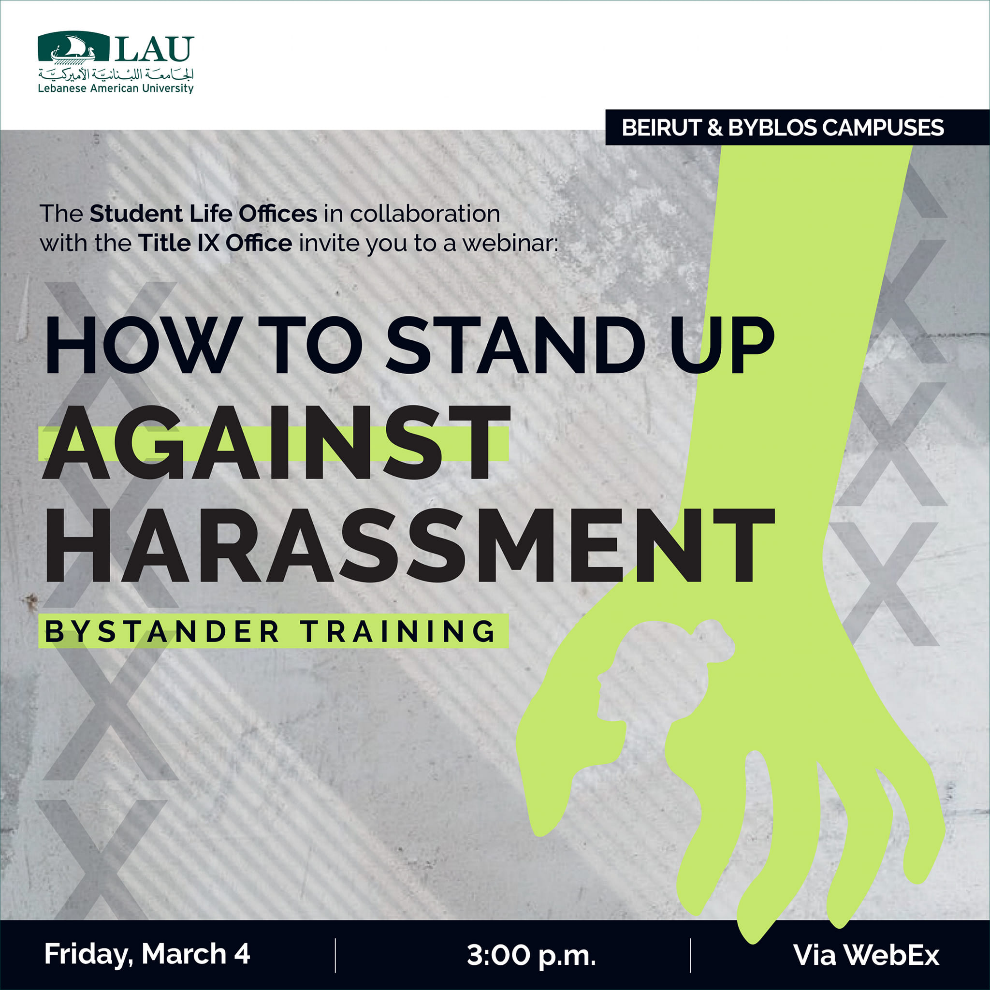
How to Stand Up Against Harrasement
https://www.facebook.com/LAUStudents/photos/pb.100064768593597.-2207520000/5090016391049932/?type=3