Mental Health Support For Faculty And Staff
LAU is deeply committed to fostering a supportive and inclusive environment by providing comprehensive access to mental health support for both students and staff. Through dedicated counseling services, employee assistance programs, and a robust network of mental health professionals, we ensure that our community has access to confidential support services. Additionally, the university organizes workshops, training sessions, and wellness programs aimed at promoting mental well-being and reducing stigma around mental health. By integrating these resources into campus life, we prioritize the mental health and resilience of our community, recognizing its critical role in academic and professional success.
On October 7, 2024, Counseling Services launched the first in a series of psychological support groups titled “Talk It Out,” led by Dr. Joumana Haddad and Ms. Tala AlNoweisser. The session offered students a safe and confidential space to share their experiences and emotions, particularly in light of recent hardships. Participants engaged in open discussions, while facilitators introduced coping strategies and emotional regulation techniques to help manage stress and anxiety.
Expanding these efforts to the broader community, the LAU Gilbert and Rose-Marie Chagoury School of Medicine’s Office for Continuing Medical Education (CME), in collaboration with the School of Arts and Sciences, launched a weekly online psychological counseling series beginning in late September 2024. The initiative aimed to support LAU students, faculty, and staff during times of crisis by providing expert-led discussions and practical mental health advice.
The first webinar, “Supporting Children and Families in Times of Crisis: Managing Panic and Anxiety,” held on September 26, featured Associate Professor of Clinical Psychology Pia Tohme and Clinical Assistant Professor of Psychiatry Wael Salame. The speakers addressed how parents can communicate with their children about traumatic events, manage fear, and provide reassurance during uncertainty. A second session, “Dealing with Uncertainty,” held on October 2, explored coping mechanisms for prolonged stress, survivor’s guilt, and emotional fatigue, providing tools for self-awareness and emotional regulation.
Associate Dean for Faculty Affairs and Development Dr. Vanda Abi Raad, who moderated the webinars, emphasized the importance of collective support. “As a community, we need to support each other by sharing resources and expertise, which is exactly what this series aimed to achieve,” she said.
The sessions, held every Wednesday from 12:00 to 1:00 p.m., drew significant participation and engagement, reflecting LAU’s commitment to fostering mental health awareness and providing accessible psychological support for its community.
The LAU Mobile Clinics Deliver Healthcare and Renewed Hope to Lebanon’s Displaced
In collaboration with the Ministry of Public Health’s assigned primary healthcare provider, the Beirut Association for Social Development–Health Sector, LAU embarks on the first of a series of missions to bring vital relief to the displaced.
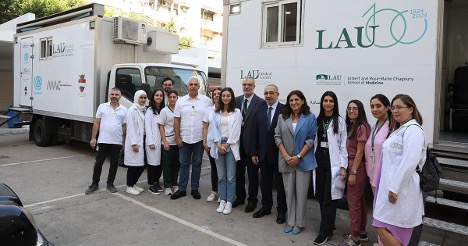
On October 9, 2024, in coordination with the Ministry of Public Health’s assigned primary healthcare provider—the Beirut Association for Social Development (BASD)–Health Sector— and as part of the university’s Emergency Relief for Lebanon, teams from the LAU Medical Center–Rizk Hospital, the LAU Medical Center–Saint John’s Hospital, LAU Gilbert and Rose-Marie Chagoury School of Medicine, LAU Alice Ramez Chagoury School of Nursing, and LAU School of Pharmacy deployed two mobile clinics to Amlieh High School in Ras El Nabaa in the first of several missions to provide essential primary care services, screenings, and dispense medications to those in need.
Upon leaving their homes, most of those displaced had either lost or had to leave behind their belongings, medicines and medical records, while newborns, lactating mothers and chronically ill patients lacked access to vital treatments. True to their raison d’être of helping Lebanon’s underserved populations, the LAU Mobile Clinics rose to the challenge. The missions were further strengthened through the skilled logistics and nursing teams at BASD, which ensured the smooth coordination and delivery of services, complementing LAU’s medical expertise with vital operational support.
At Amlieh High School, which currently shelters around 800 displaced people, the LAU medical centers’ teams—comprising one internal medicine physician with two residents, one pediatric physician with two residents, as well as four nurses and four staff members—provided primary care services, consultations, and counseling to more than 100 patients, including 44 children averaging 7.5 years of age.
At the end of the visit, the LAU team distributed 150 family care hygiene kits and 150 first aid kits and raised awareness on health and hygiene best practices.
Moving forward, the LAU Mobile Clinics Emergency Relief missions will pick up pace in the coming weeks to address the needs of as many displaced people as possible. As part of a comprehensive integrated care approach, the missions will involve the LAU schools of medicine, pharmacy, nursing, and the psychology program to ensure an integrated, comprehensive support. This initiative will provide not only primary care and mental health support but also essential pharmaceutical services and health education to improve outcomes for displaced families.
In its commitment to making a lasting difference, LAU will work tirelessly and collaboratively to provide care, compassion, and hope to every community we serve.
Click here to support the mobile clinic’s mission.
Lebanon is facing a humanitarian catastrophe, and the need for urgent support has never been greater. Your help can enable LAU to deliver critical healthcare for patients, provide primary care and mental health support to displaced individuals, and safeguard the future of students facing hardship. You can learn more by visiting the LAU Emergency Relief for Lebanon.
Counseling Services
Counseling at LAU helps you power through your university years. Starting with the school-to-college transition and all its emotional baggage, to dealing with anxiety such as that associated with remote learning, university counselors equip you with essential tools to effectively manage current and future problems.
Sessions are strictly confidential and free of charge for all students. They are typically scheduled once a week and may expand over several weeks depending on the objectives identified by the counselor.
When Should I Seek Help from a Counselor?
If you are experiencing one or more of the following concerns:
- Test anxiety
- Sleeping problems
- Low self-esteem
- Alcohol or drug abuse
- Concentration problems
- Decision making problems
- Dramatic mood swings
- Hopelessness or helplessness
- Exposure to sexual, physical, or emotional abuse
- Anxiety, fear, or anger that affects everyday life
- Eating disorders
- Suicidal thoughts
- Loneliness and/or homesickness
- Procrastination
- Relationship issues (family, friends, romantic)
- Loss of a family member or loved one
- Poor academic performance.
What Types of Counseling Services Are Offered at LAU?
- Short-term individual counseling
- General consultation
- Group counseling
- Academic skills guidance
- Career/vocational counseling
- Crisis interventions
- On/Off campus referrals
If the counselors believe that the student’s concerns are beyond the scope of the services provided at LAU, they will provide the student with a list of off-campus professionals (i.e., psychotherapists and/or psychiatrists) from which to choose.
How will a Counselor at LAU Help Me?
Counseling at LAU offers you the chance to:
- Disclose and discuss sensitive issues in a safe environment
- Confide in someone who can be trusted for their open-mindedness and professional help
- Receive support and aid in overcoming distress
While knowing that all the information discussed during counseling sessions:
- Will not go on your official record, nor on your transcripts
- Are strictly confidential – unless the counselor identifies that there is potential for self-harm, or harm to others.
Tips During these Challenging Time
Guidelines and Tips
 Mindfulness Benefits Mindfulness Benefits |
 Counseling in a nutshell (video) Counseling in a nutshell (video) |
 For a smooth transition to university For a smooth transition to university |
 Dealing with anxiety and online learning Dealing with anxiety and online learning |
 Dealing with Beirut explosion aftermath Dealing with Beirut explosion aftermath |
 Learning Challenges and Support (video) Learning Challenges and Support (video) |
Managing Anxiety Through a Holistic Balance of Mind and Body
LAU Medical Center-Rizk Hospital hosts a cross-departmental initiative to increase awareness of the relationship between the physical and mental impacts of anxiety.
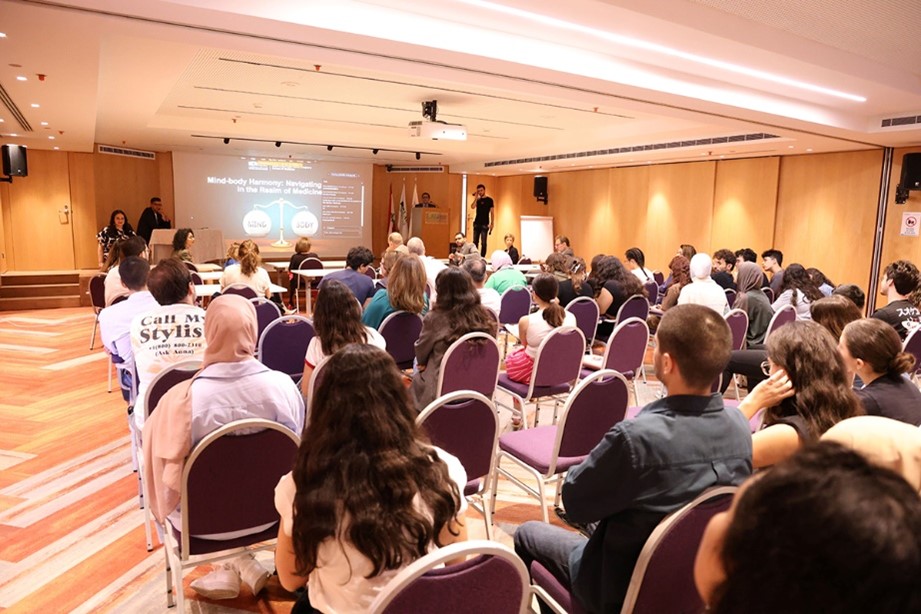
The event was attended by students and staff, in addition to residents and physicians as part of their continuing medical education.
With 14 types of anxiety disorders affecting more than 300 million people globally, the condition can have a profound impact on the mental, physical, and overall wellbeing of individuals across age groups. However, due to the prevalent siloed approach toward patient care, the medical community faces challenges in early screening, diagnosis, and treatment of one of the most common psychological disorders.
To tackle this significant issue, the Gilbert and Rose-Marie Chagoury School of Medicine, in collaboration with the Psychology Program at the School of Arts and Sciences, organized a symposium titled Mind-Body Harmony: Navigating Anxiety in Medicine at the LAU Medical Center-Rizk Hospital on November 4, 2023.
Managing Anger During Uncertainty
LAU Clinical Psychologist Wissam Kheir addresses common concerns on anger management and psychological uncertainty.

In light of distressing events, LAU clinical psychologists took the initiative to organize four sessions in October 2023, that addressed timely common concerns that faculty, staff and students across the LAU community are facing, and dedicated two in-person sessions for LAU students to learn directly from the experts.
Across the sessions, the clinical psychologists underscored that there is no “right” or “wrong” when facing emotional stress amid uncertainty. Typically, people initially react with a “fight, flight or freeze” response, which is not unhealthy initially, but which could lead to burnout if left unchecked.
Check In With Your Children
LAU Child and Adolescent Clinical Psychologist Pia Tohme answers parents’ questions on handling their children’s concerns in uncertain times.

Work-Life Balance: Are You Doing It Right?
Faculty from the Psychology Program at the School of Arts and Sciences highlight the application of psychology in the professional world, its benefits and ways to address common workplace challenges.
Since childhood, before we even get the chance to think for ourselves, we are asked what we want to be when we grow up. These aspirations may subconsciously become inseparable from our identity. Instead of wanting to work as something, we grow up believing that we must be our profession.
In the work environment, as the lines between professional and personal life often blur, navigating the demands of career and personal wellbeing is necessary to achieving harmony between work and life. But how easy can that balance be found in today’s fast-paced world?
This was the catalyst for debate in a workshop titled The Art Of Living: Strategies For Work-Life Harmony held on September 1 at the Gilbert and Rose-Marie Chagoury Health Sciences Center, LAU Byblos campus.
Assistant Professor of Clinical Psychology Pia Tohme and Assistant Professor of Psychology Myriam El Khoury-Malhame took center stage to clarify several misconceptions related to the professional realm, mostly those associated with the myth of maintaining an unbending and constant work-life equilibrium.
What are the challenges of maintaining a work-life balance?
There is no concrete or straightforward answer to this question, as multiple factors come into play. Based on a poll conducted during the workshop, faculty, staff and medical doctors indicated that understaffing, poor time management and a heavy workload, to name a few, make it difficult for individuals to achieve equilibrium between their professional and personal lives.
“We’ve glamorized business to make it seem as if it’s what defines us,” said Dr. El-Khoury Malhame. Being busy, nonetheless, leads us to develop multiple identities varying from breadwinners to caregivers, with each having to prioritize a host of things at once.
This situation was exacerbated by our dependence on online mediums during the COVID-19 era, which effectively erased the demarcation between our personal and office lives. Consequently, work-related expectations became such that we were expected to be available at all times.
“This also affects our relationships,” said Dr. Tohme, given that it raises questions related to “how well we are managing ourselves as people, as partners, as parents and also as employees.”
These factors create a real hurdle where individuals feel pushed not just to aim for a balance between work and home life, but also to consider dealing with each part separately when managing personal relationships. Instead of trying to find one-size-fits-all solutions to merge work and home life, employees may need to figure out how to adjust their priorities for each area in order to recharge and effectively manage their commitments and time.
How does this impact us as individuals?
Most days, we bring the weight of our professional responsibilities into our personal lives and vice versa, which disrupts this delicate equilibrium. Excessive demands in the workplace tend to foster a heightened sense of tension and unease in our personal lives, impacting the quality of our relationships at home.
This, in turn, can cultivate a sense of guilt for reacting excessively, which further obstructs our ability to find solace and tranquility in our homes. The audience gave the example of having to work on weekends or check emails after hours.
Given these intricate dynamics, it is not surprising that we find ourselves caught “in a vicious cycle,” as Dr. Tohme called it, where the demands at work encroach upon our personal lives, and the demands in our personal lives affect our work. This cycle, if left unchecked, can ultimately lead to burnout.
It’s easy to overlook the fact that we are the same individuals navigating both spheres in this narrative. When we compartmentalize work as the medium of reason and life as the domain of emotion, we set ourselves on a course where the efficacy of our work diminishes. Consequently, we compromise our ability to process information cohesively and holistically.
“To improve this work-life balance is to reintegrate both mediums,” noted Dr. El Khoury-Malhame.
What can be done to achieve a work-life balance?
“There’s no magical solution,” stated the assistant professors. According to them, an employee often gets lost in trying to achieve this balance, but it’s not a one-person job. The effort has to come from both ends of the spectrum: the employer and the employee.
A few strategies for doing so, as suggested by Dr. Tohme and Dr. El Khoury-Malhame, revolve around perceiving the faculty and staff as individuals rather than commodities, promoting and setting boundaries and increasing self-reflection at work. According to the audience, this is done by fostering a supportive working environment in which conversations around mental health and consideration of basic needs are appraised, such as investing in healthcare, transportation, flexible/hybrid schedules, training, childcare areas, and showing appreciation, among others.
Assessing how one processes information is also essential among colleagues. Employers model their boundaries to their employees; thus, seeing how the latter is receiving certain types of tasks and instructions helps them implement such boundaries constructively.
“Our predictors of happiness mostly fall within the relationships we have with others,” said Dr. Tohme and Dr. El Khoury-Malhame. “Being aware of our boundaries and reflecting upon them allows us to control, influence and accept our dynamics with each other.”
At the end of the workshop, focus was placed on self-reflection, and taking the time to consider how one’s personal attitudes, actions and emotional reactions might help identify one’s difficulties and capacities as well as influence individuals’ experiences in their professional lives. By reflecting on and understanding their behaviors and reactions, both employees and employers can better navigate and manage the challenges and demands of their work.
“Always remember that behind every title, there’s a person, and behind every person, there’s also a journey,” said Dr. Tohme. “There’s everything that you have gone through in order to become who you are.”
Engaging LAU Faculty & Staff as Associates in the Mental Health Support System
University students often experience high levels of stress. Any number of potential events- leaving home and moving into the dormitory, academic failure, the loss of loved one, job termination of close relatives, and so on- may require students to make adjustments in the patterns of their daily living. Not all life transitions are negative, but even positive events, when accompanied by significant changes and demands, have the potential to be distressing.
Many students weather the “stormy periods” of their lives without professional assistance; others may find that the distress of being a student provides an occasion to consult a mental health professional. Thus, every year, the University Counseling Office sees students seeking help with different concerns such as depression, anxiety, relationship problems, family issues, academic difficulties, just to name a few.
You, Faculty and Staff, play an important role in detecting and helping distressed students. However, identifying and responding to students in distress is not an easy job; it can be confusing and overwhelming. Hence, the University Counseling Office has prepared this guide that sheds some lights on the different signs and symptoms of distress; its purpose is to guide you in handling a problem until a referral to the counseling office can be arranged. If you wish to consult with professionals or believe that a student should do so, we welcome the opportunity to help.
We appreciate the role you play as associates in the Mental Health Support System at LAU, and hope that this guide will be useful to you in your efforts.
Sources of Trouble/Distress
- Family problems
- Grief and loss
- Depression
- Anxiety
- Loneliness
- Relationship problems/break-ups
- Low self-esteem
- Financial problems
- Academic pressure or failure
- Conflict with classmates/Professors
- Difficulty adjusting to university life
- Trouble adjusting to different culture
- Career indecision
- Athletes (pressure/ expectations)
- Eating disorders
- Drug/alcohol abuse
- Sexual or physical abuse or assault
- Identity/sexual confusion